Results by title
76 books match the query 'Cultural History' and 8 start with s
Saying It's So
A Cultural History of the Black Sox ScandalDaniel A. Nathan
University of Illinois Press, 2002
Self-Rule
A Cultural History of American DemocracyRobert H. Wiebe
University of Chicago Press, 1995
American democracy arrived abruptly in the 19th century; it changed just as dramatically early in the 20th. Hence, Self-Rule divides the history of American democracy into two halves: a 19th century half covering the 1820s to the present, and a 20th century half, with a major transition from the 1890s to the 1920s between them. As Wiebe explains why the original democracy of the early 19th century represented a sharp break from the past, he recreates in vivid detail the way European visitors contrasted the radical character of American democracy with their own societies. He then discusses the operation of various 19th century democratic publics, including a nationwide public, the People. Finally, he places democracy's white fraternal world of equals in a larger environment where other Americans who differed by class, race, and gender, developed their own relations to democracy.
Wiebe then picks up the history of democracy in the 1920s and carries it to the present. Individualism, once integrated with collective self-governance in the 19th century, becomes the driving force behind 20th century democracy. During those same years, other ways of defining good government and sound public policy shunt majoritarian practices to one side. Late in the 20th century, these two great themes in the history of American democracy—individualism and majoritarianism—turn on one another in modern democracy's war on itself.
Finally, Self-Rule assesses the polarized state of contemporary American democracy. Putting the judgments of sixty-odd commentators from Kevin Phillips and E.J. Dionne to Robert Bellah and Benjamin Barber to the test of history, Wiebe offers his own suggestions on the meaning and direction of today's democracy. This sweeping work explains how the history of American democracy has brought us here and how that same history invites us to create a different future.
Shadows in the Valley
A Cultural History of Illness, Death, and Loss in New England, 1840-1916Alan Swedlund
University of Massachusetts Press, 2010
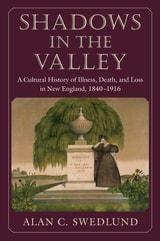
How does the experience of sickness, death, and loss change over time? We know that the incidence and virulence of particular diseases have varied from one period to another, as has their medical treatment. But what was it like for the individuals who suffered and died from those illnesses, for the health practitioners and institutions that attended to them, and for the families who buried and mourned them?
In Shadows in the Valley, Alan Swedlund addresses these questions by closely examining the history of mortality in several small communities in western Massachusetts from the mid-nineteenth to the early twentieth century—from just before the acceptance of the germ theory of disease through the early days of public health reform in the United States. This was a time when most Americans lived in rural areas or small towns rather than large cities. It was also a time when a wide range of healing practices was available to the American public, and when the modern form of Western medicine was striving for dominance and authority. As Swedlund shows, this juncture of competing practices and ideologies provides a rich opportunity for exploring the rise of modern medicine and its impact on the everyday lives of ordinary Americans.
To indicate how individuals in different stages of their lives were exposed to varying assaults on their health, the book is structured in a way that superimposes what the author calls “life-course time” onto chronological time. Thus the early chapters look at issues of infancy and childhood in the 1840s and 1850s and the last chapters at the problems of old age after 1900. The reader becomes familiar with specific individuals and families as they cope with the recurrent loss of children, struggle to understand the causes of new contagions, and seek to find meaning in untimely death. By using a broad time frame and a narrow geographical lens, Swedlund is able to engage with both the particularities and generalities of evolving medical knowledge and changing practice, and to highlight the differences in personal as well as collective responses to illness and loss.
Singular Sensations
A Cultural History of One-Panel Comics in the United StatesMichelle Ann Abate
Rutgers University Press, 2024
Shortlisted for the 2024 Eisner Award for Best Academic/Scholarly Book
What do The Family Circus, Ziggy, and The Far Side have in common? They are all single-panel comics, a seemingly simple form that cartoonists have used in vastly different ways.
Singular Sensations is the first book-length critical study to examine this important but long-neglected mode of cartoon art. Michelle Ann Abate provides an overview of how the American single-panel comic evolved, starting with Thomas Nast’s political cartoons and R.F. Outcault’s groundbreaking Yellow Kid series in the nineteenth century. In subsequent chapters, she explores everything from wry New Yorker cartoons to zany twenty-first-century comics like Bizarro. Offering an important corrective to the canonical definition of comics as “sequential art,” Abate reveals the complexity, artistry, and influence of the single-panel art form.
Engaging with a wide range of historical time periods, sociopolitical subjects, and aesthetic styles, Singular Sensations demonstrates how comics as we know and love them would not be the same without single-panel titles. Abate’s book brings the single-panel comic out of the margins and into the foreground.
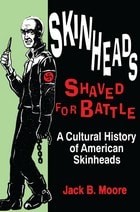
Skinheads Shaved For Battle
A Cultural History of American SkinheadsJack Moore
University of Wisconsin Press, 1993
This book describes who American skinheads are, how they have developed within larger youth group scenes, their ideas and activities, the role of music in their formation and development, how they have been perceived by the media in America, and what damage they have done in American society. Jack B. Moore focuses on the cultural history of this group in America during the 1980s and suggests that while they were originally a minor distraction on the punk scene, they have grown into a dangerous and far more politically engaged source of hate thought and crime.
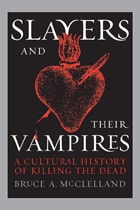
Slayers and Their Vampires
A Cultural History of Killing the DeadBruce A. McClelland
University of Michigan Press, 2010
“A fascinating comparison of the original vampire myths to their later literary transformations.”
—Adam Morton, author of On Evil
“From the Balkan Mountains to Beverly Hills, Bruce has mapped the vampire’s migration. There’s no better guide for the trek.”
—Jan L. Perkowski, Professor, Slavic Department, University of Virginia, and author of Vampires of the Slavs and The Darkling: A Treatise on Slavic Vampirism
“The vampire slayer is our protector, our hero, our Buffy. But how much do we really know about him—or her? Very little, it turns out, and Bruce McClelland shows us why: because the vampire slayer is an unsettling figure, almost as disturbing as the evil she is set to destroy. Prepare to be frightened . . . and enlightened.”
—Corey Robin, author of Fear: The History of a Political Idea
“What is unique about this book is that it is the first of its kind to focus on the vampire hunter, rather than the vampire. As such, it makes a significant contribution to the field. This book will appeal to scholars and researchers of folklore, as well as anyone interested in the literature and popular culture of the vampire.”
—Elizabeth Miller, author of Dracula and A Dracula Handbook
“Shades of Van Helsing! Vampirologist extraordinaire Bruce McClelland has managed that rarest of feats: developing a radically new and thoroughly enlightening perspective on a topic of eternal fascination. Ranging from the icons of popular culture to previously overlooked details of Balkan and Slavic history and folk practice, he has rethought the borders of life and death, good and evil, saint and sinner, vampires and their slayers. Excellent scholarship, and a story that never flags.”
—Bruce Lincoln, Caroline E. Haskell Professor of History of Religions, University of Chicago, and author of Theorizing Myth: Narrative, Ideology, and Scholarship,Authority: Construction and Corrosion, and Death, War, and Sacrifice: Studies in Ideology and Practice
Sound Streams
A Cultural History of Radio-Internet ConvergenceAndrew J. Bottomley
University of Michigan Press, 2020
Sound Streams is the first book to historicize radio-internet convergence from the early ’90s through the present, demonstrating how so-called new media represent an evolutionary shift that is nevertheless historically consistent with earlier modes of broadcasting. Various iterations of internet radio, from streaming audio to podcasting, are all new radio practices rather than each being a separate new medium: radio is any sound media that is purposefully crafted to be heard by an audience. Rather than a particular set of technologies or textual conventions, web-based broadcasting combines unique practices and features and ideas from radio history. In addition, there exists a distinctive conversationality and reflexivity to radio talk, including a propensity for personal stories and emotional disclosure, that suits networked digital media culture. What media convergence has done is extend and intensify radio’s logics of connectivity and sharing; sonically mediated personal expression intended for public consideration abounds in online media networks.
Sound Streams marks a significant contribution to digital media and internet studies. Its mix of cultural history, industry research, and genre and formal analysis, especially of contemporary audio storytelling, will appeal to media scholars, radio and podcast practitioners, audio journalism students, and dedicated podcast fans.
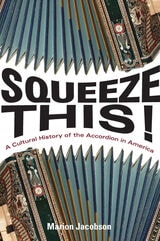
Squeeze This!
A Cultural History of the Accordion in AmericaMarion Jacobson
University of Illinois Press, 2012