Results by title
304 books match the query 'Death' and 24 start with s
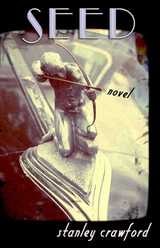
Seed
A NovelStanley Crawford
University of Alabama Press, 2015
What they get instead are Bill’s memories, made vivid by each item from the past, memories that are more exotic and curious than the lives currently lived by his young relatives.
Accompanied by his housekeeper, Ramona, and his young gardener, Jonathan, Bill is a somewhat cantankerous, wildly intelligent, and often forgetful man who recalls and speaks to his passed wife, often thinking that she's not dead. His unwillingness to recognize what has happened to her and to give away his only possession of any value, a 1937 Pierce-Arrow automobile that they bought together, becomes the measure of his grief and of his love in this profoundly funny novel that faces death and love sincerely.
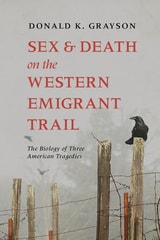
Sex and Death on the Western Emigrant Trail
The Biology of Three American TragediesDonald K. Grayson
University of Utah Press, 2018
The plights of these emigrant groups have been addressed by different historians in different ways; this book is the first to examine the tragedies in terms of biology. Grayson shows that who lived or died can largely be explained by age, sex, and family ties. His investigation reveals what happens when our cultural mechanisms for dealing with famine and extreme cold are reduced to only what our bodies can provide within structured social contexts. His results are surprising and not always intuitive as he investigates who survived in these life threatening situations.
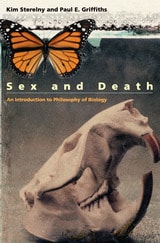
Sex and Death
An Introduction to Philosophy of BiologyKim Sterelny and Paul E. Griffiths
University of Chicago Press, 1999
Informed answers to questions like these, critical to our understanding of ourselves and the world around us, require both a knowledge of biology and a philosophical framework within which to make sense of its findings. In this accessible introduction to philosophy of biology, Kim Sterelny and Paul E. Griffiths present both the science and the philosophical context necessary for a critical understanding of the most exciting debates shaping biology today. The authors, both of whom have published extensively in this field, describe the range of competing views—including their own—on these fascinating topics.
With its clear explanations of both biological and philosophical concepts, Sex and Death will appeal not only to undergraduates, but also to the many general readers eager to think critically about the science of life.
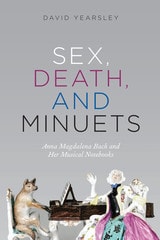
Sex, Death, and Minuets
Anna Magdalena Bach and Her Musical NotebooksDavid Yearsley
University of Chicago Press, 2019
Sex, Death, and Minuets offers the first in-depth study of these notebooks and their owner, reanimating Anna Magdalena as a multifaceted historical subject—at once pious and bawdy, spirited and tragic. In these pages, we follow Magdalena from young and flamboyant performer to bereft and impoverished widow—and visit along the way the coffee house, the raucous wedding feast, and the family home. David Yearsley explores the notebooks’ more idiosyncratic entries—like its charming ditties on illicit love and searching ruminations on mortality—against the backdrop of the social practices and concerns that women shared in eighteenth-century Lutheran Germany, from status in marriage and widowhood, to fulfilling professional and domestic roles, money, fashion, intimacy and sex, and the ever-present sickness and death of children and spouses. What emerges is a humane portrait of a musician who embraced the sensuality of song and the uplift of the keyboard, a sometimes ribald wife and oft-bereaved mother who used her cherished musical notebooks for piety and play, humor and devotion—for living and for dying.
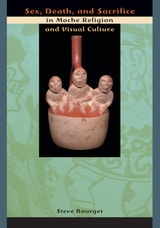
Sex, Death, and Sacrifice in Moche Religion and Visual Culture
By Steve Bourget
University of Texas Press, 2006
The Moche people who inhabited the north coast of Peru between approximately 100 and 800 AD were perhaps the first ancient Andean society to attain state-level social complexity. Although they had no written language, the Moche created the most elaborate system of iconographic representation of any ancient Peruvian culture. Amazingly realistic figures of humans, animals, and beings with supernatural attributes adorn Moche pottery, metal and wooden objects, textiles, and murals. These actors, which may have represented both living individuals and mythological beings, appear in scenes depicting ritual warfare, human sacrifice, the partaking of human blood, funerary rites, and explicit sexual activities.
In this pathfinding book, Steve Bourget raises the analysis of Moche iconography to a new level through an in-depth study of visual representations of rituals involving sex, death, and sacrifice. He begins by drawing connections between the scenes and individuals depicted on Moche pottery and other objects and the archaeological remains of human sacrifice and burial rituals. He then builds a convincing case for Moche iconography recording both actual ritual activities and Moche religious beliefs regarding the worlds of the living, the dead, and the afterlife. Offering a pioneering interpretation of the Moche worldview, Bourget argues that the use of symbolic dualities linking life and death, humans and beings with supernatural attributes, and fertility and social reproduction allowed the Moche to create a complex system of reciprocity between the world of the living and the afterworld. He concludes with an innovative model of how Moche cosmological beliefs played out in the realms of rulership and political authority.
Shadows in the Valley
A Cultural History of Illness, Death, and Loss in New England, 1840-1916Alan Swedlund
University of Massachusetts Press, 2010
How does the experience of sickness, death, and loss change over time? We know that the incidence and virulence of particular diseases have varied from one period to another, as has their medical treatment. But what was it like for the individuals who suffered and died from those illnesses, for the health practitioners and institutions that attended to them, and for the families who buried and mourned them?
In Shadows in the Valley, Alan Swedlund addresses these questions by closely examining the history of mortality in several small communities in western Massachusetts from the mid-nineteenth to the early twentieth century—from just before the acceptance of the germ theory of disease through the early days of public health reform in the United States. This was a time when most Americans lived in rural areas or small towns rather than large cities. It was also a time when a wide range of healing practices was available to the American public, and when the modern form of Western medicine was striving for dominance and authority. As Swedlund shows, this juncture of competing practices and ideologies provides a rich opportunity for exploring the rise of modern medicine and its impact on the everyday lives of ordinary Americans.
To indicate how individuals in different stages of their lives were exposed to varying assaults on their health, the book is structured in a way that superimposes what the author calls “life-course time” onto chronological time. Thus the early chapters look at issues of infancy and childhood in the 1840s and 1850s and the last chapters at the problems of old age after 1900. The reader becomes familiar with specific individuals and families as they cope with the recurrent loss of children, struggle to understand the causes of new contagions, and seek to find meaning in untimely death. By using a broad time frame and a narrow geographical lens, Swedlund is able to engage with both the particularities and generalities of evolving medical knowledge and changing practice, and to highlight the differences in personal as well as collective responses to illness and loss.

Shakespeare and the Denial of Death
James Calderwood
University of Massachusetts Press, 1987
Shakespeare's Dead
Stages of Death in Shakespeare's PlayworldsSimon Palfrey and Emma Smith
Bodleian Library Publishing, 2016
Published to accompany a major exhibition at the Bodleian Library, University of Oxford, Shakespeare’s Dead documents the many ways Shakespeare’s characters meet their demise, from suicide to murder, from death by workaday dagger to the more creative method of being baked and fed to one’s family in a meat pie. Through these examples, Simon Palfrey and Emma Smith show Shakespeare’s mastery at choreographing death as a means of rediscovery. Some characters refuse to go quietly, dying in stages, as in Nick Bottom’s performance as Pyramus killing himself with much flourish in A Midsummer Night’s Dream. Others are remembered in elegies, and still others are resurrected or reappear as ghosts. Shakespeare’s death scenes also often speak to the boundaries between theater and everyday life, with funerals and scenes of mourning that are undercut by their staged inauthenticity.
Extensively illustrated with contemporary drawings and images from stage history, Shakespeare’s Dead takes readers through the playwright’s great death scenes and tragic figures, exploring in them the theme of life in death and delineating the cultural, religious, and social contexts.
Shakespeare's Reformation
Christian Humanism and the Death of GodNalin Ranasinghe
St. Augustine's Press, 2022
"I will try to claim that Shakespeare offers an esoteric vindication of the human soul itself, not merely poetry, against the looming backdrop of the Counter-Reformation in Europe and the Puritan perversion of English Anglicanism. Neither the Scholasticism of the former nor the fundamentalism of the latter had any sympathy for the claims of men like Bottom or the Bastard to see beyond the confines of scripture and sacred social structures. While poetry could indulge in metaphysical fantasy, it could not take on the status quo without the assistance of more learned allies; this Shakespeare seems to do by his re-telling of Classical and English history. As disingenuous as Bottom (or Erasmus) in this artful use of ignorance and folly to conceal his serious goals, Shakespeare is thus tying poetry to history and giving us an alternate, if playful, account of Western Civilization."

Sick to Death
An Andy Hayes MysteryAndrew Welsh-Huggins
Ohio University Press, 2024

Singing Mother Home
A Psychologist's Journey through Anticipatory GriefDonna S. Davenport
University of North Texas Press, 2002
This intimate narrative forms the core of her book. It is emotionally wrenching, but it also provides hope for those going through similar experiences. Just as Davenport used her family's tradition of singing to comfort her mother, readers will be encouraged to find their own sources of comfort in family and legacy. The book concludes with two chapters describing psychological approaches to grief and recommending further reading.
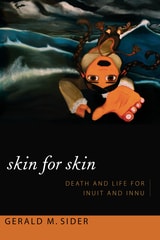
Skin for Skin
Death and Life for Inuit and InnuGerald M. Sider
Duke University Press, 2014
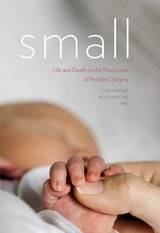
Small
Life and Death on the Front Lines of Pediatric SurgeryCatherine Musemeche
Dartmouth College Press, 2014
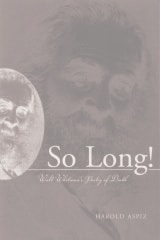
So Long! Walt Whitman's Poetry of Death
Harold Aspiz
University of Alabama Press, 2005
Walt Whitman is unquestionably a great poet of the joys of living. But as Harold Aspiz demonstrates in this study, concerns with death and dying define Whitman’s career as a thinker, a poet, and a person. Through a close reading of Leaves of Grass, its constituent poems, particularly “Song of Myself,” and Whitman’s prose and letters, Aspiz charts how the poet’s exuberant celebration of life—the cascade of sounds, sights, and smells that erupt in his verse—is a consequence of his central concern: the ever-presence of death and the prospect of an afterlife.
Until now no one has studied as systematically the degree to which mortality informs Whitman’s entire enterprise as a poet. So Long! devotes particular attention to Whitman’s language and rich artistry in the context of the poet’s social and intellectual milieus. We see Whitman (and his many personae) as a folk prophet announcing a gospel of democracy and immortality; pondering death in alternating moods of acceptance and terror; fantasizing his own dying and his postmortem selfhood; yearning for mates and lovers while conscious of fallible flesh; agonizing over the omnipresence of death in wartime; patiently awaiting death; and launching imaginary journeys toward immortality and godhood.
So Long! is valuable for American literature collections, students and scholars of Whitman and 19th-century literature, and general readers interested in Whitman and poetry. By exploring Whitman's faith in death as a meaningful experience, we may understand better how the poet—whether personified as representative man, victim, hero, lover, or visionary—lived so completely on the edge of life.
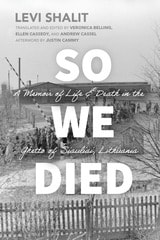
So We Died
A Memoir of Life and Death in the Ghetto of Šiauliai, LithuaniaLevi Shalit, translated and edited by Veronica Belling, Ellen Cassedy, and Andrew Cassel, introduction by Veronica Belling, afterword by Justin Cammy
University of Alabama Press, 2025
In the shadow of death, Levi Shalit wrote to remember—so we would never forget.
So We Died: A Memoir of Life and Death in the Ghetto of Šiauliai, Lithuania (Azoy zaynen mir geshtorbn) is a powerful eyewitness account of the Shavl ghetto during the Nazi occupation of Lithuania. Written in Yiddish by Levi Shalit and available now for the first time in English, the work fills a stark void in historical records.
Shalit divided his work into four sections. In the first, he describes the German invasion of Šiauliai, the murder of thousands of Jews in the city and surrounding countryside, and the forced relocation of the surviving Jews into the Shavl ghetto. In the second, he describes daily life in the ghetto in engrossing detail. In the third, titled “The Masada Book,” Shalit describes ghetto residents’ attempt to organize a resistance group of which he himself was a member. In the fourth, he narrates the transformation of the ghetto into a concentration camp and the seizure and deportation of the community’s children.
Few accounts of the Shavl ghetto survived the war. Shalit’s work offers English-language readers a rare insight into a vital chapter of history. The translators artfully reveal Shalit’s literary prowess and the ways he illuminated the Shavl ghetto’s daily struggles, false hopes, and atrocities.
More than an account of a previously overlooked episode in Holocaust history, So We Died is a testament to the enduring power of the human spirit in the face of unspeakable tragedy. It offers keen insight into a time of war, fascism, and resistance. A must-read for anyone seeking understanding and remembrance.
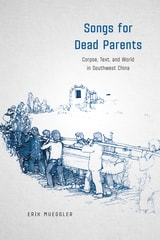
Songs for Dead Parents
Corpse, Text, and World in Southwest ChinaErik Mueggler
University of Chicago Press, 2017
Drawing on more than twenty years of fieldwork in a mountain community in Yunnan Province, Songs for Dead Parents shows how people view the dead as both material and immaterial, as effigies replace corpses, tombstones replace effigies, and texts eventually replace tombstones in a long process of disentangling the dead from the shared world of matter and memory. It is through these processes that people envision the cosmological underpinnings of the world and assess the social relations that make up their community. Thus, state interventions aimed at reforming death practices have been deeply consequential, and Mueggler traces the transformations they have wrought and their lasting effects.

Sonnets of Love and Death
Jean De Sponde
Northwestern University Press, 2001
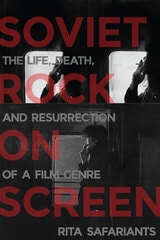
Soviet Rock on Screen
The Life, Death, and Resurrection of a Film GenreRita Safariants
University of Wisconsin Press, 2026
In Soviet Rock on Screen, Rita Safariants chronicles the birth, life, death, and resurrection of a genre that rapidly became one of the most readily recognized cultural signifiers of the perestroika era and which continues to reflect and codify Russian culture. During their initial heyday in the 1980s, rock films were influenced by and encouraged the cultural shifts of perestroika and the incipient political storm. Today, Safariants argues, the reemergence and reconfiguration of the genre indicates the extent to which Soviet-era cultural emblems inform Russian national identity and obliquely support the current political repression under Putin.
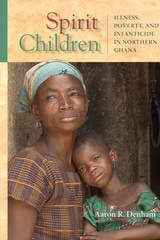
Spirit Children
Illness, Poverty, and Infanticide in Northern GhanaAaron R. Denham
University of Wisconsin Press, 2019
Refusing to generalize or oversimplify, Aaron R. Denham offers an ethnographic study of the spirit child phenomenon in Northern Ghana that considers medical, economic, religious, and political realities. He examines both the motivations of the families and the structural factors that lead to infanticide, framing these within the context of global public health. At the same time, he turns the lens on Western societies and the misunderstandings that prevail in discourse about this controversial practice. Engaging the complexity of the context, local meanings, and moral worlds of those confronting a spirit child, Denham offers visceral accounts of families' life and death decisions.

Structures of Indifference
An Indigenous Life and Death in a Canadian CityMary Jane Logan McCallum
University of Manitoba Press, 2018
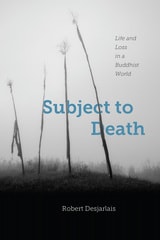
Subject to Death
Life and Loss in a Buddhist WorldRobert Desjarlais
University of Chicago Press, 2016
Survival under Dictatorships
Life and Death in Nazi and Communist RegimesLászló Borhi
Central European University Press, 2024
A complex array of individual responses to the abuse of power by the state is represented in this book in three horrific episodes in the history of East-Central Europe. The three events followed each other within a span of about ten years: the deportation and murder of Hungarian Jews in Nazi death and labor camps; the Arrow Cross terrorist rule in Budapest; and finally the Stalinist terror in Hungary and East-Central Europe. Through the prism of survival, László Borhi explores the relationship between the individual and power, attempting to understand the mechanism of oppression and terror produced by arbitrary, unbridled power through the experience of normal people.
Despite the obvious peculiarities of time and place, the Hungarian cases convey universal lessons about the Holocaust, Nazism, and Stalinism. In the author's conception, the National Socialist and Stalinist experiences are linked on several levels. Both regimes defended their visions of the future against social groups whom they saw as implacable enemies of those visions, and who therefore had to be destroyed for sake of social perfection. Furthermore, the social practices of National Socialism were passed on. And although Stalinism was imposed by a foreign power, some of the survival skills for coping with it were rehearsed under the previous hellish experience.
Surviving Alex
A Mother’s Story of Love, Loss, and AddictionPatricia A. Roos
Rutgers University Press, 2024
Weaving together a personal narrative and a sociological perspective, Surviving Alex movingly describes how even children from “good families” fall prey to addiction, and recounts the hellish toll it takes on families. Drawing from interviews with Alex’s friends, family members, therapists, teachers, and police officers—as well as files from his stays in hospitals, rehab facilities, and jails—Roos paints a compelling portrait of a young man whose life veered between happiness, anxiety, success, and despair. And as she explores how a punitive system failed her son, she calls for a community of action that would improve care for substance users and reduce addiction, realigning public health policy to address the overdose crisis.
Swooning Beauty
A Memoir Of PleasureJoanna Frueh
University of Nevada Press, 2006
When her parents died and her marriage disintegrated within the span of a few months, art historian and performance artist Joanna Frueh entered a painful period of grief and mourning. This book is about how she healed herself and in the process explored the range of her potential as a woman.Swooning Beauty is an intimate memoir of discovery and healing. Frueh’s path to recovery lay through a profound examination of her intuitions, desires, fantasies, dreams, and emotions, her capacity for pleasure—visual, sensual, intellectual, gastronomic, and erotic—and her sense of her own heroic female identity. Hers is the passionate voice of a creative, intelligent woman scrutinizing the nature of love in all its forms and the ways of being that make us free, flexible, more fully real and more fully human. The result is an engaging view into the rich and colorful inner life of a woman at the threshold of middle age, of the blossoming of mind and spirit that comes after suffering and self-realization. Pleasure, she concludes, “is the absence of lack. Self-love is a necessary plenitude. Vigilance in love brings us freedom. Freedom is not an absolute whose attainment is humanly impossible. Yogis say that the self that is not ego is free. That self is the spacious heart, the spacious mind.” Frueh offers us wisdom and comfort for the journey into middle age, and the deep pleasure of encountering a generous, lively spirit and a remarkably spacious mind.