Results by title
204 books match the query 'Direction & Production' and 18 start with s
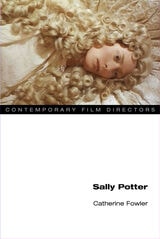
Sally Potter
Catherine Fowler
University of Illinois Press, 2008
This survey of Sally Potter’s work explores her cinematic development from the feminist reworking of La Bohème in Thriller to the provocative contemplation of romantic relationships after 9/11 in Yes. Catherine Fowler traces a clear trajectory of developing themes and preoccupations and shows how Potter uses song, dance, performance, and poetry to expand our experience of cinema beyond the audiovisual.
Potter has relentlessly struggled against predictability and safe options. Again and again, her works grapple with the complexities of being a woman in charge. Instead of the quest to find a romantic partner that drives mainstream cinema, Potter’s films feature characters seeking answers to questions about their sexual, gendered, social, cultural, and ethnic identities. They find answers by retelling stories, investigating mysteries, and traveling and interacting with people. At the heart of Potter’s work is a concern with the ways narrative circumscribes women's ability to act, speak, look, desire, and think for themselves. Her first two films, Thriller and The Gold Diggers, largely deconstruct found stories, clichés, and images. By contrast, later films like Orlando and The Tango Lesson create new and original narratives that place female acts, voices, looks, desires, and thoughts at their center.
Fowler’s analysis is supplemented by a detailed filmography, bibliography, and an extensive interview with the director.
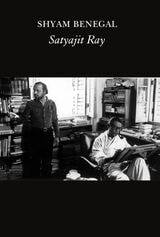
Satyajit Ray
A FilmShyam Benegal and Satyajit Ray
Seagull Books, 2025
Two of Indian cinema’s most acclaimed auteurs, Satyajit Ray and Shyam Benegal, come together in this intimate dialogue, offering a fascinating glimpse into the mind of a cinematic genius. Based on Benegal’s 1985 documentary on Ray, this volume brings together the film’s script, excerpts from extended interviews, and a remarkable collection of visual material showcasing Ray’s work as a filmmaker, illustrator, designer, and writer.
Through candid conversations, Ray reflects on his childhood and the philosophy behind his storytelling, providing an unparalleled look at his creative process. With one master filmmaker capturing another, the result is a deeply personal and layered portrait that moves beyond Ray’s films to reveal the man behind the camera. Satyajit Ray: A Film is both a historical document and a celebration of artistic legacy; a rare opportunity to witness a dialogue between two legends shaping the course of Indian and global cinema.
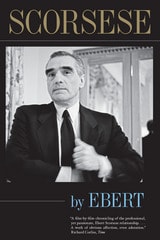
Scorsese by Ebert
Roger Ebert
University of Chicago Press, 2008
Roger Ebert wrote the first film review that director Martin Scorsese ever received—for 1967’s I Call First, later renamed Who’s That Knocking at My Door—creating a lasting bond that made him one of Scorsese’s most appreciative and perceptive commentators. Scorsese by Ebert offers the first record of America’s most respected film critic’s engagement with the works of America’s greatest living director, chronicling every single feature film in Scorsese’s considerable oeuvre, from his aforementioned debut to his 2008 release, the Rolling Stones documentary Shine a Light.
In the course of eleven interviews done over almost forty years, the book also includes Scorsese’s own insights on both his accomplishments and disappointments. Ebert has also written and included six new reconsiderations of the director’s less commented upon films, as well as a substantial introduction that provides a framework for understanding both Scorsese and his profound impact on American cinema.
"Given their career-long back-and-forth, this collection makes perfect sense. . . . In these reconsiderations, Ebert invites us into his thought processes, letting us see not just what he thinks, but how he forms his opinions. Ebert’s insights into Scorsese are terrific, but this book offers the bonus of further insights into Ebert himself."—Time Out Chicago
"Ebert, film critic for the Chicago Sun-Times, is an unabashed fan of Scorsese, whom he considers ‘the most gifted director of his generation.’ . . . Of special note are interviews with Scorsese over a 25-year period, in which the director candidly discusses his body of work."—Publishers Weekly
Scriptwork
A Director's Approach to New Play DevelopmentDavid Kahn and Donna Breed. Foreword by Lanford Wilson
Southern Illinois University Press, 1995
Despite the popular myth that plays arrive at the theater fully formed and ready for production, the truth is that for centuries, most scripts have been developed through a collaborative process in rehearsal and in concert with other theater artists. David Kahn and Donna Breed provide the first codified approach to this time-honored method of play development, with a flexible methodology that takes into account differing environments and various stages of formation.
Directors can use this unique guidebook for new play development from the beginning to the end of the process. Kahn and Breed explore ways of choosing new projects, talk about where to find new scripts, and explore the legal aspects of script development. They present a detailed system for theatrical analysis of the new script and show how to continue exploration and development of the script within the laboratory of the theater. Most importantly, they delineate the parameters of the relationship between the director and the playwright, offering proven methods to help the playwright and help facilitate the healthy development of the script.
Breed and Kahn offer suggestions on casting, incorporating rewrites, and script handling plus how and when to use audience response and how to decide what step to take next. They also include extended interviews with developmental directors, dramaturgs, and playwrights, who give credence to the new script development process.
In short, Kahn and Breed demystify a common, though often convoluted, theater process, providing a unique codification of ways to work on new plays.
Sign Language Interpreting for Theatre
A Collaborative ApproachLynnette Taylor
Gallaudet University Press, 2025
Written by three veteran interpreters with deep roots in the Deaf community and the performing arts, Sign Language Interpreting for Theatre is the first of its kind: a comprehensive guide to the art of sign language interpreting for the theatre as a collaborative practice. Drawing from their years of experience of interpreting On- and Off-Broadway and blending the theoretical with the practical, Lynnette Taylor, Stephanie Feyne, and Candace Broecker Penn provide guiding principles, best practices, processes, and strategies for creating dynamic, collaborative, culturally grounded sign language translations for theatre performances. Written in an engaging, conversational style, chapters include in-depth discussion of both theory and practice, providing techniques for translation and stagecraft along with practical insights for issues such as interpreting team attributes, character depiction, working with scripts, song translations, interpreting for young audiences, and interpreting virtual and recorded performances. With its emphasis upon dialogic interpretation, shared responsibility, and alliances, this guide is an indispensable resource for interpreters, educators, and theatre professionals.
Sisters in the Life
A History of Out African American Lesbian Media-MakingYvonne Welbon and Alexandra Juhasz, editors
Duke University Press, 2018
Contributors. Jennifer DeVere Brody, Jennifer DeClue, Raul Ferrera-Balanquet, Alexis Pauline Gumbs, Thomas Allen Harris, Devorah Heitner, Pamela L. Jennings, Alexandra Juhasz, Kara Keeling, Candace Moore, Marlon Moore, Michelle Parkerson, Roya Rastegar, L. H. Stallings, Yvonne Welbon, Patricia White, Karin D. Wimbley
Six Turkish Filmmakers
Laurence Raw
University of Wisconsin Press, 2017
In analysis of and personal interviews with Dervis Zaim, Zeki Demirkubuz, Semih Kaplanoglu, Çagan Irmak, Tolga Örnek, and Palme d'Or winner Nuri Bilge Ceylan, Raw draws connections with Turkish theater, art, sculpture, literature, poetry, philosophy, and international cinema. A native of England and a twenty-five-year resident of Turkey, Raw interleaves his film discussion with thoughtful commentary on nationalism, gender, personal identity, and cultural pluralism.
Sound Design and Science Fiction
By William Whittington
University of Texas Press, 2007
Sound is half the picture, and since the 1960s, film sound not only has rivaled the innovative imagery of contemporary Hollywood cinema, but in some ways has surpassed it in status and privilege because of the emergence of sound design.
This in-depth study by William Whittington considers the evolution of sound design not only through cultural and technological developments during the last four decades, but also through the attitudes and expectations of filmgoers. Fans of recent blockbuster films, in particular science fiction films, have come to expect a more advanced and refined degree of film sound use, which has changed the way they experience and understand spectacle and storytelling in contemporary cinema.
The book covers recent science fiction cinema in rich and compelling detail, providing a new sounding of familiar films, while offering insights into the constructed nature of cinematic sound design. This is accomplished by examining the formal elements and historical context of sound production in movies to better appreciate how a film sound track is conceived and presented.Whittington focuses on seminal science fiction films that have made specific advances in film sound, including 2001: A Space Odyssey, THX 1138, Star Wars, Alien, Blade Runner (original version and director's cut), Terminator 2: Judgment Day and The Matrix trilogy and games—milestones of the entertainment industry's technological and aesthetic advancements with sound.
Setting itself apart from other works, the book illustrates through accessible detail and compelling examples how swiftly such advancements in film sound aesthetics and technology have influenced recent science fiction cinema, and examines how these changes correlate to the history, theory, and practice of contemporary Hollywood filmmaking.
Sound
Dialogue, Music, and EffectsKalinak, Kathryn
Rutgers University Press, 2015
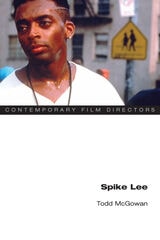
Spike Lee
Tom McGowan
University of Illinois Press, 2014
Since the release of Do the Right Thing in 1989, Spike Lee has established himself as a cinematic icon. Lee's mostly independent films garner popular audiences while at the same time engaging in substantial political and social commentary. He is arguably the most accomplished African American filmmaker in cinematic history, and his breakthrough paved the way for the success of many other African Americans in film.
In this first single-author scholarly examination of Spike Lee's oeuvre, Todd McGowan shows how Lee's films, from She's Gotta Have It through Red Hook Summer, address crucial social issues such as racism, paranoia, and economic exploitation in a formally inventive manner. McGowan argues that Lee uses excess in his films to intervene in issues of philosophy, politics, and art. McGowan contends that it is impossible to watch a Spike Lee film in the way that one watches a typical Hollywood film. By forcing observers to recognize their unconscious enjoyment of violence, paranoia, racism, sexism, and oppression, Lee's films prod spectators to see differently and to confront their own excess. In the process, his films reveal what is at stake in desire, interpersonal relations, work, and artistic creation itself.
Stage Rigging Handbook, Third Edition
Jay O. Glerum
Southern Illinois University Press, 2007
Standby
An Approach to Theatrical DesignJoshua Langman
Southern Illinois University Press, 2022
A groundbreaking philosophy of design for the stage
Standby proposes a practical philosophy of contemporary theatrical design that addresses all design disciplines, all theatrical collaborators, and all forms of theatre, from the traditional to the avant-garde. In a field that is too often dismissed as purely technical, Joshua Langman celebrates design as a transformative force with the power to elevate a performance and enable it to resonate beyond the bounds of its physical production. Beginning with the proposition that design contributes essential layers of meaning to an experience, Standby argues for a unique approach centered on the creation of revelatory theatrical moments.
In a mission to illuminate the soul of the craft, Langman investigates the purposes of design, details the elements of a production concept, uncovers the mechanics of creating meaning, explores the relationship of theatrical design to fine art and art history, and offers practical guidance on designing productions. He also considers what has changed as designers have embraced digital technology and suggests fifteen concrete methods for preserving the magic of live theatre in a digital age. Blending scholarship and storytelling, personal experience and contrarian wisdom, Standby challenges theatre-makers to harness the rich dramatic potential of theatrical design.
For additional information and supplemental materials, please visit www.standbybook.com.

Stanley Kubrick Produces
James Fenwick
Rutgers University Press, 2021
Making use of overlooked archival sources and uncovering newly discovered ‘lost’ Kubrick projects (The Cop Killer, Shark Safari, and The Perfect Marriage among them), as well as providing the first detailed overview of the World Assembly of Youth film, James Fenwick provides a comprehensive account of Kubrick’s life and career and of how he managed to obtain the level of control that he possessed by the 1970s. Along the way, the book traces the rapid changes taking place in the American film industry in the post-studio era, uncovering new perspectives about the rise of young independent producers, the operations of influential companies such as Seven Arts and United Artists, and the whole field of film marketing.
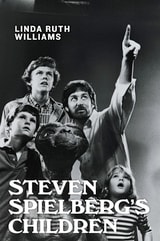
Steven Spielberg's Children
Linda Ruth Williams
Rutgers University Press, 2025
Steven Spielberg’s Children presents children and childhood in some surprising ways, not only analyzing boyhood and girlhood according to Spielberg, but considering children as alien, adult-children who refuse to grow up, and children who aren’t even human. It discusses the way in which children have served to cast Spielberg as a sentimentalist, but also how they are more frequently framed as complex, cruel, and canny. The child might be dangled as bait in an exploitation horror scenario (Jaws), might become the image of universal higher beings (Close Encounters of the Third Kind), or might be a young cultural creator like the director was himself (The Fabelmans), "born with a camera glued to [his] eye." The child, on both sides of the camera, is a resonant image, signifying all that adult culture wants it to be, yet resisting this through authorship of their own stories. The book also looks at Spielberg's young actors in the long history of child stars in theater and cinema, and how Spielberg’s children have fared as performers and celebrities.
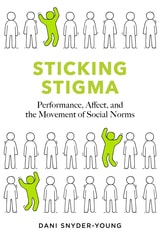
Sticking Stigma
Performance, Affect, and the Movement of Social NormsDani Snyder-Young
Vanderbilt University Press, 2026
Applied theater projects have been used to reduce the stigma related to many health conditions including bipolar disorder, HIV, suicide bereavement, mental illness, autism, and substance use disorder. Beyond this applied theater tradition, theater and performance studies tend not to use the framework or language of stigma very often. Stigma is a more commonly used framework in social science fields such as health and sociology. However, theater and performance regularly attends to the material and affective violence of stigma power: oppression, dispossession, abjection, objectification, expulsion. Snyder-Young examines a set of activist performance projects attempting to use the force of stigma to redistribute and recenter social power.
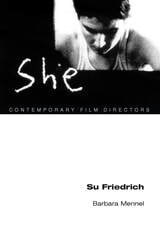
Su Friedrich
Barbara Mennel
University of Illinois Press, 2023
With acclaimed films like Sink or Swim and The Odds of Recovery, Su Friedrich’s body of work stands at the forefront of avant-garde and Queer cinema. Barbara Mennel examines the career of an experimental auteur whose merger of technical innovation and political critique connects with both cinephiles and activists. Friedrich’s integration of cinematic experimentation with lesbian advocacy serves as a beginning rather than an end point of analysis. With that in mind, Mennel provides an essential overview of the filmmaker’s oeuvre while highlighting the defining characteristics of her artistic and political signature. She also situates Friedrich within the cultural, political, and historical contexts that both shape the films and are shaped by them. Finally, Mennel expands our notion of auteurism to include directors who engage in collaborative and creative processes rooted in communities.
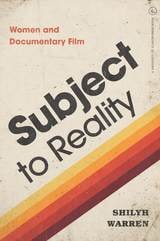
Subject to Reality
Women and Documentary FilmShilyh Warren
University of Illinois Press, 2019
Shilyh Warren reopens this understudied period and links it to a neglected era of women's filmmaking that took place from 1920 to 1940, another key period of thinking around documentary, race, and gender. Drawing women’s cultural expression during these two explosive times into conversation, Warren reconsiders key debates about subjectivity, feminism, realism, and documentary and their lasting epistemological and material consequences for film and feminist studies. She also excavates the lost ethnographic history of women's documentary filmmaking in the earlier era and explores the political and aesthetic legacy of these films in more explicitly feminist periods like the Seventies.
Filled with challenging insights and new close readings, Subject to Reality sheds light on a profound and unexamined history of feminist documentaries while revealing their influence on the filmmakers of today.
Systemic Dramaturgy
A Handbook for the Digital AgeMichael Mark Chemers and Mike Sell
Southern Illinois University Press, 2022
Systemic Dramaturgy offers an invigorating, practical look at the daunting cultural problems of the digital age as they relate to performance. Authors Michael Mark Chemers and Mike Sell reject the incompatibility of theatre with robots, digital media, or video games. Instead, they argue that technology is the original problem of theatre: How can we tell this story and move this audience with these tools? And if we have different tools, how can that change the stories we tell?
This volume attunes readers to “systemic dramaturgy”—the recursive elements of signification, innovation, and history that underlie all performance—arguing that theatre must be understood as a system of systems, a concatenation of people, places, things, politics, feelings, and interpretations, ideally working together to entertain and edify an audience. The authors discuss in-depth the application of time-tested dramaturgical skills to extra-theatrical endeavors, including multi-platform performance, installations, and videogames. And they identify the unique interventions that dramaturgs can and must make into these art forms.
More than any other book that has been published in the field, Systemic Dramaturgy places historical dramaturgy in conversation with technologies as old as the deus ex machina and as new as artificial intelligence. Spirited and playful in its approach, this volume collates histories, transcripts, and case studies and applies the concepts of systemic dramaturgy to works both old and avant-garde. Between chapters, Chemers and Sell talk with with some of the most forward-thinking, innovative, and creative people working in live media as they share their diverse approaches to the challenges of making performances, games, and digital media that move both heart and mind. This volume is nothing less than a guide for thinking about the future evolution of performance.