Results by title
56 books match the query 'Diversity' and 4 start with s
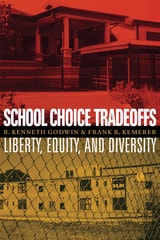
School Choice Tradeoffs
Liberty, Equity, and DiversityBy R. Kenneth Godwin and Frank R. Kemerer
University of Texas Press, 2002
Educational policy in a democracy goes beyond teaching literacy and numeracy. It also supports teaching moral reasoning, political tolerance, respect for diversity, and citizenship. Education policy should encourage liberty and equality of opportunity, hold educational institutions accountable, and be efficient. School Choice Tradeoffs examines the tradeoffs among these goals when government affords parents the means to select the schools their children attend.
Godwin and Kemerer compare current policy that uses family residence to assign students to schools with alternative policies that range from expanding public choice options to school vouchers. They identify the benefits and costs of each policy approach through a review of past empirical literature, the presentation of new empirical work, and legal and philosophic analysis.
The authors offer a balanced perspective that goes beyond rhetoric and ideology to offer policymakers and the public insight into the complex tradeoffs that are inherent in the design and implementation of school choice policies. While all policies create winners and losers, the key questions concern who these individuals are and how much they gain or lose. By placing school choice within a broader context, this book will stimulate reflective thought in all readers.
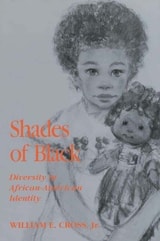
Shades of Black
Diversity in African American IdentityWilliam Cross
Temple University Press, 1991
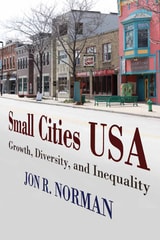
Small Cities USA
Growth, Diversity, and InequalityNorman, Jon R
Rutgers University Press, 2012
Drawing on an assessment of eighty small cities between 1970 and 2000, Norman considers the factors that have altered the physical, social, and economic landscapes of such places. These cities are examined in relation to new patterns of immigration, shifts in the global economy, and changing residential preferences. Small Cities USA presents the first large-scale comparison of smaller cities over time in the United States, showing that small cities that have prospered over time have done so because of diverse populations and economies. These "glocal" cities, as Norman calls them, are doing well without necessarily growing into large metropolises.
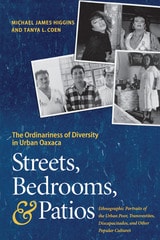
Streets, Bedrooms, and Patios
The Ordinariness of Diversity in Urban OaxacaBy Michael James Higgins and Tanya L. Coen
University of Texas Press, 2000
Diversity characterizes the people of Oaxaca, Mexico. Within this city of half a million, residents are rising against traditional barriers of race and class, defining new gender roles, and expanding access for the disabled. In this rich ethnography of the city, Michael Higgins and Tanya Coen explore how these activities fit into the ordinary daily lives of the people of Oaxaca.
Higgins and Coen focus their attention on groups that are often marginalized—the urban poor, transvestite and female prostitutes, discapacitados (the physically challenged), gays and lesbians, and artists and intellectuals. Blending portraits of and comments by group members with their own ethnographic observations, the authors reveal how such issues as racism, sexism, sexuality, spirituality, and class struggle play out in the people's daily lives and in grassroots political activism. By doing so, they translate the abstract concepts of social action and identity formation into the actual lived experiences of real people.