55 books match the query 'Documentary films' and 4 start with s
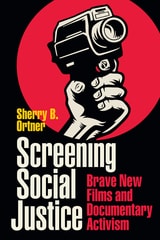
cover of Screening Social Justice: Brave New Films and Documentary Activism

Screening Social Justice

Brave New Films and Documentary Activism

Sherry B. Ortner

Duke University Press, 2023
In Screening Social Justice, award-winning anthropologist Sherry B. Ortner presents an ethnographic study of Brave New Films, a nonprofit film production company that makes documentaries intended to mobilize progressive grassroots activism. Ortner positions the work of the company within a tradition of activist documentary filmmaking and within the larger field of “alternative media” that is committed to challenging the mainstream media and telling the truth about the world today. The company’s films cover a range of social justice issues, with particular focus on the hidden workings of capitalism, racism, and right-wing extremism. Beyond the films themselves, Brave New Films is also famous for its creative distribution strategies. All of the films are available for free on YouTube. Central to the intention of promoting political activism, the films circulate through networks of other activist and social justice organizations and are shown almost entirely in live screenings in which the power of the film is amplified. Ortner takes the reader inside both the production process and the screenings to show how a film can be made and used to mobilize action for a better world.
[more]
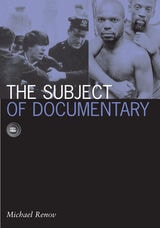
cover of Subject Of Documentary

Subject Of Documentary

Michael Renov

University of Minnesota Press, 2004
The documentary, a genre as old as cinema itself, has traditionally aspired to objectivity. Whether making ethnographic, propagandistic, or educational films, documentarians have pointed the camera outward, drawing as little attention to themselves as possible. In recent decades, however, a new kind of documentary has emerged in which the filmmaker has become the subject of the work. Whether chronicling family history, sexual identity, or a personal or social world, this new generation of nonfiction filmmakers has defiantly embraced autobiography. In The Subject of Documentary, Michael Renov focuses on how documentary filmmaking has become an important means for both examining and constructing selfhood. By looking at key figures in documentary filmmaking as well as noncanonical video art and avant-garde artists, Renov broadens the definition of what counts as documentary, and explores the intersection of the personal and political, considering how memory can create a way into asking troubling questions about identity, oppression, and resiliency. Offering historical context for the explosion of personal nonfiction filmmaking in the 1980s and 1990s, Renov analyzes films in which the subjectivity of the filmmaker is expressly defined in relation to political struggle or historical trauma, from Haskell Wexler's Medium Cool to Jonas Mekas's Lost, Lost, Lost. And, looking beyond the traditional documentary, Renov contemplates such nontraditional modes of autobiographical practice as the essay film, the video confession, and the personal Web page.Unique in its attention to diverse expressions of personal nonfiction filmmaking, The Subject of Documentary forges a new understanding of the heightened role and function of subjectivity in contemporary documentary practice.Michael Renov is professor of critical studies at the USC School of Cinema-Television. He is the editor of Theorizing Documentary and the coeditor of Resolutions: Contemporary Video Practices (Minnesota, 1996) and Collecting Visible Evidence (Minnesota, 1999).
[more]
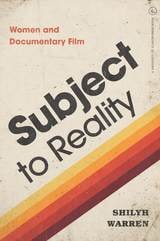
cover of Subject to Reality: Women and Documentary Film

Subject to Reality

Women and Documentary Film

Shilyh Warren

University of Illinois Press, 2019

Revolutionary thinking around gender and race merged with new film technologies to usher in a wave of women's documentaries in the 1970s. Driven by the various promises of second-wave feminism, activist filmmakers believed authentic stories about women would bring more people into an imminent revolution. Yet their films soon faded into obscurity.

Shilyh Warren reopens this understudied period and links it to a neglected era of women's filmmaking that took place from 1920 to 1940, another key period of thinking around documentary, race, and gender. Drawing women’s cultural expression during these two explosive times into conversation, Warren reconsiders key debates about subjectivity, feminism, realism, and documentary and their lasting epistemological and material consequences for film and feminist studies. She also excavates the lost ethnographic history of women's documentary filmmaking in the earlier era and explores the political and aesthetic legacy of these films in more explicitly feminist periods like the Seventies.

Filled with challenging insights and new close readings, Subject to Reality sheds light on a profound and unexamined history of feminist documentaries while revealing their influence on the filmmakers of today.
[more]
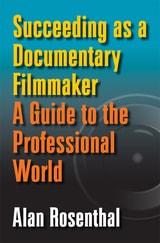
cover of Succeeding as a Documentary Filmmaker: A Guide to the Professional World

Succeeding as a Documentary Filmmaker

A Guide to the Professional World

Alan Rosenthal

Southern Illinois University Press, 2011

 
While many film programs prepare students for the realities of Hollywood, comparatively little guidance is provided for the aspiring documentary filmmaker. Alan Rosenthal fills this void with Succeeding as a Documentary Filmmaker: A Guide to the Professional World. Unlike traditional manuals on documentary filmmaking, which focus primarily on the creation of films, this user-friendly volume draws upon real-world examples and the advice of experienced filmmakers to provide essential information about the nonfiction movie business. 

From the basics of the current film business environment and how to navigate it, to tips on how to maximize distribution and sales for a finished film, Rosenthal leads novice filmmakers step-by-step through the professional arena of documentary moviemaking. Included here are recommendations for how to make the most of a film school education; the best ways to find financing for a film and the realities of working with a budget; how to develop a successful proposal for a project; the intricacies of working both as an independent filmmaker and for others; and insight into the often complicated arenas of contracts and markets. Throughout the volume, Rosenthal shares the expertise of actual filmmakers on such subjects as film school and starting a career; pitching and funding projects; contract negotiation; effective marketing; and commissioning editors and legal help. Not limiting himself to merely the documentary world, the author also offers valuable information and advice for filmmakers interested in other genres of nonfiction movies - such as industrial, public relations, travel, and educational films - to provide a truly comprehensive and one-of-a-kind guide for readers. 

Packed with useful tips for novices, film students, and practitioners alike, Succeeding as a Documentary Filmmaker is an indispensable addition to the library of anyone involved in the world of nonfiction filmmaking.
[more]