Results by title
917 books match the query 'Economics' and 58 start with s
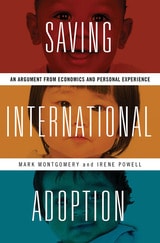
Saving International Adoption
An Argument from Economics and Personal ExperienceMark Montgomery
Vanderbilt University Press, 2018
International adoption is in a state of virtual collapse, rates having fallen by more than half since 2004 and continuing to fall. Yet around the world millions of orphaned and vulnerable children need permanent homes, and thousands of American and European families are eager to take them in. Many government officials, international bureaucrats, and social commentators claim these adoptions are not "in the best interests" of the child. They claim that adoption deprives children of their "birth culture," threatens their racial identities, and even encourages widespread child trafficking. Celebrity adopters are publicly excoriated for stealing children from their birth families.
This book argues that opposition to adoption ostensibly based on the well-being of the child is often a smokescreen for protecting national pride. Concerns about the harm done by transracial adoption are largely inconsistent with empirical evidence. As for trafficking, opponents of international adoption want to shut it down because it is too much like a market for children. But this book offers a radical challenge to this view—that is, what if instead of trying to suppress market forces in international adoption, we embraced them so they could be properly regulated? What if the international system functioned more like open adoption in the United States, where birth and adoptive parents can meet and privately negotiate the exchange of parental rights? This arrangement, the authors argue, could eliminate the abuses that currently haunt international adoption.
The authors challenge the prevailing wisdom with their economic analyses and provocative analogies from other policy realms. Based on their own family's experience with the adoption process, they also write frankly about how that process feels for parents and children.

Savings in the Modern Economy
A SymposiumWalter Heller
University of Minnesota Press, 1953
Scanner Data and Price Indexes
Edited by Robert C. Feenstra and Matthew D. Shapiro
University of Chicago Press, 2003
Scanner Data and Price Indexes assesses both the promise and the challenges of using scanner data to produce economic statistics. Three papers present the results of work in progress at statistical agencies in the U.S., United Kingdom, and Canada, including a project at the U.S. Bureau of Labor Statistics to investigate the feasibility of incorporating scanner data into the monthly Consumer Price Index. Other papers demonstrate the enormous potential of using scanner data to test economic theories and estimate the parameters of economic models, and provide solutions for some of the problems that arise when using scanner data, such as dealing with missing data.

Science Bought and Sold
Essays in the Economics of ScienceEdited by Philip Mirowski and Esther-Mirjam Sent
University of Chicago Press, 2001
Bringing together central themes in this emerging discipline, the editors have assembled important articles that provide a wider context and background against which the economics of science can be evaluated. Roughly one-third of the essays presented here are original papers, and the rest are critical articles previously published in the field. From essays examining economic welfare to the idea of scientists as agents to the digital aspects of higher education,Science Bought and Sold presents a comprehensive overview of the new directions of this expanding area.
Contributors:
Kenneth J. Arrow
Mario Biagioli
William A. Brock
Michel Callon
Partha Dasgupta
Paul A. David
Steven N. Durlauf
Paul Forman
Steve Fuller
D. Wade Hands
Shaun P. Hargreaves Heap
Philip Kitcher
Sharon G. Levin
Richard R. Nelson
David F. Noble
Michael Polanyi
Gary Rhoades
Charles Sanders Peirce
Sheila Slaughter
Paula E. Stephan
Stephen Turner
James R. Wible
John Ziman

Science and Ceremony
The Institutional Economics of C. E. AyresEdited by William Breit and William Patton Culbertson, Jr.
University of Texas Press, 1976
Clarence Edwin Ayres was the leading American institutionalist economist in the post–World War II era. His innovative theories concerning the causes and significance of technological change provided the philosophical framework for that school of economics called institutionalism. In his recognition that the critical economic issues of the future would be the realization of the full economic potential of industrial society and the development of the third world, he was at least twenty years ahead of his time. In addition, Ayres's influence as an economics teacher at the University of Texas at Austin went well beyond the discipline of economics to students of anthropology, psychology, philosophy, education, and even music and art.
This book constitutes the first major appraisal of the work and influence of C. E. Ayres. The essays are written from a transatlantic as well as a national viewpoint and do not evince anyone ideological bias. As John Kenneth Galbraith says in his Foreword, the essays are not meant as a monument to Ayres; instead, they critique what he thought and did, showing "his range of interests, his diligence, his originality of mind and method."
Contributions to the volume are "Clarence Edwin Ayres: An Intellectual's Portrait" by editors William Breit and William Patton Culbertson, Jr.; "Clarence Ayres's Place in the History of American Economics: An Interim Assessment" by A. W. Coats; "C. E. Ayres on the Industrial Revolution" by R. M. Hartwell; "Clarence Ayres and the Roots of Economic Progress" by S. Herbert Frankel; "Technology and the Price System" by W. W. Rostow; "Limits to Growth: Biospheric or Institutional?" by Joseph J. Spengler; "Science's Feet of Clay" by Gordon Tullock; "Ayres's Views on Moral Relativism" by Alfred F. Chalk; "Methods and Morals in Economics: The Ayres-Knight Discussion" by James M. Buchanan; " Clarence Ayres's Economics and Sociology" by Talcott Parsons; and "Clarence E. Ayres as a University Teacher" by Marion J. Levy, Jr.
Science, Money, and Politics
Political Triumph and Ethical ErosionDaniel S. Greenberg
University of Chicago Press, 2001

Secret Origins of Modern Microeconomics
Dupuit and the EngineersRobert B. Ekelund Jr. and Robert F. Hébert
University of Chicago Press, 1999
"A very fine piece of work that provides material I have never seen before, is well written, and has undoubtable merits."—William Baumol, C.V. Starr Center for Applied Economics, New York University
"By bringing to the forefront the achievements of French engineer Jules Dupuit, this work changes our view of the history of microeconomics. Secret Origin of Modern Microeconomics is a commentary on our discipline's mythology of origins: it reminds us that, in the construction and maintenance of canonical authority, the recoginition of founding fathers requires simultaneous, often subtle, gestures of exclusion."—Philippe Fontaine, école Normale Supèrieure de Cachan

Seeking the Best Master
State Ownership in the Varieties of CapitalismMiklós Szanyi
Central European University Press, 2020
Selected Essays by Frank H. Knight, Volume 1
"What is Truth" in Economics?Frank H. Knight
University of Chicago Press, 2000
Ross B. Emmett's selection of Knight's essays is the first to offer a comprehensive picture of the work of this notable social scientist over the span of his career. Included are not only Knight's most influential writings, but also a number of uncollected papers which have not previously been widely accessible. These essays illustrate Knight's views on the central debates regarding economics, social science, ethics, education, and modern liberalism. Volume 1: "What is Truth" in Economics? contains fifteen of Knight's papers up through 1940. Volume 2: Laissez Faire: Pro and Con includes fourteen of Knight's papers from 1940 through 1967, including "Socialism: The Nature of the Problem" and "The Sickness of Liberal Society."
These twenty-nine essays together stand not only as a monument to one of economics' most significant and original thinkers, but will also serve as an invaluable resource for economists, philosophers, and political scientists interested in the development of the western liberal tradition.

Selected Essays by Frank H. Knight, Volume 2
Laissez Faire: Pro and ConFrank H. Knight
University of Chicago Press, 2000
Ross B. Emmett's selection of Knight's essays is the first to offer a comprehensive picture of the work of this notable social scientist over the span of his career. Included are not only Knight's most influential writings, but also a number of uncollected papers which have not previously been widely accessible. These essays illustrate Knight's views on the central debates regarding economics, social science, ethics, education, and modern liberalism. Volume 1: "What is Truth" in Economics? contains fifteen of Knight's papers up through 1940. Volume 2: Laissez Faire: Pro and Con includes fourteen of Knight's papers from 1940 through 1967, including "Socialism: The Nature of the Problem" and "The Sickness of Liberal Society."
These twenty-nine essays together stand not only as a monument to one of economics' most significant and original thinkers, but will also serve as an invaluable resource for economists, philosophers, and political scientists interested in the development of the western liberal tradition.

Selected Works of Merton H. Miller
A Celebration of Markets: Volume 1: FinanceMerton H. Miller
University of Chicago Press, 2002
Miller was perhaps best known for a series of highly influential papers he cowrote in the 1950s and 1960s with fellow Nobel laureate Franco Modigliani that advanced a set of capital structure theorems later dubbed the "M and M propositions." In brief, the M and M propositions state that the actions of investors, firms, and capital markets will cause the market value of a firm to be independent of its capital structure. In other words, a corporation's value depends on its investments in people, ideas, and physical capital goods and not on the mix of bonds, stocks, and other securities used to finance the investments. Four of these papers are reprinted here, together with important later work by Miller in macroeconomics, corporate capital structure, management science, asset pricing, and the economic and regulatory problems of the financial services industry.
Diverse and innovative, the papers in Selected Works of Merton H. Miller will interest students and practitioners of economics, finance, and business, as well as policymakers responsible for market regulation.
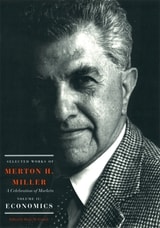
Selected Works of Merton H. Miller
A Celebration of Markets: Volume 2: EconomicsMerton H. Miller
University of Chicago Press, 2002
Miller was perhaps best known for a series of highly influential papers he cowrote in the 1950s and 1960s with fellow Nobel laureate Franco Modigliani that advanced a set of capital structure theorems later dubbed the "M and M propositions." In brief, the M and M propositions state that the actions of investors, firms, and capital markets will cause the market value of a firm to be independent of its capital structure. In other words, a corporation's value depends on its investments in people, ideas, and physical capital goods and not on the mix of bonds, stocks, and other securities used to finance the investments. Four of these papers are reprinted here, together with important later work by Miller in macroeconomics, corporate capital structure, management science, asset pricing, and the economic and regulatory problems of the financial services industry.
Diverse and innovative, the papers in Selected Works of Merton H. Miller will interest students and practitioners of economics, finance, and business, as well as policymakers responsible for market regulation.
Selling Power
Economics, Policy, and Electric Utilities Before 1940John L. Neufeld
University of Chicago Press, 2016
John L. Neufeld offers a comprehensive historical treatment of the economics that shaped electric utilities. Compared with most industries, the organization of the electric utility industry is not—and cannot be—economically efficient. Most industries are kept by law in a state of fair competition, but the capital necessary to start an electric company—generators, transmission and distribution systems, and land and buildings—is so substantial that few companies can enter the market and compete. Therefore, the natural state of the electric utility industry since its inception has been a monopoly subject to government oversight. These characteristics of electric utilities—and electricity’s importance—have created over time sharp political controversies, and changing public policies have dramatically changed the industry’s structure to an extent matched by few other industries. Neufeld outlines the struggles that shaped the industry’s development, and shows how the experience of electric utilities provides insight into the design of economic institutions, including today’s new large-scale markets.

Sentimental Materialism
Gender, Commodity Culture, and Nineteenth-Century American LiteratureLori Merish
Duke University Press, 2000
The phenomenon of female consumption was capitalism’s complement to male production: It created what Merish calls the “Other Protestant Ethic,”a feminine and sentimental counterpart to Max Weber’s ethic of hard work, economic rationality, and self-control. In addition, driven by the culture’s effort to civilize the “cannibalistic” practices of ethnic, class, and national otherness, appropriate female consumerism, marked by taste and refinement, identified certain women and their families as proper citizens of the United States. The public nature of consumption, however, had curiously conflicting effects: While the achievement of cultured material circumstances facilitated women’s civic agency, it also reinforced stereotypes of domestic womanhood.
Sentimental Materialism’s inquiry into middle-class consumption and accompanying ideals of womanhood will appeal to readers in a variety of disciplines, including American studies, cultural studies, feminist theory, and cultural history.
Shared Capitalism at Work
Employee Ownership, Profit and Gain Sharing, and Broad-Based Stock OptionsEdited by Douglas L. Kruse, Richard B. Freeman, and Joseph R. Blasi
University of Chicago Press, 2010
The historical relationship between capital and labor has evolved in the past few decades. One particularly noteworthy development is the rise of shared capitalism, a system in which workers have become partial owners of their firms and thus, in effect, both employees and stockholders. Profit sharing arrangements and gain-sharing bonuses, which tie compensation directly to a firm’s performance, also reflect this new attitude toward labor.
Shared Capitalism at Work analyzes the effects of this trend on workers and firms. The contributors focus on four main areas: the fraction of firms that participate in shared capitalism programs in the United States and abroad, the factors that enable these firms to overcome classic free rider and risk problems, the effect of shared capitalism on firm performance, and the impact of shared capitalism on worker well-being. This volume provides essential studies for understanding the increasingly important role of shared capitalism in the modern workplace.
Shortcut or Piecemeal
Economic Development Strategies and Structural ChangeJan Winiecki
Central European University Press, 2016
Side Effects and Complications
The Economic Consequences of Health-Care ReformCasey B. Mulligan
University of Chicago Press, 2015
Looking specifically at the labor market, Mulligan reveals how the costs of health care under the ACA actually create implicit taxes on individuals, and how increased costs to employers will be passed on to their employees. Mulligan shows how, as a result, millions of workers will find themselves in a situation in which full-time work, adjusted for the expense of health care, will actually pay less than part-time work or even not working at all. Analyzing the incentives—or lack thereof—for people to earn more by working more, Mulligan offers projections on how many hours people will work and how productively they will work, as well as how much they will spend in general. Using the powerful tools of economics, he then illustrates the detrimental consequences on overall employment in the near future.
Drawing on extensive knowledge of the labor market and the economic theories at its foundation, Side Effects and Complications offers a crucial wake-up call about the risks the ACA poses for the economy. Plainly laying out the true costs of the ACA, Mulligan’s grounded and thorough predictions are something that workers and policy makers cannot afford to ignore.
Signaling Goodness
Social Rules and Public ChoicePhillip J. Nelson and Kenneth V. Greene
University of Michigan Press, 2003

Small Is Necessary
Shared Living on a Shared PlanetAnitra Nelson
Pluto Press, 2018
Using successful examples from a range of countries, Anitra Nelson shows how 'eco-collaborative housing' - resident-driven low impact living with shared facilities and activities - can address the great social, economic and sustainability challenges that householders and capitalist societies face today. Sharing living spaces and facilities results in householders having more amenities and opportunities for neighbourly interaction.
Small is Necessary places contemporary models of 'alternative' housing and living at centre stage arguing that they are outward-looking, culturally rich, with low ecological footprints and offer governance techniques for a more equitable and sustainable future.
Social Class
How Does It Work?Annette Lareau
Russell Sage Foundation, 2008
Social Dimensions of U.S. Trade Policies
Alan V. Deardorff and Robert M. Stern, Editors
University of Michigan Press, 2000

Social Exchange
Barter as Economic and Cultural Activism in Medellín, ColombiaBrian J. Burke
Rutgers University Press, 2022
Social Inequality
Kathryn Neckerman
Russell Sage Foundation, 2004
Social Norms and Economic Institutions
Kenneth J. Koford and Jeffrey B. Miller, Editors
University of Michigan Press, 1991
Social Security Policy in a Changing Environment
Edited by Jeffrey R. Brown, Jeffrey B. Liebman, and David A. Wise
University of Chicago Press, 2009

Social Security Programs and Retirement around the World
Disability Insurance Programs and RetirementEdited by David A. Wise
University of Chicago Press, 2015
The sixth stage of an ongoing research project studying the relationship between social security programs and labor force participation, this volume draws on the work of an eminent group of international economists to consider the extent to which differences in labor force participation across countries are determined by the provisions of disability insurance programs. Presented in an easily comparable way, their research covers twelve countries, including Canada, Japan, and the United States, and considers the requirements of disability insurance programs, as well as other pathways to retirement.
Social Security Programs and Retirement around the World
Fiscal Implications of ReformEdited by Jonathan Gruber and David A. Wise
University of Chicago Press, 2007
Drawing on the work of an international group of noted economists, the editors argue that social security programs provide strong incentives for workers to leave the labor force by retiring and taking the benefits to which they are entitled. By penalizing work, social security systems magnify the increased financial burden caused by aging populations, thus contributing to the insolvency of the system. This book is a model of comparative analysis that evaluates the effects of illustrative policies for countries facing the impending rapid growth of social security benefits. Its insights will help inform one of the most pressing debates.

Social Security Programs and Retirement around the World
Historical Trends in Mortality and Health, Employment, and Disability Insurance Participation and ReformsEdited by David A. Wise
University of Chicago Press, 2012
In nearly every industrialized country, large aging populations and increased life expectancy have placed enormous pressure on social security programs—and, until recently, the pressure has been compounded by a trend toward retirement at an earlier age. With a larger fraction of the population receiving benefits, in coming decades social security in many countries may have to be reformed in order to remain financially viable.
This volume offers a cross-country analysis of the effects of disability insurance programs on labor force participation by older workers. Drawing on measures of health that are comparable across countries, the authors explore the extent to which differences in the labor force are determined by disability insurance programs and to what extent disability insurance reforms are prompted by the circumstances of a country’s elderly population.

Social Security Programs and Retirement around the World
The Capacity to Work at Older AgesEdited by David A. Wise
University of Chicago Press, 2017
Social Security Programs and Retirement around the World
Working LongerEdited by Courtney C. Coile, Kevin Milligan, and David A. Wise
University of Chicago Press, 2019
This eighth phase of the International Social Security project, which compares the social security and retirement experiences of twelve developed countries, documents trends in participation and employment and explores reasons for the rising participation rates of older workers. The chapters use a common template for analysis, which facilitates comparison of results across countries. Using within-country natural experiments and cross-country comparisons, the researchers study the impact of improving health and education, changes in the occupation mix, the retirement incentives of social security programs, and the emergence of women in the workplace, on labor markets. The findings suggest that social security reforms and other factors such as the movement of women into the labor force have played an important role in labor force participation trends.

Social Security
A Fresh Look at Policy AlternativesJagadeesh Gokhale
University of Chicago Press, 2010
Many of us suspect that Social Security faces eventual bankruptcy. But the government projects its future finances using long outdated methods. Employing a more up-to-date approach, Jagadeesh Gokhale here argues that the program faces insolvency far sooner than previously thought.
To assess Social Security’s fate more accurately under current and alternative policies, Gokhale constructs a detailed simulation of the forces shaping American demographics and the economy to project their future evolution. He then uses this simulation to analyze six prominent Social Security reform packages—two liberal, two centrist, and two conservative—to demonstrate how far they would restore the program’s financial health and which population groups would be helped or hurt in the process.
Arguments over Social Security have raged for decades, but they have taken place in a relative informational vacuum; Social Security provides the necessary bedrock of analysis that will prove vital for anyone with a stake in this important debate.
Social Security
The Phony CrisisDean Baker and Mark Weisbrot
University of Chicago Press, 1999
According to the authors of this important new study, the answer to these questions is a resounding no. In Social Security: The Phony Crisis, economists Dean Baker and Mark Weisbrot argue that there is no economic, demographic, or actuarial basis for the widespread belief that the program needs to be fixed.
As the authors emphasize, there is virtually no disagreement about the facts of Social Security's finances, or even the projections for its future. Rather, the Social Security debate has been foundering on misconceptions, confusion, and lack of agreement on the meaning of crucial terms.
The authors also take on related issues: that privatization would help save Social Security, that America has a pressing need to increase its national savings, and that future generations will suffer from the costs—especially for health care—of supporting a growing elderly population.
As New York Times columnist Fred Brock recently wrote, "So-called reform of the Social Security system is looking more and more like a solution in search of a problem." In this accessible and insightful work, Baker and Weisbrot seek to cut through some of the myths and fallacies surrounding this crucial policy issue.
"Dean Baker and Mark Weisbrot have no trouble at all demonstrating that even on highly conservative assumptions about economic growth, the much-forecast insolvency of the Social Security system by about 2030 is most unlikely to happen then, if indeed ever."—The Economist
"The authors challenge basic assumptions with vigor and intelligence. . . . An absolutely relevant and important analysis, presented with force and clarity, that asks, basically, what kind of a nation we really are."—Kirkus Reviews
"Proponents—like George W. Bush—of Social Security privatization . . . typically ignore prospects for a stagnant or falling stock market. In Social Security: The Phony Crisis, [Baker and Weisbrot] show how a falling stock market could place pressure on both future Social Security payments and privatization schemes because earnings from the trust fund could actually fall."—Jeff Madrick, New York Review of Books
Socialism after Hayek
Theodore A. Burczak
University of Michigan Press, 2009
Socialism after Hayek recasts and reinvigorates the socialist quest for class justice by rendering it compatible with Hayek's social and economic theories. Theodore A. Burczak puts forth a conception of socialism from a postmodern perspective, drawing from the apparently opposing ideas of Marx and Hayek (the latter of whom achieved worldwide recognition in the twentieth century as a champion of the free market and fierce opponent of government interference in markets). Burczak sketches an institutional structure that would promote a democratic socialist notion of distributive justice and his own interpretation of Marx's notion of freely associated labor, while avoiding Hayek's criticisms of centrally planned socialism.
Burczak's version of market socialism is one in which privately owned firms are run democratically by workers, governments engage in ongoing redistribution of wealth to support human development, and markets are otherwise unregulated. Burczak poses this model of "free market socialism" against other models of socialism, especially those developed by John Roemer, Michael Albert, and Robin Hahnel.
Socialism and War
Essays, Documents, ReviewsF. A. Hayek
University of Chicago Press, 1997
Opening with Hayek's arguments against market socialism, the volume continues with his writings on the economics of war, many in response to the proposals made in John Maynard Keynes's famous pamphlet, How to Pay for the War. The last section presents articles that anticipated The Road to Serfdom, Hayek's classic meditation on the dangers of collectivism. An appendix contains a number of topical book reviews written by Hayek during this crucial period, and a masterful introduction by the volume editor, Bruce Caldwell, sets Hayek's work in context.
Socialism and War will interest not just fans of The Road to Serfdom, but anyone concerned with the ongoing debates over the propriety of government intervention in the economy.
"When he wrote The Road to Serfdom, [Hayek's] was a voice in the wilderness. Now the fight [has] been taken up by people all over the world, by institutions and movements, and the ideas that seemed so strange to many in 1944 can be found from scholarly journals to television programs."—Thomas Sowell, Forbes
"Intellectually [Hayek] towers like a giant oak in a forest of saplings."—Chicago Tribune
"Each new addition to The Collected Works of F. A. Hayek, the University of Chicago's painstaking series of reissues and collections, is a gem."—Liberty on Volume IX of The Collected Works of F. A. Hayek

Socialist States and the Environment
Lessons for Eco-Socialist FuturesSalvatore Engel-Di Mauro
Pluto Press, 2021
More than thirty years after the collapse of the USSR, the critique of state socialism is still used to deny alternatives to capitalism, irrespective of global capitalist ecological and social devastation. There is seemingly nothing worthwhile salvaging from decades of state socialist experiences.
As the climate crisis deepens, Engel-Di Mauro argues that we need to re-evaluate the environmental practices and policies of state socialism, especially as they had more environmentally beneficial than destructive effects. Rather than dismissing state socialism’s heritage out of hand, we should reclaim it for contemporary eco-socialist ends.
By means of a comparative and multiple-scaled approach, Engel-Di Mauro points to highly diverse and environmentally constructive state socialist experiences. Taking the reader from the USSR to China and Cuba, this is a fiery and contentious look at what worked, what didn’t, and how we can move towards an eco-socialist future.

Solidarity in Strategy
Making Business Meaningful in American Trade AssociationsLyn Spillman
University of Chicago Press, 2012
Popular conceptions hold that capitalism is driven almost entirely by the pursuit of profit and self-interest. Challenging that assumption, this major new study of American business associations shows how market and non-market relations are actually profoundly entwined at the heart of capitalism.
In Solidarity in Strategy, Lyn Spillman draws on rich documentary archives and a comprehensive data set of more than four thousand trade associations from diverse and obscure corners of commercial life to reveal a busy and often surprising arena of American economic activity. From the Intelligent Transportation Society to the American Gem Trade Association, Spillman explains how business associations are more collegial than cutthroat, and how they make capitalist action meaningful not only by developing shared ideas about collective interests but also by articulating a disinterested solidarity that transcends those interests.
Deeply grounded in both economic and cultural sociology, Solidarity in Strategy provides rich, lively, and often surprising insights into the world of business, and leads us to question some of our most fundamental assumptions about economic life and how cultural context influences economic.
Solutions Manual to Elements of Econometrics
Jan Kmenta
University of Michigan Press, 1997
The Solutions Manual to Elements of Econometrics, Second Edition provides chapter solutions to the exercises in the college textbook: Elements of Econometrics, Second Edition by Jan Kmenta.

Speculum Iuris
Roman Law as a Reflection of Social and Economic Life in AntiquityJean-Jacques Aubert and Boudewijn Sirks, Editors
University of Michigan Press, 2002
Speculum Iuris examines the complex relationship between law and social practice from the particular angle of Roman legislation and jurisprudence as conditioned by or reacting to a specific social, economic, and political context. Using various strategies, the editors and contributors mine a huge body of texts to study attitudes and behaviors of the Roman upper class, whose social concerns are reflected in the development of legal rules.
A close reading of juristic opinions and Republican or imperial legislation allows the contributors to find rationales behind rules and decisions in order to explain practices and mentalities of the elite within a larger social context. This book demonstrates clearly that Roman law was not divorced from the realities of daily life, even if some jurists may have been working with purely hypothetical cases.
Speculum Iuris provides a multidisciplinary approach to the question of the interplay of legal and social forces in the Roman world. As such, it will be a helpful study for general classicists and ancient historians, as well as for legal historians, social historians, economic historians, sociologists, and cultural anthropologists.
Jean-Jacques Aubert is Professor of Latin Language and Literature, University of Neuchâtel, Switzerland. Boudewijn Sirks is Professor of the History of Ancient Law, the History of European Private Law, and German Civil Law, Institute for the History of Law, Germany.

Squaring Up
Policy Strategies to Raise Women's Incomes in the United StatesMary C. King, Editor
University of Michigan Press, 2001

Staircases or Treadmills?
Labor Market Intermediaries and Economic Opportunity in a Changing EconomyChris Benner
Russell Sage Foundation, 2007

State Employment Policy in Hard Times
Michael Barker, ed.
Duke University Press, 1983
Stories Employers Tell
Race, Skill, and Hiring in AmericaPhilip Moss
Russell Sage Foundation, 2001
Strained Relations
US Foreign-Exchange Operations and Monetary Policy in the Twentieth CenturyMichael D. Bordo, Owen F. Humpage, and Anna J. Schwartz
University of Chicago Press, 2015
Straining at the Anchor
The Argentine Currency Board and the Search for Macroeconomic Stability, 1880-1935Gerardo della Paolera and Alan M. Taylor
University of Chicago Press, 2001
With many countries now using—or seriously contemplating—monetary arrangements similar to Argentina's, this important and persuasive study maps out one of history's most interesting monetary experiments to show what works and what doesn't.
Strategy or Principle?
The Choice Between Regulation and TaxationMark Kelman
University of Michigan Press, 1999
Street-Level Bureaucracy, 30th Anniversary Edition
Dilemmas of the Individual in Public ServiceMichael Lipsky
Russell Sage Foundation, 2010
Street-Level Bureaucracy
Dilemmas of the Individual in Public ServiceMichael Lipsky
Russell Sage Foundation, 1983

Structural Impediments to Growth in Japan
Edited by Magnus Blomström, Jennifer Corbett, Fumio Hayashi, and Anil Kashyap
University of Chicago Press, 2003
In this, the first book-length academic treatment of this important issue, a team of notable contributors present nine papers, offering a comprehensive assessment of those economic difficulties and addressing a range of specific issues, from financial restructuring and the impact of the aging Japanese population to corporate behavior, public lending, employment practices, and innovative capacity. In each paper, contributors clearly identify and outline problems and concerns, carefully pose provocative questions, and in many instances present concrete suggestions for improvement.
The resulting volume is a timely and important examination of critical issues for Japan's stalling economy, packed with both telling data and expert analysis and offering valuable perspectives on Japan's current obstacles.
Studies in International Taxation
Edited by Alberto Giovannini, R. Glenn Hubbard, and Joel Slemrod
University of Chicago Press, 1993
The contributors examine the effects of taxation on decisions about international financial management, business investment, and international income shifting. They consider the influence of tax rules on dividend policy decisions within multinationals; the extent to which tax incentives affect the level and location of research and development across countries; and the fact that foreign-controlled companies operating in the United States pay lower taxes than do domestically controlled companies.
The contributors to this volume are Rosanne Altshuler, Alan J. Auerbach, Neil Bruce, Timothy Goodspeed, Roger H. Gordon, Harry Grubert, Bronwyn H. Hall, David Harris, Kevin Hassett, James R. Hines Jr., Roy D. Hogg, Joosung Jun, Jeffrey K. Mackie-Mason, Jack M. Mintz, Randall Morck, John Mutti, T. Scott Newlon, James M. Poterba, Joel Slemrod, Deborah Swenson, G. Peter Wilson, and Bernard Yeung.
Studies in Philosophy, Politics, and Economics
F. A. Hayek
University of Chicago Press, 1967