Results by title
94 books match the query 'Economy' and 2 start with s
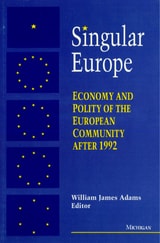
Singular Europe
Economy and Polity of the European Community after 1992William James Adams, Editor
University of Michigan Press, 1994
Singular Europe: Economy and Polity of the European Community after 1992 offers a thorough, multidisciplinary analysis of the sweeping changes and enduring challenges that faced the European Community in the wake of its ambitious 1992 integration project. Sponsored by the Chicago Council on Foreign Relations and drawing on the insights of leading economists, political scientists, and policymakers, this volume examines the economic, legal, and political forces that would shape Europe’s future at the end of the twentieth century.Taking its cue from the landmark “Project 1992”—the drive to create a single market for goods, services, capital, and people—the book begins by exploring the transformative view of a Europe no longer defined by its declining “Old Continent” image, but as a dynamic, populous, and increasingly prosperous global actor. Through three thematic parts, contributors address critical questions about the meaning and limits of integration: What steps remain for true political and economic union? How has European integration redefined competition, corporate strategy, social policy, and regulation? What are the external implications, and will the so-called “Fortress Europe” change global economic relations?With essays covering legitimacy and democracy after Maastricht, German reunification, the challenges of monetary union, competition policy, the social welfare state, telecommunications, banking, and international trade, Singular Europe blends scholarly rigor and policy relevance. The volume is a vital resource for anyone seeking to understand the ambitions and anxieties of a pivotal moment in Europe’s integration—and the ongoing debate over the balance between unity and diversity within the continent.
[more]
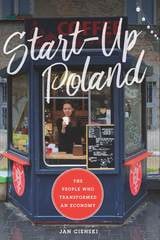
Start-Up Poland
The People Who Transformed an EconomyJan Cienski
University of Chicago Press, 2018
Poland in the 1980s was filled with shuttered restaurants and shops that bore such imaginative names as “bread,” “shoes,” and “milk products,” from which lines could stretch for days on the mere rumor there was something worth buying. But you’d be hard-pressed to recognize the same squares—buzzing with bars and cafés—today. In the years since the collapse of communism, Poland’s GDP has almost tripled, making it the eighth-largest economy in the European Union, with a wealth of well-educated and highly skilled workers and a buoyant private sector that competes in international markets. Many consider it one of the only European countries to have truly weathered the financial crisis.
As the Warsaw bureau chief for the Financial Times, Jan Cienski spent more than a decade talking with the people who did something that had never been done before: recreating a market economy out of a socialist one. Poland had always lagged behind wealthier Western Europe, but in the 1980s the gap had grown to its widest in centuries. But the corrupt Polish version of communism also created the conditions for its eventual revitalization, bringing forth a remarkably resilient and entrepreneurial people prepared to brave red tape and limited access to capital. In the 1990s, more than a million Polish people opened their own businesses, selling everything from bicycles to leather jackets, Japanese VCRs, and romance novels. The most business-savvy turned those primitive operations into complex corporations that now have global reach.
Well researched and accessibly and entertainingly written, Start-Up Poland tells the story of the opening bell in the East, painting lively portraits of the men and women who built successful businesses there, what their lives were like, and what they did to catapult their ideas to incredible success. At a time when Poland’s new right-wing government plays on past grievances and forms part of the populist and nationalist revolution sweeping the Western world, Cienski’s book also serves as a reminder that the past century has been the most successful in Poland’s history.
[more]