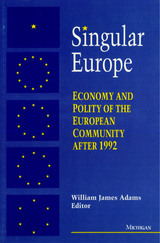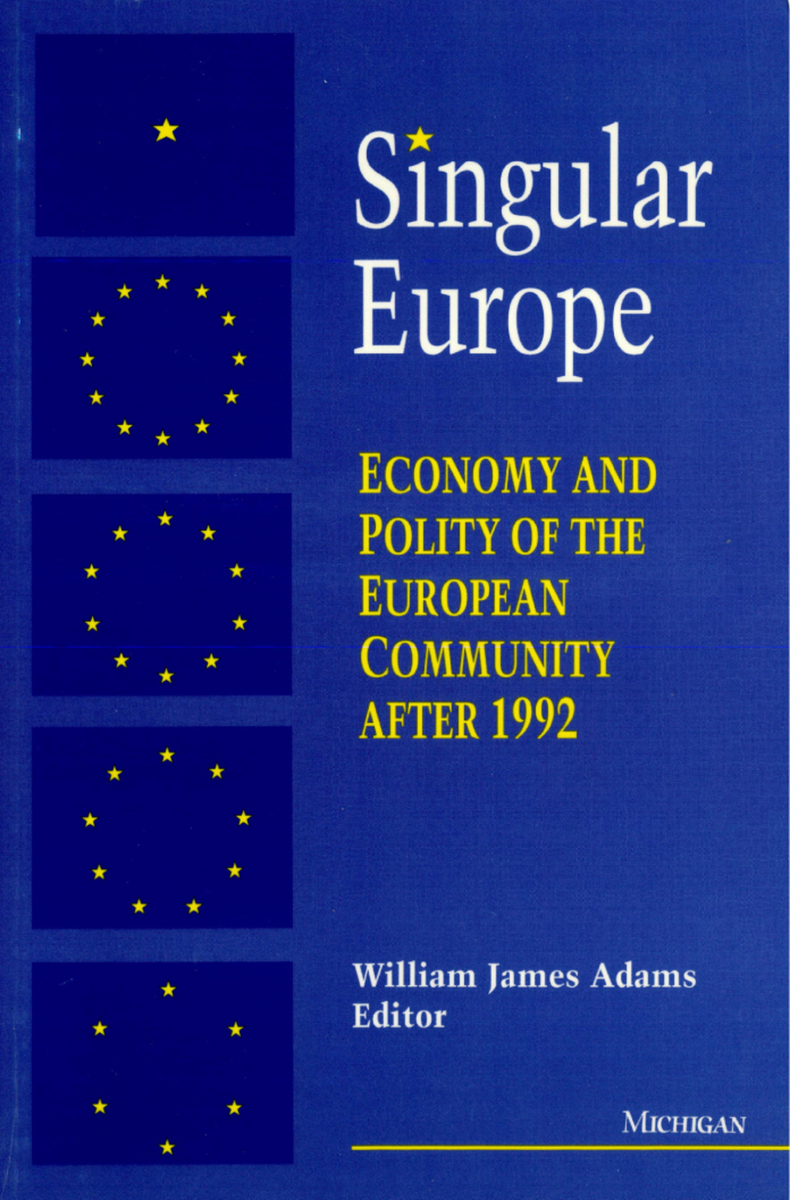
Singular Europe: Economy and Polity of the European Community after 1992
University of Michigan Press, 1994
Cloth: 978-0-472-09504-9 | Paper: 978-0-472-06504-2 | eISBN: 978-0-472-22574-3 (standard)
Library of Congress Classification HC241.2.S5323 1993
Dewey Decimal Classification 341.2422
Cloth: 978-0-472-09504-9 | Paper: 978-0-472-06504-2 | eISBN: 978-0-472-22574-3 (standard)
Library of Congress Classification HC241.2.S5323 1993
Dewey Decimal Classification 341.2422
ABOUT THIS BOOK | AUTHOR BIOGRAPHY | REQUEST ACCESSIBLE FILE
ABOUT THIS BOOK
Singular Europe: Economy and Polity of the European Community after 1992 offers a thorough, multidisciplinary analysis of the sweeping changes and enduring challenges that faced the European Community in the wake of its ambitious 1992 integration project. Sponsored by the Chicago Council on Foreign Relations and drawing on the insights of leading economists, political scientists, and policymakers, this volume examines the economic, legal, and political forces that would shape Europe’s future at the end of the twentieth century.Taking its cue from the landmark “Project 1992”—the drive to create a single market for goods, services, capital, and people—the book begins by exploring the transformative view of a Europe no longer defined by its declining “Old Continent” image, but as a dynamic, populous, and increasingly prosperous global actor. Through three thematic parts, contributors address critical questions about the meaning and limits of integration: What steps remain for true political and economic union? How has European integration redefined competition, corporate strategy, social policy, and regulation? What are the external implications, and will the so-called “Fortress Europe” change global economic relations?With essays covering legitimacy and democracy after Maastricht, German reunification, the challenges of monetary union, competition policy, the social welfare state, telecommunications, banking, and international trade, Singular Europe blends scholarly rigor and policy relevance. The volume is a vital resource for anyone seeking to understand the ambitions and anxieties of a pivotal moment in Europe’s integration—and the ongoing debate over the balance between unity and diversity within the continent.
See other books on: Economics & Trade | Economy | European Economic Community | Foreign economic relations | Polity
See other titles from University of Michigan Press