
 A SCHOLARLY BOOK REPOSITORY
John J. McCloy was the "wise man" of the Cold War era who had the longest substantial American connection with Germany. A self-made man of great ambition, enormous vitality, and extraordinary tenacity, McCloy served in several government positions before being appointed High Commissioner of Germany in 1949.
America's Germany is the first study of McCloy's critical years in Germany. Drawing on deep archival research and interviews, Thomas Schwartz argues that McCloy played a decisive role in the American effort to restore democracy and integrate Germany into Western Europe. Convinced that reunification should wait until Germany was firmly linked to the West, McCloy implemented a policy of "dual containment," designed to keep both the Soviet Union and Germany from dominating Europe.
McCloy represented the best and the worst of the values and beliefs of a generation of American foreign policy leaders. He strove to learn from the mistakes made in the aftermath of the collapse of the Weimar Republic, when the West did not do enough to help German democracy survive. Yet his leniency toward convicted Nazi war criminals compromised the ideals for which America had fought in World War II.
America's Germany offers an essential history for those wishing to understand the recent changes in Germany and Europe. The book describes a unique period in the relationship between America and Germany, when the two nations forged an extraordinary range of connections--political, economic, military, and cultural--as the Federal Republic became part of the Western club and the new Europe.

Which European and non-European ideas and practices facilitated the shaping of European unity? Or rather, which pursuits led to deadlocks in the cooperation between states?
The book seeks answers to these questions by surveying the historical attempts at realizing supranational patterns of governance in Europe since the Middle Ages. The main focus is on the nineteenth and twentieth century organizational models of European unification.
The analysis draws on an abundance of historical and legal source material. While the author encourages critical thinking about European integration, the exploration is admittedly based on specific values. Éva Bóka claims that the struggle for the humanization of power with its democratic creative force has been the major driver in the development of the system of liberties and the idea of European unity. The analysis of the historical process up to the Lisbon Treaty (2007) with the recognition of common, shared, and supported competences meets the author’s set of values to a great extent. The last part of the book examines whether the European Union can serve as a political and economic organizational model for other parts of the world.
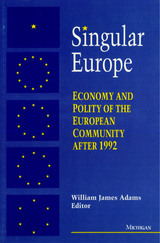

In Brussels, Belgium—since 1957 home to the European Union—such change is taking place. Observing the change, Alexis G. Papadopoulos explores a new geographical concept, the Central Executive District. This urban form is significantly different from the Central Business District, its conventional counterpart. Drawing on game and rational choice theories, spatial analysis, and land economics, the author analyzes how the landscape of the city's center has evolved over the last three decades under the influence of successive coalitions of local and foreign elites. He describes how foreign diplomats, international corporate executives, and real-estate developers cooperate with one another to carry out major urban projects in the face of resistance from local neighborhood groups, conservationists, and political factions.
This study makes a substantial contribution to geography and urban studies both for its implications about the future of world cities like New York, London, and Paris and for its original application of the notion of cooperative regimes.
READERS
Browse our collection.
PUBLISHERS
See BiblioVault's publisher services.
STUDENT SERVICES
Files for college accessibility offices.
RECENTLY PUBLISHED




UChicago Accessibility Resources
home | accessibility | search | about | contact us
BiblioVault ® 2001 - 2026
The University of Chicago Press