Results by title
72 books match the query 'Elementary' and 7 start with s

School Principal
Managing in PublicDan C. Lortie
University of Chicago Press, 2009
When we think about school principals, most of us imagine a figure of vague, yet intimidating authority—for an elementary school student, being sent to the principal’s office is roughly on par with a trip to Orwell’s Room 101. But with School Principal, Dan C. Lortie aims to change that. Much as he did for teachers with his groundbreaking book Schoolteacher, Lortie offers here an intensive and detailed look at principals, painting a compelling portrait of what they do, how they do it, and why.
Lortie begins with a brief history of the job before turning to the daily work of a principal. These men and women, he finds, stand at the center of a constellation of competing interests around and within the school. School district officials, teachers, parents, and students all have needs and demands that frequently clash, and it is the principal’s job to manage these conflicting expectations to best serve the public. Unsurprisingly then, Lortie records his subjects’ professional dissatisfactions, but he also vividly depicts the pleasures of their work and the pride they take in their accomplishments. Finally, School Principal offers a glimpse of the future with an analysis of current issues and trends in education, including the increasing presence of women in the role and the effects of widespread testing mandated by the government.
Lortie’s scope is both broad and deep, offering an eminently useful range of perspectives on his subject. From the day-to-day toil to the long-term course of an entire career, from finding out just what goes on inside that office to mapping out the larger social and organizational context of the job, School Principal is a truly comprehensive account of a little-understood profession.
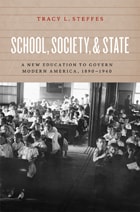
School, Society, and State
A New Education to Govern Modern America, 1890-1940Tracy L. Steffes
University of Chicago Press, 2012
“Democracy has to be born anew every generation, and education is its midwife,” wrote John Dewey in his classic work The School and Society. In School, Society, and State, Tracy Steffes places that idea at the center of her exploration of the connections between public school reform in the early twentieth century and American political development from 1890 to 1940.
American public schooling, Steffes shows, was not merely another reform project of the Progressive Era, but a central one. She addresses why Americans invested in public education and explains how an array of reformers subtly transformed schooling into a tool of social governance to address the consequences of industrialization and urbanization. By extending the reach of schools, broadening their mandate, and expanding their authority over the well-being of children, the state assumed a defining role in the education—and in the lives—of American families.
In School, Society, and State, Steffes returns the state to the study of the history of education and brings the schools back into our discussion of state power during a pivotal moment in American political development.
School, State, and Society
The Growth of Elementary Schooling in Nineteenth-Century France--A Quantitative AnalysisRaymond Grew and Patrick J. Harrigan
University of Michigan Press, 1992
Schooled and Sorted
How Educational Categories Create InequalityThurston Domina
Russell Sage Foundation, 2023
Some educational categories have broadly egalitarian consequences. Indeed, Domina, Penner, and Penner argue that when societies enroll young people in school, making them students, they mark them as individuals who are worthy of rights. But other educational categories reinforce powerful social categories—including race, gender, and class—and ultimately reproduce social and economic inequality in society. Elite colleges, tracked high schools, and elementary school gifted programs provide not only different educational experiences, but also create merit and inequality by sorting students into categories that are defined by the students who are excluded.
Schooled & Sorted highlights that many of the decisions that define educational categories occur in school-based committee meetings and other relatively local settings. The local nature of these decisions provides many opportunities to define educational categories differently, and for school communities to bring about change.
Schooled & Sorted is an illuminating investigation into the ways sorting within schools translates into inequality in the larger world. While some educational categorization may be unavoidable, the authors suggest ways to build a more equitable system—and thus a more equitable society.
Segregation by Experience
Agency, Racism, and Learning in the Early GradesJennifer Keys Adair and Kiyomi Sánchez-Suzuki Colegrove
University of Chicago Press, 2021
Early childhood can be a time of rich discovery, a period when educators have an opportunity to harness their students’ fascination to create unique learning opportunities. Some teachers engage with their students’ ideas in ways that make learning collaborative--but not all students have access to these kinds of learning environments.
In Segregation by Experience, the authors filmed and studied a a first-grade classroom led by a Black immigrant teacher who encouraged her diverse group of students to exercise their agency. When the researchers showed the film to other schools, everyone struggled. Educators admired the teacher but didn’t think her practices would work with their own Black and brown students. Parents of color—many of them immigrants—liked many of the practices, but worried that they would compromise their children. And the young children who viewed the film thought that the kids in the film were terrible, loud, and badly behaved; they told the authors that learning was supposed to be quiet, still, and obedient. In Segregation by Experience Jennifer Keys Adair and Kiyomi Sánchez-Suzuki Colegrove show us just how much our expectations of children of color affect what and how they learn at school, and they ask us to consider which children get to have sophisticated, dynamic learning experiences at school and which children are denied such experiences because of our continued racist assumptions about them.
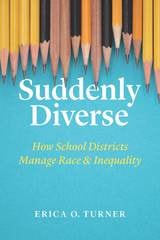
Suddenly Diverse
How School Districts Manage Race and InequalityErica O. Turner
University of Chicago Press, 2020
Suddenly Diverse is an ethnographic account of two school districts in the Midwest responding to rapidly changing demographics at their schools. It is based on observations and in-depth interviews with school board members and superintendents, as well as staff, community members, and other stakeholders in each district: one serving “Lakeside,” a predominately working class, conservative community and the other serving “Fairview,” a more affluent, liberal community. Erica O. Turner looks at district leaders’ adoption of business-inspired policy tools and the ultimate successes and failures of such responses. Turner’s findings demonstrate that, despite their intentions to promote “diversity” or eliminate “achievement gaps,” district leaders adopted policies and practices that ultimately perpetuated existing inequalities and advanced new forms of racism.
While suggesting some ways forward, Suddenly Diverse shows that, without changes to these managerial policies and practices and larger transformations to the whole system, even district leaders’ best efforts will continue to undermine the promise of educational equity and the realization of more robust public schools.

Summers Off?
A History of U.S. Teachers' Other Three MonthsChristine A. Ogren
Rutgers University Press, 2026