Results by title
394 books match the query 'English literature' and 20 start with s
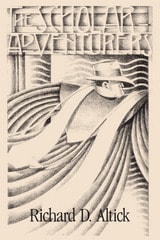
SCHOLAR ADVENTURERS
Richard D. Altick
The Ohio State University Press, 1987
SCOTLAND BRITAIN EMPIRE
WRITING THE HIGHLANDS, 1760-1860KENNETH MCNEIL
The Ohio State University Press, 2007
Kenneth McNeil invokes recent work in postcolonial studies to show how British writers of the Romantic period were actually shaping a more complex national and imperial consciousness. He discusses canonical works—the works of James Macpherson and Sir Walter Scott—and noncanonical and nonliterary works—particularly in the fields of historiography, anthropology, and sociology. This book calls for a rethinking of the “romanticization” of the Highlands and shows that Scottish writing on the Highlands reflects the unique circumstances of a culture simultaneously feeling the weight of imperial “anglobalization” while playing a vital role in its inception.
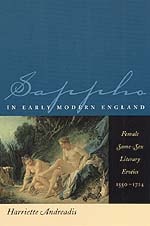
Sappho in Early Modern England
Female Same-Sex Literary Erotics, 1550-1714Harriette Andreadis
University of Chicago Press, 2001
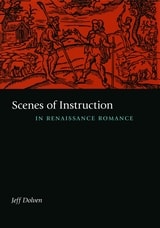
Scenes of Instruction in Renaissance Romance
Jeff Dolven
University of Chicago Press, 2007
We take it for granted today that the study of poetry belongs in school—but in sixteenth-century England, making Ovid or Virgil into pillars of the curriculum was a revolution. Scenes of Instruction in Renaissance Romance explores how poets reacted to the new authority of humanist pedagogy, and how they transformed a genre to express their most radical doubts.
Jeff Dolven investigates what it meant for a book to teach as he traces the rivalry between poet and schoolmaster in the works of John Lyly, Philip Sydney, Edmund Spenser, and John Milton. Drawing deeply on the era’s pedagogical literature, Dolven explores the links between humanist strategies of instruction and romance narrative, rethinking such concepts as experience, sententiousness, example, method, punishment, lessons, and endings. In scrutinizing this pivotal moment in the ancient, intimate contest between art and education, Scenes of Instruction in Renaissance Romance offers a new view of one of the most unconsidered—yet fundamental—problems in literary criticism: poetry’s power to please and instruct.

Scepticism and Hope in Twentieth Century Fantasy Literature
Kath Filmer
University of Wisconsin Press, 1992
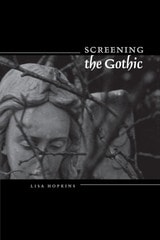
Screening the Gothic
By Lisa Hopkins
University of Texas Press, 2005
Filmmakers have long been drawn to the Gothic with its eerie settings and promise of horror lurking beneath the surface. Moreover, the Gothic allows filmmakers to hold a mirror up to their own age and reveal society's deepest fears. Franco Zeffirelli's Jane Eyre, Francis Ford Coppola's Bram Stoker's Dracula, and Kenneth Branagh's Hamlet are just a few examples of film adaptations of literary Gothic texts. In this ground-breaking study, Lisa Hopkins explores how the Gothic has been deployed in these and other contemporary films and comes to some surprising conclusions. For instance, in a brilliant chapter on films geared to children, Hopkins finds that horror resides not in the trolls, wizards, and goblins that abound in Harry Potter, but in the heart of the family.
Screening the Gothic offers a radical new way of understanding the relationship between film and the Gothic as it surveys a wide range of films, many of which have received scant critical attention. Its central claim is that, paradoxically, those texts whose affiliations with the Gothic were the clearest became the least Gothic when filmed. Thus, Hopkins surprises readers by revealing Gothic elements in films such as Sense and Sensibility and Mansfield Park, as well as exploring more obviously Gothic films like The Mummy and The Fellowship of the Ring. Written in an accessible and engaging manner, Screening the Gothic will be of interest to film lovers as well as students and scholars.
Scribit Mater
Marey and the Language Arts in the Literature of Medieval EnglandGeorgiana Donavin
Catholic University of America Press, 2012
Selected Writings of John V. Kelleher on Ireland and Irish America
John V. Kelleher. Edited by Charles Fanning
Southern Illinois University Press, 2002
A collection of eighteen critical essays and twenty-six translations spanning the career of one of the founding intellects of Irish Studies, the Selected Writings of John V. Kelleher on Ireland and Irish America consists of five accessible sections. The first gathers Kelleher’s essays on the most widely known Irish cultural phenomenon—the literary renaissance of the early twentieth century. Part two contains his judicious assessments of Irish literature in its post-Revolutionary phase. The third section includes Kelleher’s insightful essays on the experience of the Irish in America. The fourth section contains essays that examine early Irish literature and culture, opening with a benchmark essay for Irish Studies, “Early Irish History and Pseudo-History,” which was read at the inaugural meeting of the American Conference for Irish Studies in 1961. The collection concludes with Kelleher’s translations and adaptations of poems in Old, Middle, and Modern Irish, illustrating his command of the language at every stage.
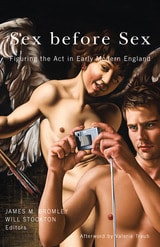
Sex before Sex
Figuring the Act in Early Modern EnglandJames M. Bromley
University of Minnesota Press, 2013
What is sex exactly? Does everyone agree on a definition? And does that definition hold when considering literary production in other times and places? Sex before Sex makes clear that we cannot simply transfer our contemporary notions of what constitutes a sex act into the past and expect them to be true for the people who were then reading literature and watching plays. The contributors confront how our current critical assumptions about definitions of sex restrict our understanding of representations of sexuality in early modern England.
Drawing attention to overlooked forms of sexual activity in early modern culture, from anilingus and interspecies sex to “chin-chucking” and convivial drinking, Sex before Sex offers a multifaceted view of what sex looked like before the term entered history. Through incisive interpretations of a wide range of literary texts, including Romeo and Juliet, The Comedy of Errors, Paradise Lost, the figure of Lucretia, and pornographic poetry, this collection queries what might constitute sex in the absence of a widely accepted definition and how a historicized concept of sex affects the kinds of arguments that can be made about early modern sexualities.
Contributors: Holly Dugan, George Washington U; Will Fisher, CUNY–Lehman College; Stephen Guy-Bray, U of British Columbia; Melissa J. Jones, Eastern Michigan U; Thomas H. Luxon, Dartmouth College; Nicholas F. Radel, Furman U; Kathryn Schwarz, Vanderbilt U; Christine Varnado, U of Buffalo–SUNY.
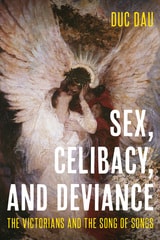
Sex, Celibacy, and Deviance
The Victorians and the Song of SongsDuc Dau
The Ohio State University Press, 2024
Sex, Celibacy, and Deviance is the first major study to explore the Song of Songs (or Song of Solomon) in Victorian literature and art. As the Bible’s only erotic poem, the Song of Songs is the canonical Judeo-Christian book about love, furnishing the Victorians with an authoritative and literary language for love, marriage, sex, mourning, and religious celibacy.
Duc Dau adopts a queer and feminist lens to consider how Victorians employed and interpreted the Song of Songs in their work. How did writers and artists fashion and, most importantly, challenge the norms of gender, romantic love, and marriage? Spanning the early Victorian era through the first two decades of the twentieth century, Sex, Celibacy, and Deviance considers the works of Charlotte Brontë, Thomas Hardy, Christina Rossetti, John Gray, Michael Field, Edward Burne-Jones, and Simeon Solomon alongside two lesser-known figures: Irish-born Scottish artist Phoebe Anna Traquair and the Catholic religious leader Augusta Theodosia Drane. By addressing the relevance of the Song of Songs in light of shifting and conflicting religious and social contexts, Dau provides a fresh perspective on Victorian literature, religion, and culture.
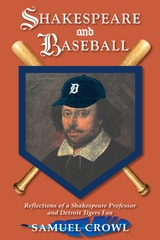
Shakespeare and Baseball
Reflections of a Shakespeare Professor and Detroit Tigers FanSamuel Crowl
Ohio University Press, 2024
Shakespeare's Once and Future Child
Speculations on SovereigntyJoseph Campana
University of Chicago Press, 2024
Politicians are fond of saying that “children are the future.” How did the child become a figure for our political hopes? Joseph Campana’s book locates the source of this idea in transformations of childhood and political sovereignty during the age of Shakespeare, changes spectacularly dramatized by the playwright himself. Shakespeare’s works feature far more child figures—and more politically entangled children—than other literary or theatrical works of the era. Campana delves into this rich corpus to show how children and childhood expose assumptions about the shape of an ideal polity, the nature of citizenship, the growing importance of population and demographics, and the question of what is or is not human. As our ability to imagine viable futures on our planet feels ever more limited, and as children take up legal proceedings to sue on behalf of the future, it behooves us to understand the way past child figures haunt our conversations about intergenerational justice. Shakespeare offers critical precedents for questions we still struggle to answer.
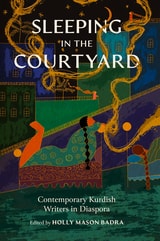
Sleeping in the Courtyard
Contemporary Kurdish Writers in DiasporaHolly Mason Badra
University of Arkansas Press, 2025
Sleeping in the Courtyard brings together historically isolated writers in community—and invites readers to join them around the table to share in their memories, secrets, tears, and joys. Featuring poetry, fiction, nonfiction, and graphic work by emerging and well-established writers, this collection shines a light on works by a diverse group of contemporary Kurdish women and nonbinary writers living in Kurdistan and in diaspora.
Recognizing the complex web of physical and lingual displacement of the Kurdish people and celebrating the diverse tapestry of their stories, this collection presents work originally written in English and work translated from Kurdish dialects as well as from Arabic, Turkish, Persian, and Swedish. A few works in Kurdish dialects appear alongside their translations, both in recognition of the experience of linguicide and to push against oppressive attempts to strip away Kurdish language.
Several works here explore the impact of the countless forms of militarized displacement, cultural destruction, and mass genocide that Kurds have endured. Other pieces illuminate Kurdish experiences of desire, friendship, empowerment, familial intricacies, and other topics spanning across universal human conditions. The writers in these pages take risks both in craft and content—and in some cases, just by daring to write and publish. What emerges in Sleeping in the Courtyard is the antithesis of erasure.
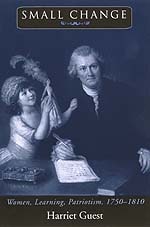
Small Change
Women, Learning, Patriotism, 1750-1810Harriet Guest
University of Chicago Press, 2000
During the second half of the eighteenth century, the social role of educated women and the nature of domesticity were the focus of widespread debate in Britain. The emergence of an identifiably feminist voice in that debate is the subject of Harriet Guest's new study, which explores how small changes in the meaning of patriotism and the relations between public and private categories permitted educated British women to imagine themselves as political subjects.
Small Change considers the celebration of learned women as tokens of national progress in the context of a commercial culture that complicates notions of gender difference. Guest offers a fascinating account of the women of the bluestocking circle, focusing in particular on Elizabeth Carter, hailed as the paradigmatic learned and domestic woman. She discusses the importance of the American war to the changing relation between patriotism and gender in the 1770s and 1780s, and she casts new light on Mary Wollstonecraft's writing of the 1790s, considering it in relation to the anti-feminine discourse of Hannah More, and the utopian feminism of Mary Hays.

Some Catholic Writers
Ralph McInerny
St. Augustine's Press, 2007

Spectacular Disappearances
Celebrity and Privacy, 1696-1801Julia H. Fawcett
University of Michigan Press, 2016
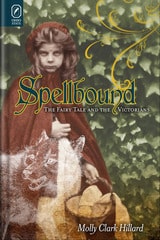
Spellbound
The Fairy Tale and the VictoriansMolly Clark Hillard
The Ohio State University Press, 2014
Through close readings of the novels of Dickens, Eliot, and Charlotte Brontë; the poetry of Tennyson and Christina Rossetti; the visual artistry of Burne-Jones and Punch; and the popular theatricals of dramatists like Planche and Buckingham, Spellbound opens fresh territory into well-traversed titles of the Victorian canon. Hillard demonstrates that these literary forms were all cross-pollenated by the fairy tale and that their authors were—however reluctantly—purveyors of disruptive fairy tale matter over which they had but imperfect control.
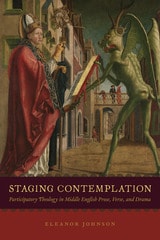
Staging Contemplation
Participatory Theology in Middle English Prose, Verse, and DramaEleanor Johnson
University of Chicago Press, 2018
Yet, in this groundbreaking new book, Eleanor Johnson argues instead for the pervasiveness and accessibility of contemplative works to medieval audiences. By drawing together ostensibly diverse literary genres—devotional prose, allegorical poetry, cycle dramas, and morality plays—Staging Contemplation paints late Middle English contemplative writing as a broad genre that operated collectively and experientially as much as through radical individual disengagement from the world. Johnson further argues that the contemplative genre played a crucial role in the exploration of the English vernacular as a literary and theological language in the fifteenth century, tracing how these works engaged modes of disfluency—from strained syntax and aberrant grammar, to puns, slang, code-switching, and laughter—to explore the limits, norms, and potential of English as a devotional language. Full of virtuoso close readings, this book demonstrates a sustained interest in how poetic language can foster a participatory experience of likeness to God among lay and devotional audiences alike.
Strange Meetings
Anglo-German Literary Encounters from 1910 to 1960Peter Edgerly Firchow
Catholic University of America Press, 2008
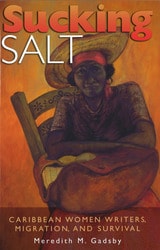
Sucking Salt
Caribbean Women Writers, Migration, and SurvivalMeredith M. Gadsby
University of Missouri Press, 2006