Results by title
83 books match the query 'Enlightenment' and 5 start with s
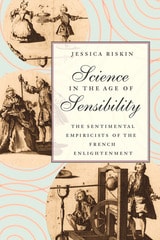
Science in the Age of Sensibility
The Sentimental Empiricists of the French EnlightenmentJessica Riskin
University of Chicago Press, 2002
Empiricism today implies the dispassionate scrutiny of facts. But Jessica Riskin finds that in the French Enlightenment, empiricism was intimately bound up with sensibility. In what she calls a "sentimental empiricism," natural knowledge was taken to rest on a blend of experience and emotion.
Riskin argues that sentimental empiricism brought together ideas and institutions, practices and politics. She shows, for instance, how the study of blindness, led by ideas about the mental and moral role of vision and by cataract surgeries, shaped the first school for the blind; how Benjamin Franklin's electrical physics, ascribing desires to nature, engaged French economic reformers; and how the question of the role of language in science and social life linked disputes over Antoine Lavoisier's new chemical names to the founding of France's modern system of civic education.
Recasting the Age of Reason by stressing its conjunction with the Age of Sensibility, Riskin offers an entirely new perspective on the development of modern science and the history of the Enlightenment.
[more]
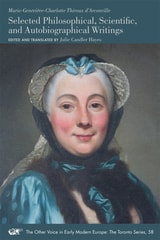
Selected Philosophical, Scientific, and Autobiographical Writings
Marie-Geneviève-Charlotte Thiroux d’Arconville
Iter Press, 2018
Marie-Geneviève-Charlotte Thiroux d’Arconville combined fierce intellectual ambition with the proper demeanor of the wife of a leading magistrate. Bemoaning her lack of a formal education in childhood, as an adult she read widely, studied languages, and sought out mentors among the scientific elite of the day. Always publishing anonymously, her works included moralist philosophy, scientific and literary translations, original scientific research, fiction, and history. Recently, a trove of unpublished essays and autobiographical writings from her final years, long thought to have been lost, has come to light, revealing her as a writer of insight, wit, and feeling.
Edited and translated by Julie Candler Hayes
The Other Voice in Early Modern Europe: The Toronto Series, volume 58
Edited and translated by Julie Candler Hayes
The Other Voice in Early Modern Europe: The Toronto Series, volume 58
[more]
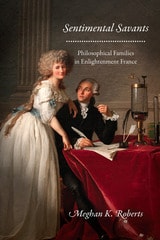
Sentimental Savants
Philosophical Families in Enlightenment FranceMeghan K. Roberts
University of Chicago Press, 2016
Though the public may retain a hoary image of the lone scientific or philosophical genius generating insights in isolation, scholars discarded it long ago. In reality, the families of scientists and philosophers in the Enlightenment played a substantial role, not only making space for inquiry within the home but also assisting in observing, translating, calculating, and illustrating.
Sentimental Savants is the first book to explore the place of the family among the savants of the French Enlightenment, a group that openly embraced their families and domestic lives, even going so far as to test out their ideas—from education to inoculation—on their own children. Meghan K. Roberts delves into the lives and work of such major figures as Denis Diderot, Émilie Du Châtelet, the Marquis de Condorcet, Antoine Lavoisier, and Jérôme Lalande to paint a striking portrait of how sentiment and reason interacted in the eighteenth century to produce not only new kinds of knowledge but new kinds of families as well.
Sentimental Savants is the first book to explore the place of the family among the savants of the French Enlightenment, a group that openly embraced their families and domestic lives, even going so far as to test out their ideas—from education to inoculation—on their own children. Meghan K. Roberts delves into the lives and work of such major figures as Denis Diderot, Émilie Du Châtelet, the Marquis de Condorcet, Antoine Lavoisier, and Jérôme Lalande to paint a striking portrait of how sentiment and reason interacted in the eighteenth century to produce not only new kinds of knowledge but new kinds of families as well.
[more]
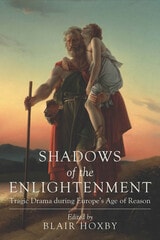
Shadows of the Enlightenment
Tragic Drama during Europe’s Age of ReasonEdited by Blair Hoxby
The Ohio State University Press, 2022
To refer to Enlightenment tragedy is to teeter on the brink of paradox. The eighteenth century is famous for its celebration and deployment of ideals such as optimism, reason, and human progress—ideals seemingly contradicted by the pessimism and passion of much classical tragedy. Moreover, tragedy in the Enlightenment is also often overlooked in favor of its illustrious seventeenth-century predecessors. In Shadows of the Enlightenment, an assemblage of respected experts specializing in classical, eighteenth-century, comparative, and modernist literary traditions offer a corrective analysis, proving that the Enlightenment was a critical period for tragic drama, during which the signature classical influences of the era coexisted with an emerging modern identity. By analyzing a highly diverse set of works—from Johann Christoph Gottsched to Voltaire to Joanna Baillie—with a rare pan-European scope, the contributors excavate the dynamic, and indeed paradoxical, entanglement of antiquity and modernity encapsulated by Enlightenment tragedy. Contributors: Joshua Billings, Logan J. Connors, Adrian Daub, Cécile Dudouyt, James Harriman-Smith, Joseph Harris, Alex Eric Hernandez, Blair Hoxby, Russ Leo, Larry F. Norman, Stefan Tilg
[more]
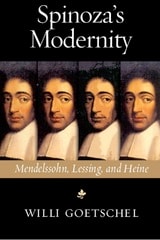
Spinoza's Modernity
Mendelssohn, Lessing, and HeineWilli Goetschel
University of Wisconsin Press, 2004
Spinoza’s Modernity is a major, original work of intellectual history that reassesses the philosophical project of Baruch Spinoza, uncovers his influence on later thinkers, and demonstrates how that crucial influence on Moses Mendelssohn, G. E. Lessing, and Heinrich Heine shaped the development of modern critical thought. Excommunicated by his Jewish community, Spinoza was a controversial figure in his lifetime and for centuries afterward. Willi Goetschel shows how Spinoza’s philosophy was a direct challenge to the theological and metaphysical assumptions of modern European thought. He locates the driving force of this challenge in Spinoza’s Jewishness, which is deeply inscribed in his philosophy and defines the radical nature of his modernity.
[more]