60 books match the query 'Environmental justice' and 3 start with s

cover of Song Walking: Women, Music, and Environmental Justice in an African Borderland

Song Walking

Women, Music, and Environmental Justice in an African Borderland

Angela Impey

University of Chicago Press, 2018

Song Walking explores the politics of land, its position in memories, and its foundation in changing land-use practices in western Maputaland, a borderland region situated at the juncture of South Africa, Mozambique, and Swaziland. Angela Impey investigates contrasting accounts of this little-known geopolitical triangle, offsetting textual histories with the memories of a group of elderly women whose songs and everyday practices narrativize a century of borderland dynamics. Drawing evidence from women’s walking songs (amaculo manihamba)—once performed while traversing vast distances to the accompaniment of the European mouth-harp (isitweletwele)—she uncovers the manifold impacts of internationally-driven transboundary environmental conservation on land, livelihoods, and local senses of place.

This book links ethnomusicological research to larger themes of international development, environmental conservation, gender, and local economic access to resources. By demonstrating that development processes are essentially cultural processes and revealing how music fits within this frame, Song Walking testifies to the affective, spatial, and economic dimensions of place, while contributing to a more inclusive and culturally apposite alignment between land and environmental policies and local needs and practices.
[more]
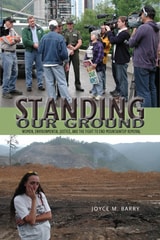
cover of Standing Our Ground: Women, Environmental Justice, and the Fight to End Mountaintop Removal

Standing Our Ground

Women, Environmental Justice, and the Fight to End Mountaintop Removal

Joyce M. Barry

Ohio University Press, 2012

Standing Our Ground: Women, Environmental Justice, and the Fight to End Mountaintop Removal examines women’s efforts to end mountaintop removal coal mining in West Virginia. Mountaintop removal coal mining, which involves demolishing the tops of hills and mountains to provide access to coal seams, is one of the most significant environmental threats in Appalachia, where it is most commonly practiced.

The Appalachian women featured in Barry’s book have firsthand experience with the negative impacts of Big Coal in West Virginia. Through their work in organizations such as the Coal River Mountain Watch and the Ohio Valley Environmental Coalition, they fight to save their mountain communities by promoting the development of alternative energy resources. Barry’s engaging and original work reveals how women’s tireless organizing efforts have made mountaintop removal a global political and environmental issue and laid the groundwork for a robust environmental justice movement in central Appalachia.
[more]
cover of Subjects of the Sun: Solar Energy in the Shadows of Racial Capitalism

Subjects of the Sun

Solar Energy in the Shadows of Racial Capitalism

Myles Lennon

Duke University Press, 2025

In the face of accelerating climate change, anticapitalist environmental justice activists and elite tech corporations increasingly see eye to eye. Both envision solar-powered futures where renewable energy redresses gentrification, systemic racism, and underemployment. However, as Myles Lennon argues in Subjects of the Sun, solar power is no less likely to exploit marginalized communities than dirtier forms of energy. Drawing from ethnographic research on clean energy corporations and community solar campaigns in New York City, Lennon argues that both groups overlook solar’s extractive underside because they primarily experience energy from the sun in the virtual world of the cloud. He shows how the material properties of solar technology—its shiny surfaces, decentralized spatiality, and modularity—work closely with images, digital platforms, and quantitative graphics to shape utopic visions in which renewable energy can eradicate the constitutive tensions of racial capitalism. As a corrective to this virtual world, Lennon calls for an equitable energy transition that centers the senses and sensibilities neglected by screenwork: one’s haptic care for their local environment; the full-bodied feel of infrastructural labor; and the sublime affect of the sun.
[more]