Results by title
118 books match the query 'Epistemology' and 14 start with s
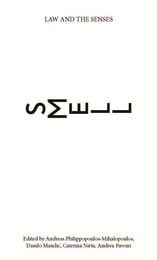
SMELL
Andrea Pavoni, Danilo Mandic, Caterina Nirta and Andreas Philippopoulos-Mihalopoulos
University of Westminster Press, 2023
Although somewhat marginal in relation to the other senses, smell is the most potent way of anchoring ourselves to the world. We subconsciously find our place in it by sniffing our body, the body of the one next to us, the room in which we are, the culture with which we are familiar. There is an incessant olfactory flow consisting of bodies, human and nonhuman, that are agents of generation, consumption, diffusion, reproduction and dissolution of odours. As they move or pause, as they cluster with others or try to move away, these bodies constantly partake in this olfactory flow, this dense planetary swirl that leaves nothing outside.
The law aims at presenting itself as rational and objective. Smell, on the other hand, is one of the least integrated senses in the legal edifice, in comparison to, say, seeing and hearing. This can be attributed mainly to the fact that sense-making of smell and law are different, even antithetical. Smell operates undercurrent, tickling the olfactory antennas of individual and collective bodies while habitually hiding behind other sensory volumes. Law, on the other hand, has an interest in appearing present, universal, constant. Olfactory sense-making relies on its elusiveness; legal sense-making invests in its obviousness. Yet, the two can interact in most unexpected ways, as this volume amply shows. If anything, smell airs the way in which law conceptualises and contextualises its own actuality. Smell brings law forth by allowing it to show its underbelly, its elusive sense-making that is invariably sacrificed in preference to the necessity of legal impressions of constancy. However, smell’s fragmentary, discontinuous and unstable nature, despite all the ordering that goes to it, poses a peculiar challenge to the law. This volume sets out to investigate this juncture.
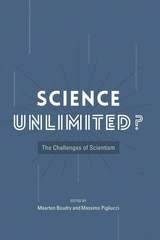
Science Unlimited?
The Challenges of ScientismEdited by Maarten Boudry and Massimo Pigliucci
University of Chicago Press, 2017
In this wide-ranging collection, contributors ask whether the term scientism in fact (or in belief) captures an interesting and important intellectual stance, and whether it is something that should alarm us. Is scientism a well-developed position about the superiority of science over all other modes of human inquiry? Or is it more a form of excessive confidence, an uncritical attitude of glowing admiration? What, if any, are its dangers? Are fears that science will marginalize the humanities and eradicate the human subject—that it will explain away emotion, free will, consciousness, and the mystery of existence—justified? Does science need to be reined in before it drives out all other disciplines and ways of knowing? Both rigorous and balanced, Science Unlimited? interrogates our use of a term that is now all but ubiquitous in a wide variety of contexts and debates. Bringing together scientists and philosophers, both friends and foes of scientism, it is a conversation long overdue.

Science and Relativism
Some Key Controversies in the Philosophy of ScienceLarry Laudan
University of Chicago Press, 1990
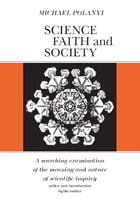
Science, Faith and Society
Michael Polanyi
University of Chicago Press, 1964
Polanyi aims to show that science must be understood as a community of inquirers held together by a common faith; science, he argues, is not the use of "scientific method" but rather consists in a discipline imposed by scientists on themselves in the interests of discovering an objective, impersonal truth. That such truth exists and can be found is part of the scientists' faith. Polanyi maintains that both authoritarianism and scepticism, attacking this faith, are attacking science itself.
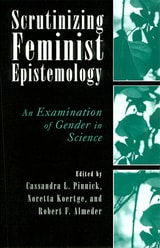
Scrutinizing Feminist Epistemology
An Examination of Gender in SciencePinnick, Cassandra
Rutgers University Press, 2003
This volume presents the first systematic evaluation of a feminist epistemology of sciences’ power to transform both the practice of science and our society. Unlike existing critiques, this book questions the fundamental feminist suggestion that purging science of alleged male biases will advance the cause of both science and by extension, social justice.
The book is divided into four sections: the strange status of feminist epistemology, testing feminist claims about scientific practice, philosophical and political critiques of feminist epistemology, and future prospects of feminist epistemology. Each of the essays¾most of which are original to this text¾ directly confronts the very idea that there could be a feminist epistemology or philosophy of science. Rather than attempting to deal in detail with all of the philosophical views that fall under the general rubric of feminist epistemology, the contributors focus on positions that provide the most influential perspectives on science. Not all of the authors agree amongst themselves, of course, but each submits feminist theories to careful scrutiny. Scrutinizing Feminist Epistemology provides a timely, well-rounded, and much needed examination of the role of gender in scientific research.
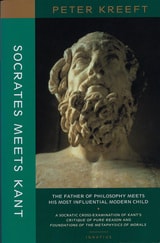
Socrates Meets Kant
The Father of Philosophy Meets His Most Influential Modern ChildPeter Kreeft
St. Augustine's Press, 2009
Kreeft’s Socrates reflects what the historical philosopher would likely have made of Kant’s ideas, while also recognizing the greatness, genius, and insightfulness of Kant. The result is a helpful, highly readable, even amusing book. Kant’s philosopher of knowing truly is a “Copernican revolution in philosophy,” as he himself dubbed it. His ethics intended to set out the rational grounds for morality. Did he achieve his goals? What would Socrates say about the matter?
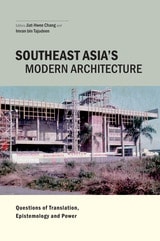
Southeast Asia's Modern Architecture
Questions of Translation, Epistemology and PowerEdited by Jiat-Hwee Chang and Imran bin Tajudeen
National University of Singapore Press, 2018
Southern Epistemologies
Knowledge, Wisdom, and Understanding in the Andes and Western AmazonEdited by H. Clark Barrett, Michael L. Cepek, Pablo Quintanilla, Emanuele Fabiano, and Edouard Machery
HAU, 2026
What does it mean to know, and how is knowledge practiced? How can Indigenous perspectives challenge conventional concepts of knowledge in the Global North? Drawing on Indigenous epistemologies from the Andes and Western Amazon, Southern Epistemologies investigates how knowledge, wisdom, and understanding are shaped by local cultures, languages, bodies, and environments.
Bringing together linguists, philosophers, anthropologists, and Indigenous knowledge holders, the volume examines the dynamic interactions between culture, language, and place, showing how the unique linguistic histories and worldviews of Andean and Amazonian societies inform distinct ways of knowing. By interpreting these perspectives on their own terms, the book offers fresh insights into the plurality and diversity of human knowledge.
As the first volume specifically focused on Indigenous South American epistemologies, Southern Epistemologies foregrounds Indigenous knowledge systems and science while fostering dialogue with academic traditions. By opening new interdisciplinary and cross-cultural conversations, this groundbreaking volume challenges conventional notions of knowledge and illuminates how engagement with Indigenous perspectives can expand and enrich our understanding of what it truly means to know.
Speculative Formalism
Literature, Theory, and the Critical PresentTom Eyers
Northwestern University Press, 2017
Through a combination of philosophical reflection and close rhetorical readings, Eyers explores the possibilities and limits of deconstructive approaches to the literary, the impact of the “digital humanities” on theory, and the prospects for a formalist approach to “world literature.” The book includes sustained close readings of Baudelaire, Mallarmé, Yeats, and Wallace Stevens, as well as Alain Badiou, Paul de Man, and Fredric Jameson.
Steps to an Ecology of Mind
Collected Essays in Anthropology, Psychiatry, Evolution, and EpistemologyGregory Bateson
University of Chicago Press, 2000
Structure and Thought
Toward a Materialist Theory of Representational CognitionDaniel Sacilotto; Foreword by Ray Brassier
Northwestern University Press, 2024
This study develops a novel account of representational cognition, explaining how cognitive systems progressively come to map the structure of their worlds. Daniel Sacilotto offers a constructive response to the critique of representation formulated throughout the post‑Kantian philosophical tradition. Rather than a skepticism or idealism whereby thinking can grasp appearances but never the real, representation, Sacilotto shows, is a constitutive dimension of cognitive systems’ creative capacity to know and intervene in the world of which they are part.
Structure and Thought: Toward a Materialist Theory of Representational Cognition integrates various lines in contemporary philosophy, including those often seen as incommensurable or in irresolvable tension with one another. Sacilotto thus advances a productive synthesis of a materialist ambition to provide a creative and historical understanding of cognition with a structural realist account of representation. He shows how the different forms of sensory, discursive, and theoretical mediation that characterize human cognition are conducive to a realist epistemological framework that explains how the possibility of knowledge about a mind‑independent reality is conceivable.

Studies in Epistemology
Peter A. French, Theodore E. Uehling Jr., and Howard K. Wettstein, Editors
University of Minnesota Press, 1980
Studies in Epistemology was first published in 1980. Minnesota Archive Editions uses digital technology to make long-unavailable books once again accessible, and are published unaltered from the original University of Minnesota Press editions.
This is Volume V in the series Midwest Studies in Philosophy
In 1979 the University of Minnesota Press assumed publication of the annual Midwest Studies in Philosophy, previously published by the University of Minnesota, Morris. At that time, the young series had already received acclaim from philosophers. Alan Donagan called the Studies "a significant and up-to-date forum of discussion on topics that matter to all serious philosophers," and, according to W. V. Quine, the Studies have maintained "an unusually high standard."
Studies in Metaphysics
Peter A. French, Theodore E. Uehling Jr., and Howard K. Wettstein, Editors
University of Minnesota Press, 1979
Studies in Metaphysics was first published in 1979. Minnesota Archive Editions uses digital technology to make long-unavailable books once again accessible, and are published unaltered from the original University of Minnesota Press editions.
Surviving the Age of Virtual Reality
Thomas Langan
University of Missouri Press, 2000
As the technological phenomenon known as the worldwide web permeates civilization, it creates some cultures and destroys others. In this pioneering book, philosopher Thomas Langan explores "virtual reality"Can inherently contradictory phrase"and the effects of technology on our very being. In our present-day high- technology environment, making simple, everyday decisions is difficult because the virtual world we've created doesn't necessarily operate according to the old "common sense." To retain our intellectual fitness, we must, Langan argues, consider these essential questions: If virtual reality is, in fact, reality, what is this life that we are caught up in? What is being within the context of virtual reality? How can we establish a system for distinguishing truth from fiction?
Although technology minimizes distances between people and makes the information they seek more accessible, it simultaneously blurs the line dividing fact from falsehood and real from virtual. An individual's intellectual survival is threatened as technological advancement challenges our collective understanding of what reality is. Because much of the information that is presented as fact simply works to fulfill a specific agenda, we cannot accept as truth everything that appears on the internet or in the media. To survive, we must learn to manage our lives and resources despite the flood of information we are bombarded with daily.
Addressing the general educated reader, Surviving the Age of Virtual Reality expertly interweaves the worlds of technology and philosophy, pushing the analysis of this technological and human phenomenon to new depths.