Results by title
98 books match the query 'Existentialism' and 9 start with s

Sade My Neighbor
Pierre Klossowski
Northwestern University Press, 1991
Klossowski was one of the first philosophers in postwar Europe to ask whether Sade's reason, although aberrant and perverted to evil passions, could be taken seriously. Klossowski's seminal work inspired virtually all subsequent study of Sadean thought, including that of de Beauvoir, Deleuze, Derrida, Bataille, Blanchot, Paulhan, and Lacan.
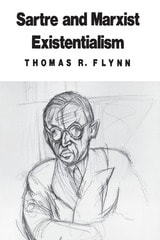
Sartre and Marxist Existentialism
The Test Case of Collective ResponsibilityThomas R. Flynn
University of Chicago Press, 1986
The study begins with an examination of the uses of "responsibility" in Being and Nothingness and in several postwar essays. Flynn then concentrates on the Critique of Dialectical Reason, offering a thorough analysis of the remarkable social theory Sartre constructs there. A masterful contribution to Sartre scholarship, Sartre and Marxist Existentialism will be of great interest to social and political philosophers involved in the debate over collective responsibility.
Sartre, Foucault, and Historical Reason, Volume One
Toward an Existentialist Theory of HistoryThomas R. Flynn
University of Chicago Press, 1997
A history, thought Foucault, should be a kind of map, a comparative charting of structural transformations and displacements. But for Sartre, authentic historical understanding demanded a much more personal and committed narrative, a kind of interpretive diary of moral choices and risks compelled by critical necessity and an exacting reality. Sartre's history, a rational history of individual lives and their intrinsic social worlds, was in essence immersed in biography.
In Volume One of this authoritative two-volume work, Thomas R. Flynn conducts a pivotal and comprehensive reconstruction of Sartrean historical theory, and provocatively anticipates the Foucauldian counterpoint to come in Volume Two.

Self-Awareness and Alterity
A Phenomenological InvestigationDan Zahavi
Northwestern University Press, 2020
As a contribution to the current philosophical debate concerning self-awareness, the book presents a comprehensive reconstruction of Husserl’s theory of pre-reflective self-awareness, thereby criticizing a number of prevalent interpretations. In addition, Zahavi also offers a systematic discussion of a number of phenomenological insights related to the issue of self-awareness, including analyses of the temporal, intentional, reflexive, bodily, and social nature of the self.
The new edition of this prize-winning book has been updated and revised, and all quotations have been translated into English. It also contains a new preface in which Zahavi traces the developments of the debates around self-awareness over the last twenty years and situates this book in the context of his subsequent work.

Self-Relation
A Phenomenology of AmbiguityEllie Anderson
Northwestern University Press, 2027
A perceptive new look at the perennial subject of selfhood
In the wake of the so-called death of the subject, some philosophers within or adjacent to phenomenology have come to embrace the idea that the self does indeed exist but is multiplicitous in nature. Many today appeal to the idea that the self is therefore relational: that the self exists only in and through its relations to others. Though this is true, there is also more to the relationality of the self than the fact that we are always relating to what is beyond ourselves. In this book, Ellie Anderson argues that the defining feature of the self is that it is self-relating. That is, the self has identity by virtue of its own self-relationality.
Anderson develops a relational account of the self, drawing on the French philosophical tradition of existential phenomenology—in particular, Jean-Paul Sartre, Maurice Merleau-Ponty, and Simone de Beauvoir. Anderson contends that a throughline in their work is an emergent account of self-relation, which both provides a phenomenologically grounded alternative to some of the more popular views of the self today and highlights the ethical character of the self. Through novel approaches to the topics of self-objectification, bad faith, self-affection, and responsibility, Self-Relation develops an account of the self as having a peculiar kind of identity—ipseity—that is grounded in the structure of consciousness, and a selfhood that not only accommodates but also requires difference.

Sense and Non-Sense
Maurice Merleau-Ponty
Northwestern University Press, 1992
The first part of Sense and Non-Sense, "Arts," is concerned with Merleau-Ponty's concepts of perception, which were advanced in his major philosophical treatise, Phenomenology of Perception. Here the analysis is focused and enriched in descriptions of the perceptual world of Cezanne, the encounter with the Other as expressed in the novels of Simone de Beauvoir and Sartre, and the gestalt quality of experience brought out in the film art form. In the second part, "Ideas," Merleau-Ponty shows how the categories of the phenomenology of perception can be understood as an outgrowth of the behavioral sciences and how a model of existence based on perception sensitizes us to the insights and limitations of previous philosophies and suggests constructive criticisms of contemporary philosophy. The third part, "Politics," clarifies the political dilemmas facing intellectuals in postwar France.
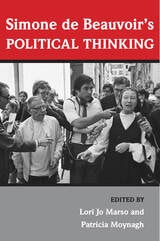
Simone de Beauvoir’s Political Thinking
Edited by Lori Jo Marso and Patricia Moynagh
University of Illinois Press, 2006
By exploring the life and work of the influential feminist thinker Simone de Beauvoir, this book shows how each of us lives within political and social structures that we can--and must--play a part in transforming. It argues that Beauvoir’s careful examination of her own existence can also be understood as a dynamic method for political thinking.
As the contributors illustrate, Beauvoir's political thinking proceeds from the bottom up, using examples from individual lives as the basis for understanding and transforming our collective existence. For example, she embraced her responsibility as a French citizen as making her complicit in the French war against Algeria. Here, she sees her role as an oppressor. In other contexts, she looks to the lives of individual women, including herself, to understand the dimensions of gender inequality.
This volume’s six tightly connected essays home in on the individual’s relationship to community, and how one’s freedom interacts with the freedom of other people. Here, Beauvoir is read as neither a liberal nor a communitarian. The authors focus on her call for individuals to realize their freedom while remaining consistent with ethical obligations to the community. Beauvoir's account of her own life and the lives of others is interpreted as a method to understand individuals in relations to others, and as within structures of personal, material, and political oppression. Beauvoir's political thinking makes it clear that we cannot avoid political action. To do nothing in the face of oppression denies freedom to everyone, including oneself.
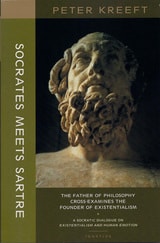
Socrates Meets Sartre
The Father of Philosophy Cross-examines the Founder of ExistentialismPeter Kreeft
St. Augustine's Press, 2005
Kreeft takes the reader through the world of existentialist philosophy, posing questions that challenge the concepts that Sartre proposed. Based on an imagination dialogue between Socrates and Sartre that takes place in the afterlife, this profound and witty book makes an entertaining and informative exploration of modern philosophy
“Peter Kreeft’s work is (1) unfailingly brilliant, (2) intellectually agile, (3) astonishingly perspicacious, (4) gloriously orthodox, (5) Chestertonian aphoristic.” – Thomas Howard, author of On Being Catholic
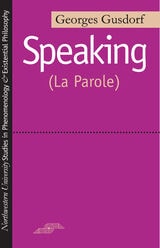
Speaking
(La Parole)Georges Gusdorf
Northwestern University Press, 1965