207 books match the query 'Feminist theory' and 13 start with s
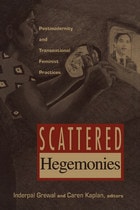
cover of Scattered Hegemonies: Postmodernity and Transnational Feminist Practices

Scattered Hegemonies

Postmodernity and Transnational Feminist Practices

Inderpal Grewal

University of Minnesota Press, 1994

[more]
cover of Sciences from Below: Feminisms, Postcolonialities, and Modernities

Sciences from Below

Feminisms, Postcolonialities, and Modernities

Sandra Harding

Duke University Press, 2008

In Sciences from Below, the esteemed feminist science studies scholar Sandra Harding synthesizes modernity studies with progressive tendencies in science and technology studies to suggest how scientific and technological pursuits might be more productively linked to social justice projects around the world. Harding illuminates the idea of multiple modernities as well as the major contributions of post-Kuhnian Western, feminist, and postcolonial science studies. She explains how these schools of thought can help those seeking to implement progressive social projects refine their thinking to overcome limiting ideas about what modernity and modernization are, the objectivity of scientific knowledge, patriarchy, and Eurocentricity. She also reveals how ideas about gender and colonialism frame the conventional contrast between modernity and tradition. As she has done before, Harding points the way forward in Sciences from Below.

Describing the work of the post-Kuhnian science studies scholars Bruno Latour, Ulrich Beck, and the team of Michael Gibbons, Helga Nowtony, and Peter Scott, Harding reveals how, from different perspectives, they provide useful resources for rethinking the modernity versus tradition binary and its effects on the production of scientific knowledge. Yet, for the most part, they do not take feminist or postcolonial critiques into account. As Harding demonstrates, feminist science studies and postcolonial science studies have vital contributions to make; they bring to light not only the male supremacist investments in the Western conception of modernity and the historical and epistemological bases of Western science but also the empirical knowledge traditions of the global South. Sciences from Below is a clear and compelling argument that modernity studies and post-Kuhnian, feminist, and postcolonial sciences studies each have something important, and necessary, to offer to those formulating socially progressive scientific research and policy.

[more]
cover of Scrap Theory: Reproductive Injustice in the Black Feminist Imagination

Scrap Theory

Reproductive Injustice in the Black Feminist Imagination

Mali D. Collins

The Ohio State University Press, 2025

Reproductive justice debates have often focused on the right to not have children, but rarely do they address the right to remember children lost to violence. Turning her attention to visual and written works by Black women documenting mother–child separation, Mali D. Collins invites us to deploy a theory of “scraps” to understand the ways that the lives of Black mothers and children are documentations of centuries of racialized and gendered torment. Focusing on creative works from the late twentieth century through the present, including the writings of Toni Cade Bambara, M. NourbeSe Philip, and Edwidge Danticat; the critical activism of Erica Garner; and visual/material art by Samaria Rice and Elizabeth Catlett, Collins argues that Black women’s creative work should be recognized as memory work that plays a crucial role in the cultural processing of racial and maternal trauma. By centering creative scraps—interstitial, fragmentary, or discarded elements—of maternal dispossession, Scrap Theory brings together theories of archival injustice and reproductive injustice to illuminate how the archival erasure of Black motherhood is an urgent concern for the movement for reproductive justice.
[more]
cover of Searching for Sycorax: Black Women's Hauntings of Contemporary Horror

Searching for Sycorax

Black Women's Hauntings of Contemporary Horror

Brooks, Kinitra D

Rutgers University Press, 2018

Searching for Sycorax highlights the unique position of Black women in horror as both characters and creators. Kinitra D. Brooks creates a racially gendered critical analysis of African diasporic women, challenging the horror genre’s historic themes and interrogating forms of literature that have often been ignored by Black feminist theory. Brooks examines the works of women across the African diaspora, from Haiti, Trinidad, and Jamaica, to England and the United States, looking at new and canonized horror texts by Nalo Hopkinson, NK Jemisin, Gloria Naylor, and Chesya Burke. These Black women fiction writers take advantage of horror’s ability to highlight U.S. white dominant cultural anxieties by using Africana folklore to revise horror’s semiotics within their own imaginary. Ultimately, Brooks compares the legacy of Shakespeare’s Sycorax (of The Tempest) to Black women writers themselves, who, deprived of mainstream access to self-articulation, nevertheless influence the trajectory of horror criticism by forcing the genre to de-centralize whiteness and maleness.  
[more]
cover of See Me Naked: Black Women Defining Pleasure in the Interwar Era

See Me Naked

Black Women Defining Pleasure in the Interwar Era

Tara T. Green

Rutgers University Press, 2022

Pleasure refers to the freedom to pursue a desire, deliberately sought in order to satisfy the self. Putting pleasure first is liberating. During their extraordinary lives, Lena Horne, Moms Mabley, Yolande DuBois, and Memphis Minnie enjoyed pleasure as they gave pleasure to both those in their lives and to the public at large. They were Black women who, despite their public profiles, whether through Black society or through the world of entertainment, discovered ways to enjoy pleasure.They left home, undertook careers they loved, and did what they wanted, despite perhaps not meeting the standards for respectability in the interwar era. See Me Naked looks at these women as representative of other Black women of the time, who were watched, criticized, and judged by their families, peers, and, in some cases, the government, yet still managed to enjoy themselves. Among the voyeurs of Black women was Langston Hughes, whose novel Not Without Laughter was clearly a work of fiction inspired by women he observed in public and knew personally, including Black clubwomen, blues performers, and his mother. How did these complicated women wrest loose from the voyeurs to define their own sense of themselves? At very young ages, they found and celebrated aspects of themselves. Using examples from these women’s lives, Green explores their challenges and achievements.
[more]
cover of Sex Isn't Real: The Invention of an Incoherent Binary

Sex Isn't Real

The Invention of an Incoherent Binary

Beans Velocci

Duke University Press, 2026

In Sex Isn’t Real, Beans Velocci traces the history of current high stakes attempts to define sex and to create a world devoid of trans life. Drawing on lab notes, family genealogies, medical case studies, and more, Velocci follows scientists and clinicians from the mid-nineteenth through the mid-twentieth century and across five disciplines—zoology, eugenics, gynecology, statistical sexology, and transsexual medicine—as their ideas and practices created a definitional tangle. They demonstrate how the sorting of bodies into male and female persists not despite but because of sex’s incoherence: the defining features of these categories shift to contain various understandings of anatomy and physiology, theories of race, developments in research and medical methodologies, and bodies that cannot be accounted for in a binary framework. Exposing the endless work required to produce a world in which most people have a binary gender identity that neatly fits their binarily sexed body, Velocci demonstrates that it is not cis people who fit the categories; it’s the categories that flex to make them fit.
[more]
cover of Shock and Yawn: Resisting Banal Terror Through Queer Storytelling

Shock and Yawn

Resisting Banal Terror Through Queer Storytelling

Megan Sibbett

The Ohio State University Press, 2026

In Shock and Yawn, Megan Sibbett confronts state-sanctioned, mundane violence committed in the name of protection and argues that queer storytelling is an ideal avenue for recognizing, theorizing, and subverting it: Through queer stories, we have a direct window into the real-world ramifications of violence that purports to be for the public good. This violence, reinforced and normalized through surveillance campaigns, failure-to-protect laws, border policies, and government messaging, is obscured by both its banality and its benevolent veneer, in which children, or imagined children, are central to its logic of protection.

Building on queer theorists’ critiques of intimate and administrative violence, especially Gloria Anzaldúa’s “intimate terrorism,” Sibbett develops methodologies for conceptualizing and subverting violence aimed at queer, racialized, and gendered bodies in this era of surveillance and increasing authoritarianism. Sibbett addresses book bans, anti-trans legislation, idealized histories of westward expansion, and more, examining materials that include public service announcements, advertising, social media, news reports, poems, interviews, and novels. In so doing, she demonstrates the crucial role queer testimonies—and queer histories and queer futures—play in revealing systemic violence and illuminating the transformative potential of everyday resistance.

[more]
cover of Skeptical Feminism: Activist Theory, Activist Practice

Skeptical Feminism

Activist Theory, Activist Practice

Carolyn Dever

University of Minnesota Press, 2003

A clarion call for a new approach to feminist thought

In this major work, Carolyn Dever considers the ambivalence or outright hostility many feminists feel toward theory, arguing that a fundamental skepticism toward abstraction has been vital to the development of the movement.

Dever analyzes the politics of feminist theory by looking at its popular, activist, and academic modes, from the liberation movements of the 1970s to gender and queer studies now. Using key moments in the history of modern feminism-consciousness-raising, best-selling books like Sexual Politics by Kate Millett and The Women’s Room by Marilyn French, and media representations of women’s struggle for equality—Dever outlines heated debates over psychoanalysis, sexuality, and activism. The abstract and the grounded converge in discussions about the relationship between the feminist mind and the feminist body and in the preoccupation, both uneasy and utopian, with lesbian sexuality. Powerful, illuminating, and galvanizing, Skeptical Feminism traces the strategies the women’s movement has used to make theory matter—and points toward a new, politically engaged approach to feminist thought.

[more]
cover of Space, Place, and Gender

Space, Place, and Gender

Doreen Massey

University of Minnesota Press, 1994

A leading feminist geographer puts forth new ways of thinking about space and place. In these days of global acceleration on the one hand and intensifying local nationalisms on the other, how should we be thinking about space and place? This new book brings together Doreen Massey's key writings on this debate. In it she argues that we have seen some problematical readings of both terms in recent years, and she proposes an alternative approach more adequate to the issues facing the social sciences today. Massey has organized these debates around the three themes of space, place, and gender. She traces the development of ideas about the social structure of space and place, and the relation of both to issues of gender and certain debates within feminism. Beginning with the economy and social structures of production, Massey develops a wider notion of spatiality as the product of intersecting social relations. On this basis she proposes an approach to "places" that is essentially open and hybrid while always provisional and contested. The themes intersect with much current thinking about identity within feminism and cultural studies. The chapters range from studies of the concepts of place employed in debates on uneven regional development and inner-city problems to arguments about the relationship between the conceptualization of space/place and the social construction of gender relations. "This book presents a collection of Massey's writings that have appeared over the last two decades. The volume is, however, more than a sum of its parts, in that Massey uses commentaries throughout the book to delineate an intellectual trajectory in Anglo geography that connects the concerns of economic geography with critiques and extensions by feminist and postcolonial writers. Massey builds a multifaceted argument of the richness of geographical analysis and its centrality for contemporary social theory debates." Professional Geographer "In a compilation of essays spanning over fifteen years, Space, Place and Gender, Doreen Massey explores the intricate and profound connection of space and place with gender and the construction of gender relations. Spaces and places are gendered, she argues, at once reflecting and affecting how gender is understood." Harvard Design Magazine Doreen Massey is professor of geography at the Open University in the United Kingdom. She is the author of five books, including Spatial Divisions of Labour (1984) and, with David Weild and Paul Quintas, High-Tech Fantasies (1991).
[more]
cover of Spectacles Of Realism: Gender, Body, Genre

Spectacles Of Realism

Gender, Body, Genre

Margaret Cohen

University of Minnesota Press, 1995

A rethinking of realism that reveals its relevance to sexual and cultural politics.

Despite rumors of its demise in literary theory and practice, realism persists. Why this is, and how realism is relevant to current interdisciplinary debates in gender studies and cultural studies, are the questions underlying Spectacles of Realism. With particular reference to nineteenth-century French culture, the contributors explore the role realism has played in the social construction of gender and sexuality. Among their subjects are nineteenth-century physiologies, photographs, caricatures, and Balzac’s Comédie humaine; the ethnographic claims of Goncourt’s naturalism and the historical claims of Zola’s; and the allure of exotica displayed at new museums and international expositions.

Contributors: April Alliston, Princeton U; Emily Apter, UCLA; Charles Bernheimer, U of Pennsylvania; Rhonda Garelick; Judith Goldstein, Vassar; Anne Higonnet, Wellesley; Roger Huss, Queen Mary and Westfield College; Dorothy Kelly, Boston U; Diana Knight, U of Nottingham; Jann Matlock, Harvard U; Linda Nochlin, NYU; Patrick O’Donovan, King’s College; Vanessa Schwartz, American U; Naomi Segal, U of Reading; Barbara Vinken, NYU.

[more]
cover of Strange Tastes: Aesthetics and the Public in Latin American and Latinx Feminisms

Strange Tastes

Aesthetics and the Public in Latin American and Latinx Feminisms

Monique Roelofs

Duke University Press, 2026

Strange Tastes is a philosophical excursion into aesthetic experience and the public through the works of contemporary Latin American and Latinx women writers and artists. In a careful study of this revelatory archive, Monique Roelofs shows how life lived aesthetically can embrace public space instead of surrendering it to the constrictive forces of gendering and racial capital. Joining notions of sensibility grounded in Enlightenment aesthetics with the creative capabilities of a decolonial aesthetics, Roelofs looks to practices that animate the public through intimate, social, and political registers, particularly by engaging the historical and critical potentialities of disinterested play and what she calls “strange tastes,” or the unusual, uncanny, and nonnormative desires and sensations of marginalized individuals. Through sustained attention to materiality and lived experience, Roelofs offers a feminist philosophy of aesthetics that takes seriously the role of the public, where strange tastes turn aesthetic imaginaries into powerful possibilities to remake self, city, nation, and world.
[more]
cover of Surrender: Feminist Rhetoric and Ethics in Love and Illness

Surrender

Feminist Rhetoric and Ethics in Love and Illness

Jessica Restaino

Southern Illinois University Press, 2019

Winner, CCCC Outstanding Book Award, 2020

One of Library Journal's Top 20 Best-Selling Language Titles of 2019
 
In an ethnographic study spanning the last years of research collaborator and friend Susan Lundy Maute’s life with terminal breast cancer, author Jessica Restaino argues the interpretative challenges posed by research and writing amid illness and intimacy demand a methodological break from accepted genres and established practices of knowledge making. Restaino searches their experiences—recorded in interviews, informal writings, and correspondence—to discover a rhetoric of love and illness. She encourages a synthesis of methods and the acceptance of a reversal of roles—researcher and researched, writer and written-about—and emphasizes the relevancy of methodological diversity, the necessity of the personal, and the analytical richness of unpredictability and risk in being who we are in our scholarship at any given moment.
 
Bringing together critical analysis, qualitative-style research methods, close reading, Surrender: Feminist Rhetoric and Ethics inLove and Illness resists traditional ideas about academic writing and invites others to pursue collaborations that subvert accepted approaches to representation, textual production, and subjectivity. Restaino demonstrates a way of writing—the rendering of the academic text itself—that suggests how we do our work has resonance for what we produce. She offers framing questions for use by others interested in doing similar kinds of scholarship that may frighten, overwhelm, or confound. This book deepens our understanding of subjectivity and the gains made by feminist resistance to conventional concepts of objectivity in research collaborations.
[more]
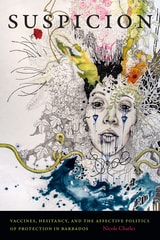
cover of Suspicion: Vaccines, Hesitancy, and the Affective Politics of Protection in Barbados

Suspicion

Vaccines, Hesitancy, and the Affective Politics of Protection in Barbados

Nicole Charles

Duke University Press, 2021

In 2014 Barbados introduced a vaccine to prevent certain strains of the human papillomavirus (HPV) and reduce the risk of cervical cancer in young women. Despite the disproportionate burden of cervical cancer in the Caribbean, many Afro-Barbadians chose not to immunize their daughters. In Suspicion, Nicole Charles reframes Afro-Barbadian vaccine refusal from a question of hesitancy to one of suspicion. Drawing on ethnographic fieldwork, black feminist theory, transnational feminist studies and science and technology studies, Charles foregrounds Afro-Barbadians' gut feelings and emotions and the lingering trauma of colonial and biopolitical violence. She shows that suspicion, far from being irrational, is a fraught and generative affective orientation grounded in concrete histories of mistrust of government and coercive medical practices foisted on colonized peoples. By contextualizing suspicion within these longer cultural and political histories, Charles troubles traditional narratives of vaccine hesitancy while offering new entry points into discussions on racialized biopolitics, neocolonialism, care, affect, and biomedicine across the Black diaspora.

Duke University Press Scholars of Color First Book Award recipient
[more]