Results by title
50 books match the query 'Field' and 4 start with s
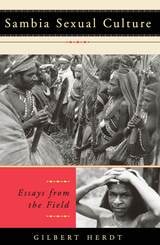
Sambia Sexual Culture
Essays from the FieldGilbert Herdt
University of Chicago Press, 1999
Over the course of 20 years, Herdt made 13 field trips to live with the Sambia in order to understand sexuality and ritual in the context of warfare and gender segregation. Herdt's essays examine Sambia fetish and fantasy, ritual nose-bleeding, the role of homoerotic insemination, the role of the father and mother in the process of identity formation, and the creation of a "third sex" in nature and culture. He also discusses the representation of homosexuality in cross-cultural literature on premodern societies, arguing that scholars have long viewed desires through the tropes of negative western models. Herdt asks us to reconsider the realities and subjective experiences of desires in their own context, and to rethink how the homoerotic is expressed in radically divergent sexual cultures.

Sioux War Dispatches
Reports from the Field, 1876-1877Marc H. Abrams
Westholme Publishing, 2012
Rare, First-Hand Accounts from Newspaper Correspondents Describing the Course of America’s Largest Indian War, Compiled and Edited for the First Time in One Volume
“No one commands better the story of the Great Sioux War of 1876–1877 as presented in the nation’s newspapers than does Marc Abrams. Here is Abrams’s story of America’s greatest Indian war woven from those timely reports, augmented with insightful introductions and annotations. Abrams has produced a significant addition to the historiography of this endlessly fascinating struggle and its colorful personalities.” —Paul L. Hedren, author of After Custer: Loss and Transformation in Sioux Country
“Marc Abrams has provided an invaluable service to both scholars and lay readers in compiling this treasure trove of primary information. Like the correspondents he has come to know through his research, Marc has done the hard work; we need only read in comfort and benefit from his efforts.” —Douglas W. Ellison, author of Sole Survivor: An Examination of the Frank Finkel Narrative
“Marc Abrams’s book is an exciting and innovative approach that brings immediacy to the campaigns of Custer, Crook, and Miles, and teems with fascinating new detail. Sioux War Dispatches not only offers a gripping contemporary window into those times, it fills an important reference need as well.” —Jerome A. Greene, author of Stricken Field: The Little Bighorn Since 1876
Sioux War Dispatches: Reports from the Field, 1876-1877, tells the story of the Great Sioux War, including the battle of the Little Big Horn, primarily through the eyes of contemporary newspaper correspondents, both civilian and military. The volume begins with the Black Hills dilemma and the issue of the unceded territory (the disputed lands that were adjacent to the Great Sioux Reservation) and continues through to the spring of 1877 with the surrender of the legendary Sioux leader Crazy Horse. Along the way readers will learn about the Reynolds battle, the skirmish at Tongue River Heights, the battle of the Rosebud, the battle of the Little Big Horn, the skirmish at Warbonnet Creek, the fight at Slim Buttes, and more. In addition to numerous annotated excerpts from those who were there, are rare original dispatches, reprinted in full, that will take readers on a wild ride through several battles.
Sociology and the Field of Public Health
Edward Suchman
Russell Sage Foundation, 1963
Stations in the Field
A History of Place-Based Animal Research, 1870-1930Raf De Bont
University of Chicago Press, 2015
Raf De Bont’s Stations in the Field focuses on the early history of biological field stations and the role these played in the rise of zoological place-based research. Beginning in the 1870s, a growing number of biological field stations were founded—first in Europe and later elsewhere around the world—and thousands of zoologists received their training and performed their research at these sites. Through case studies, De Bont examines the material and social context in which field stations arose, the actual research that was produced in these places, the scientific claims that were developed there, and the rhetorical strategies that were deployed to convince others that these claims made sense. From the life of parasitic invertebrates in northern France and freshwater plankton in Schleswig-Holstein, to migratory birds in East Prussia and pest insects in Belgium, De Bont’s book is fascinating tour through the history of studying nature in nature.