Results by title
80 books match the query 'Foreign economic relations' and 5 start with s
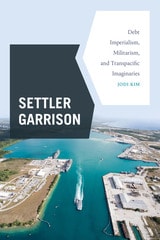
Settler Garrison
Debt Imperialism, Militarism, and Transpacific ImaginariesJodi Kim
Duke University Press, 2022
In Settler Garrison Jodi Kim theorizes how the United States extends its sovereignty across Asia and the Pacific in the post-World War II era through a militarist settler imperialism that is leveraged on debt as a manifold economic and cultural relation undergirded by asymmetries of power. Kim demonstrates that despite being the largest debtor nation in the world, the United States positions itself as an imperial creditor that imposes financial and affective indebtedness alongside a disciplinary payback temporality even as it evades repayment of its own debts. This debt imperialism is violently reproduced in juridically ambiguous spaces Kim calls the “settler garrison”: a colonial archipelago of distinct yet linked military camptowns, bases, POW camps, and unincorporated territories situated across the Pacific from South Korea to Okinawa to Guam. Kim reveals this process through an analysis of how a wide array of transpacific cultural productions creates antimilitarist and decolonial imaginaries that diagnose US militarist settler imperialism while envisioning alternatives to it.
[more]
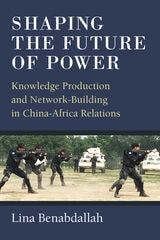
Shaping the Future of Power
Knowledge Production and Network-Building in China-Africa RelationsLina Benabdallah
University of Michigan Press, 2020
China’s rise to power is one of the biggest questions in International Relations theory (IRT) and foreign policy circles. Although power has been a core concept of IRT for a long time, the faces and mechanisms of power as it relates to Chinese foreign policymaking has changed the contours of that debate. The rise of China and other powers across the global political arena sparks a new visibility for different kinds of encounters between states, particularly between China and other Global South states. These encounters are more visible to IR scholars because of the increasing influence that rising powers have in the international system. This book shows that foreign policy encounters between rising powers and Global South states do not necessarily exhibit the same logics, behaviors, or investment strategies of Euro-American hegemons. Instead, they have distinctive features that require new theoretical frameworks for analysis. Shaping the Future of Power probes the types of power mechanisms that build, diffuse, and project China’s power in Africa. One must take into account the processes of knowledge production, social capital formation, and skills transfers that Chinese foreign policy directs toward African states to fully understand China’s power-building mechanisms. The relational power framework requires these elements to capture both the material aspects and ideational people-centered aspects to power. By examining China’s investments in human resource development programs for Africa, the book reveals a vital, yet undertheorized, aspect of China’s foreign policy making.
[more]
Singular Europe
Economy and Polity of the European Community after 1992William James Adams, Editor
University of Michigan Press, 1994
Singular Europe: Economy and Polity of the European Community after 1992 offers a thorough, multidisciplinary analysis of the sweeping changes and enduring challenges that faced the European Community in the wake of its ambitious 1992 integration project. Sponsored by the Chicago Council on Foreign Relations and drawing on the insights of leading economists, political scientists, and policymakers, this volume examines the economic, legal, and political forces that would shape Europe’s future at the end of the twentieth century.Taking its cue from the landmark “Project 1992”—the drive to create a single market for goods, services, capital, and people—the book begins by exploring the transformative view of a Europe no longer defined by its declining “Old Continent” image, but as a dynamic, populous, and increasingly prosperous global actor. Through three thematic parts, contributors address critical questions about the meaning and limits of integration: What steps remain for true political and economic union? How has European integration redefined competition, corporate strategy, social policy, and regulation? What are the external implications, and will the so-called “Fortress Europe” change global economic relations?With essays covering legitimacy and democracy after Maastricht, German reunification, the challenges of monetary union, competition policy, the social welfare state, telecommunications, banking, and international trade, Singular Europe blends scholarly rigor and policy relevance. The volume is a vital resource for anyone seeking to understand the ambitions and anxieties of a pivotal moment in Europe’s integration—and the ongoing debate over the balance between unity and diversity within the continent.
[more]

Soviet International Law and the World Economic Order
Kazimierz Grzybowski
Duke University Press, 1987
The author, a preeminent authority in the field of Soviet international law, here undertakes a policy-oriented approach to the study of international law.
[more]

Super Imperialism
The Origin and Fundamentals of U.S. World DominanceMichael Hudson
Pluto Press, 2003
[more]