Results by title
377 books match the query 'French' and 23 start with s
Sade
The Invention Of The Libertine BodyMarcel Henaff
University of Minnesota Press, 1999
A new model for examining Sade and his creations.
A new model for examining Sade and his creations.
Decried as a misogynist and pornographer, imprisoned for debauchery and for his writings, there is scarcely a cultural figure as flamboyant and controversial as the Marquis de Sade, the father of the new libertine body. But this is not, Hénaff maintains, the only way to see Sade. In this long-awaited English translation, Hénaff says that Sade should be discussed less for the sensual heat of his writing and more for the larger poetic and economic model his work represents.With unabashed candor, Sade describes bodies in terms not of flesh but of production, use, exchange, and waste. In his writing, this libertine self is unleashed from its constraints, no longer bound by old conceptions of desire and traditions of courtship. Hénaff’s argument that Sade is a sign of his times-exposing the courtly facade of a society unable to preserve itself-reveals dark, disquieting secrets about the direction of civilization. The libertine body, he says, is a child of this new order.ISBN 0-8166-2536-0 Cloth £34.50 $49.95xxISBN 0-8166-2537-9 Paper £14.00 $19.95x296 Pages 5 7/8 x 9 OctoberTranslation inquiries: University of Minnesota Press
Salonnières, Furies, and Fairies, revised edition
The Politics of Gender and Cultural Change in Absolutist FranceAnne E. Duggan
University of Delaware Press, 2021
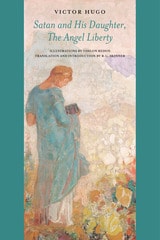
Satan and His Daughter, the Angel Liberty
Selected VersesVictor Hugo
Swan Isle Press, 2018
Satan and his Daughter, the Angel Liberty, drawn from this larger poem, tells the story of Satan and his daughter, the angel created by God from a feather left behind following his banishment. Hugo details Satan’s fall, and through a despairing soliloquy, reveals him intent on revenge, yet desiring God’s forgiveness. The angel Liberty, meanwhile, is presented by Hugo as the embodiment of good, working to convince her father to return to Heaven.
This new translation by Richard Skinner presents Hugo’s verse in a unique prose approach to the poet’s poignant work, and is accompanied by the Symbolist artist Odilon Redon’s haunting illustrations. No adventurous reader will want to miss this beautiful mingling of the epic and familial, religious and political.

Searching for Emma
Gustave Flaubert and Madame BovaryDacia Maraini
University of Chicago Press, 1997
Maraini argues that in their desire to claim Emma Bovary as a standard-bearer of revolt, women have often overlooked the bitter, pitiless way in which Flaubert evokes Emma's insignificance and vulgarity. Searching for Emma guides the reader through Flaubert's novel and many of his letters, seeking out the sources of his obsessive cruelty toward Emma. Maraini relates Flaubert's contempt for Emma to his relationship with his mistress, Louise Colet, to his general terror of women, and to his own self-loathing. It was entirely in spite of himself, Maraini writes, that Flaubert created the female Don Quixote so admired for her restlessness and determination.
Searching for Emma offers a novelist's insight into the complex relationship between author and character, and into the deepest motivations of fiction.
Secular Scriptures
Modern Theological Poetics in the Wake of DanteWilliam Franke
The Ohio State University Press, 2015
Secular Scriptures examines, through its own original speculative outlook, some of the most compelling exemplars of religious-poetic revelation in modern Western literature. The essays taken as an ensemble revolve around and are bookended by Dante, but they also explore the work of Chaucer, Shakespeare, Milton, Blake, Leopardi, Baudelaire, Dickinson, and Yeats. Looking both backward and forward from the vantage of Dante, Franke explores the roots of secularized religious vision in antiquity and the Middle Ages, even as he also looks forward toward its fruits in modern poetry and poetics. Ultimately, Franke’s analyses demonstrate the possibilities opened by understanding literature as secularized religious revelation.
Seeing Double
Baudelaire's ModernityFrançoise Meltzer
University of Chicago Press, 2011
The poet Charles Baudelaire (1821–1867) has been labeled the very icon of modernity, the scribe of the modern city, and an observer of an emerging capitalist culture. Seeing Double reconsiders this iconic literary figure and his fraught relationship with the nineteenth-century world by examining the way in which he viewed the increasing dominance of modern life. In doing so, it revises some of our most common assumptions about the unresolved tensions that emerged in Baudelaire’s writing during a time of political and social upheaval.
Françoise Meltzer argues that Baudelaire did not simply describe the contradictions of modernity; instead, his work embodied and recorded them, leaving them unresolved and often less than comprehensible. Baudelaire’s penchant for looking simultaneously backward to an idealized past and forward to an anxious future, while suspending the tension between them, is part of what Meltzer calls his “double vision”—a way of seeing that produces encounters that are doomed to fail, poems that can’t advance, and communications that always seem to falter. In looking again at the poet and his work, Seeing Double helps to us to understand the prodigious transformations at stake in the writing of modern life.

Selected Philosophical and Scientific Writings
Emilie Du Châtelet
University of Chicago Press, 2009
Though most historians remember her as the mistress of Voltaire, Emilie Du Châtelet (1706–49) was an accomplished writer in her own right, who published multiple editions of her scientific writings during her lifetime, as well as a translation of Newton’s Principia Mathematica that is still the standard edition of that work in French. Had she been a man, her reputation as a member of the eighteenth-century French intellectual elite would have been assured.
In the 1970s, feminist historians of science began the slow work of recovering Du Châtelet’s writings and her contributions to history and philosophy. For this edition, Judith P. Zinsser has selected key sections from Du Châtelet’s published and unpublished works, as well as related correspondence, part of her little-known critique of the Old and New Testaments, and a treatise on happiness that is a refreshingly uncensored piece of autobiography—making all of them available for the first time in English. The resulting volume will recover Châtelet’s place in the pantheon of French letters and culture.

Selected Philosophical, Scientific, and Autobiographical Writings
Marie-Geneviève-Charlotte Thiroux d’Arconville
Iter Press, 2018
Edited and translated by Julie Candler Hayes
The Other Voice in Early Modern Europe: The Toronto Series, volume 58
Selected Poems of Victor Hugo
A Bilingual EditionVictor Hugo
University of Chicago Press, 2001
Although best known as the author of Notre Dame de Paris and Les Misérables, Victor Hugo was primarily a poet—one of the most important and prolific in French history. Despite his renown, however, there are few comprehensive collections of his verse available and even fewer translated editions.
Translators E. H. and A. M. Blackmore have collected Victor Hugo's essential verse into a single, bilingual volume that showcases all the facets of Hugo's oeuvre, including intimate love poems, satires against the political establishment, serene meditations, religious verse, and narrative poems illustrating his mastery of the art of storytelling and his abiding concern for the social issues of his time. More than half of this volume's eight thousand lines of verse appear here for the first time in English, providing readers with a new perspective on each of the fascinating periods of Hugo's career and aspects of his style. Introductions to each section guide the reader through the stages of Hugo's writing, while notes on individual poems provide information not found in even the most detailed French-language editions.
Illustrated with Hugo's own paintings and drawings, this lucid translation pays homage to this towering figure of nineteenth-century literature by capturing the energy of his poetry, the drama and satirical force of his language, and the visionary beauty of his writing as a whole.
Sex Work, Text Work
Mapping Prostitution in the Nineteenth-Century French NovelJessica Tanner
Northwestern University Press, 2027
While prostitutes in nineteenth-century Paris were subject to municipal laws that policed their bodies and movements, writers of the era enlisted them to stake their own claims on both the city and the novel as literary territory. Sex Work, Text Work: Mapping Prostitution in the Nineteenth-Century French Novel explores how prostitutes depicted by Émile Zola, Joris-Karl Huysmans, Edmond de Goncourt, Adolphe Tabarant, and Charles-Louis Philippe “write back,” confounding civil and literary efforts to contain them in space and in narrative.
In city-regulated brothels, brasseries à femmes, Haussmannian boulevards, and the novel itself, working-class prostitutes served to reinforce the boundaries of social inclusion and exclusion. And yet, Jessica Tanner contends, even the novels that most explicitly aligned with the disciplinary logic of regulated prostitution make space for a distinctly literary form of resistance: these women elude or disrupt the mapping that would claim them as literary territory, revealing their authors’ failure to secure their narratives as property. Tanner pushes back against the critical tendency to attribute agency only to courtesans who became published authors and forwards a new framework for understanding the political work novels engage in as they circulate. Observing that debates about the regulation of prostitution surfaced in tandem with racialized anxieties about the boundaries of the French nation, Tanner ultimately expands that framework to the history of French colonialism and the politics of immigration in the current day. This book shows that while sex workers have been recruited to mark the borders of civic and moral life, prostitution can also make space for more inclusive forms of community, both in the novel and in the world beyond its bounds.

Shakespeare and the French Poet
Yves Bonnefoy
University of Chicago Press, 2004
Translated specifically for an American readership, Shakespeare and the French Poet also features a new interview with Bonnefoy. For Shakespeare scholars, Bonnefoy enthusiasts, and students of literary translation, Shakespeare and the French Poet is a celebration of the global language of poetry and the art of "making someone else's voice live again in one's own."
Sin and Salvation in Early Modern France
Three Women’s StoriesMarguerite d'Auge, Renée Burlamacchi, and Jeanne du Laurens
Iter Press, 2017
The texts available here in English for the first time open a window into the lives of three early modern Frenchwomen as they explore the common themes of family, memory, sin, and salvation. The Regrets of Marguerite d’Auge (1600), the Memoirs of Renée Burlamacchi (1623), and the Genealogy of Jeanne du Laurens (1631), taken from different genres of historical writings, raise important questions: Why and how did female authorship find its way into the historical record? How did these voices escape the censorship and prejudice against female publication? In a time of extreme religious conflict, how did these women convey their views on controversial issues such as primacy of grace, indulgences, and salvation without disrupting the gender expectations of the era?

Social Contract, Discourse on the Virtue Most Necessary for a Hero, Political Fragments, and Geneva Manuscript
Jean-Jacques Rousseau
Dartmouth College Press, 1994
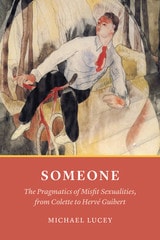
Someone
The Pragmatics of Misfit Sexualities, from Colette to Hervé GuibertMichael Lucey
University of Chicago Press, 2019
In Someone, Michael Lucey considers characters from twentieth-century French literary texts whose sexual forms prove difficult to conceptualize or represent. The characters expressing these “misfit” sexualities gravitate towards same-sex encounters. Yet they differ in subtle but crucial ways from mainstream gay or lesbian identities—whether because of a discordance between gender identity and sexuality, practices specific to a certain place and time, or the fleetingness or non-exclusivity of desire. Investigating works by Simone de Beauvoir, Colette, Jean Genet, and others, Lucey probes both the range of same-sex sexual forms in twentieth-century France and the innovative literary language authors have used to explore these evanescent forms.
As a portrait of fragile sexualities that involve awkward and delicate maneuvers and modes of articulation, Someone reveals just how messy the ways in which we experience and perceive sexuality remain, even to ourselves.
Spatial Prepositions
A Case Study from FrenchClaude Vandeloise
University of Chicago Press, 1991
Most previous analyses of spatial prepositions have assumed that their semantic properties can be adequately explained by familiar logical and geometrical concepts. Thus, the standard view of the preposition "in" as it appears in the sentence "the ball is in the bag" postulates that it refers to the geometrical relation of inclusion. This paradigm, however, falters when faced with the contrast in acceptability between sentences such as "the bulb is in the socket" and "the bottle is in the cap." The force exerted by the "landmark" (a conceptually fixed object) on the "target" (a moveable object) is crucial in this difference: the functional notion of containment seems more operational in the use of the preposition "in" than inclusion. That is, what are taken to be the landmark and the target depend greatly on the functions these objects serve in the human scheme. This offers important clues to otherwise problematic linguistic quirks, such as why one sleeps in one's bed, while one is said to lie on one's deathbed.
While many of the examples apply in English as well as French, there are some noteworthy differences—in French one sits on a chair, but in a couch. Vandeloise convincingly argues that it is precisely this subjective element which makes a standard geometrical account unfeasible.
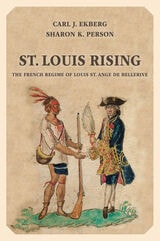
St. Louis Rising
The French Regime of Louis St. Ange de BelleriveCarl J. Ekberg and Sharon K. Person
University of Illinois Press, 2015
Drawing on new source materials, the authors delve into the complexities of politics, Indian affairs, slavery, and material culture that defined the city's founding period. Their alternative version of the oft-told tale uncovers the imperial realities--as personified by St. Ange--that truly governed in the Illinois Country of the time, and provide a trove of new information on everything from the fur trade to the arrival of the British and Spanish after the Seven Years' War.

States of Plague
Reading Albert Camus in a PandemicAlice Kaplan and Laura Marris
University of Chicago Press, 2022
As one of the most discussed books of the COVID-19 crisis, Albert Camus’s classic novel The Plague has become a new kind of literary touchstone. Surrounded by terror and uncertainty, often separated from loved ones or unable to travel, readers sought answers within the pages of Camus’s 1947 tale about an Algerian city gripped by an epidemic. Many found in it a story about their own lives—a book to shed light on a global health crisis.
In thirteen linked chapters told in alternating voices, Alice Kaplan and Laura Marris hold the past and present of The Plague in conversation, discovering how the novel has reached people in their current moment. Kaplan’s chapters explore the book’s tangled and vivid history, while Marris’s are drawn to the ecology of landscape and language. Through these pages, they find that their sense of Camus evolves under the force of a new reality, alongside the pressures of illness, recovery, concern, and care in their own lives. Along the way, Kaplan and Marris examine how the novel’s original allegory might resonate with a new generation of readers who have experienced a global pandemic. They describe how they learned to contemplate the skies of a plague spring, to examine the body politic and the politics of immunity.
Both personal and eloquently written, States of Plague uncovers for us the mysterious way a novel can imagine the world during a crisis and draw back the veil on other possible futures.
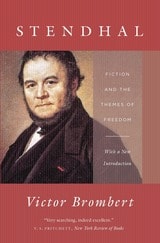
Stendhal
Fiction and the Themes of FreedomVictor Brombert
University of Chicago Press, 2017
For Brombert, Stendhal’s work is deeply personal; elsewhere, he has written about the myriad connections between Stendhal’s ironic inquiries into identity and his own boyhood in France on the brink of World War II. Proceeding via careful and nuanced readings of passages from Stendhal’s fiction and autobiography, Brombert pays particular attention to style, tone, and meaning. Paradoxically, Stendhal’s heroes often feel most free when in prison, and in a statement of stunning relevance for our contemporary world, Brombert contends that Stendhal is far clearer than any writer before him on the “crisis and contradictions of modern humanism that . . . render political freedom illusory.” Featuring a new introduction in which Brombert explores his earliest encounters with Stendhal—the beginnings of his “affair” during a year spent as a Fulbright scholar in Rome—Stendhal remains a spirited, elegant, and resonant account.
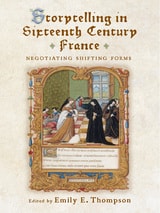
Storytelling in Sixteenth-Century France
Negotiating Shifting FormsEmily E. Thompson
University of Delaware Press, 2022
Published by the University of Delaware Press. Distributed worldwide by Rutgers University Press.

Studies in French-Classical Tragedy
Lacy Lockert
Vanderbilt University Press, 0
Numerous, often lengthy, quoted passages (with an English verse translation accompanying the French in every case) exemplify the achievement and exhibit the qualities of the dramas and dramatists discussed.
That portion of the author’s critical work in this field which has already appeared, as introductions in his volumes of translated plays, has been much appreciated, as witness the following brief excerpts from reviews of those books:
“The plays…are discussed with insight and enthusiasm.”—(London) Notes and Queries.
“Refreshingly original and yet free from specious pleading or naïve enthusiasm.”—Chattanooga Times.
“Thoughtful, discerning appraisals.”—Seventeenth Century News.
“An excellent critical introduction.”—The Library Journal.
“A judicious introduction.”—Arthur Knodel in The Personalist.
“The very best interpretative treatment of Corneille that has appeared.”—C. Maxwell Lancaster.

Subject/Object and Beyond
Women in Early Modern FranceEdited by Nancy M. Frelick and Edith Benkov
Iter Press, 2023
Subject/Object and Beyond brings together essays by established and emerging scholars to honor the exceptionally rich contributions and career of scholar Colette H. Winn. It also celebrates fifty years of sustained scholarship on early modern women, along with the foundation of Women’s Studies as a recognized academic discipline in North America. The collection comprises seventeen articles that explore multiple perspectives on early modern women, including their writings, translations, reception, and contributions to various fields, including literature, music, politics, religion, and science.
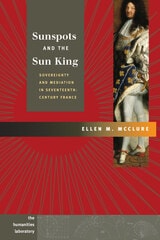
Sunspots and the Sun King
Sovereignty and Mediation in Seventeenth-Century FranceEllen M. McClure
University of Illinois Press, 2006
Mediation, monarchy, and Louis XIV's attempts to legitimize his reign
In order to assert his divine right, Louis XIV missed no opportunity to identify himself as God’s representative on earth. However, in Sunspots and the Sun King Ellen McClure explores the contradictions inherent in attempting to reconcile the logical and mystical aspects of divine right monarchy. McClure analyzes texts devoted to definitions of sovereignty, presents a meticulous reading of Louis XIV’s memoirs to the crown prince, and offers a novel analysis of diplomats and ambassadors as the mediators who preserved and transmitted the king’s authority. McClure asserts that these discussions, ranging from treatises to theater, expose incommensurable models of authority and representation permeating almost every aspect of seventeenth-century French culture.
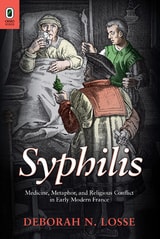
Syphilis
Medicine, Metaphor, and Religious Conflict in Early Modern FranceDeborah N. Losse
The Ohio State University Press, 2015
Losse provides close readings of a range of genres, moving between polemical poetry, satirical narratives, dialogical colloquies, travel literature, and the personal essay. With chapters featuring Erasmus, Rabelais, Montaigne, Léry, and Agrippa d’Aubigné, this study compares literary descriptions of syphilis with medical descriptions. In the first full-length study of Renaissance writers’ engagement with syphilis, Deborah Losse charts a history from the most vehement rhetoric of the pox to a tenuous resolution of France’s conflicts, when both sides called for a return to order.