Results by title
74 books match the query 'Friendship' and 6 start with s
Searching for Soul
A Survivor’s GuideBobbe Tyler
Ohio University Press, 2009
To dive deep into your inner life. To navigate its complexity and explore your story in depth. To discover who you are exactly—the courage you have when life breaks apart, how conscious you become in that process, and how rich you feel learning the meaning of your life. On a search for wholeness, Bobbe Tyler delves deep to find and tell her story—the trauma of familial mental illness, marriage and divorce, spiritual despair, accountability, addiction and the joy of recovery, surviving loss, and finally that which matters most: love in all its ways. The rewards of her wisdom belong not to her alone but, by way of her unflinching examination of life’s many paths, to all who have a story of their own to tell—who have faced a life-choice gone wrong, or met the peace that had always seemed just out of reach. This searing self-appraisal provides a model for those who seek to know themselves better and are willing to sound their depths to find their story in full.
Shakespeare on Love and Friendship
Allan Bloom
University of Chicago Press, 2000
This volume includes essays on five plays, Romeo and Juliet, Anthony and Cleopatra, Measure for Measure, Troilus and Cressida, and The Winter's Tale, and within these Bloom meditates on Shakespeare's work as a whole. He also draws on his formidable knowledge of Plato, Rousseau, and others to bring both ancients and moderns into the conversation. The result is a truly synoptic treatment of eros—not only a philosophical reflection on Shakespeare, but a survey of the human spirit and its tendency to seek what Bloom calls the "connectedness" of love and friendship.
These highly original interpretations of the plays convey a deep respect for their author and a deep conviction that we still have much to learn from him. In Bloom's view, we live in a love-impoverished age; he asks us to turn once more to Shakespeare because the playwright gives us a rich version of what is permanent in human nature without sharing our contemporary assumptions about erotic love.
"Provocative and illuminating." —Michiko Kakutani, New York Times
"A brilliant analysis of the erotic ugliness and the balancing erotic grace of The Winter's Tale . . . and Bloom makes more sense of [Measure for Measure] than anyone else I have read." —A. S. Byatt, Washington Post Book World
At his death in 1992, Allan Bloom was the John U. Nef Distinguished Service Professor in the Committee on Social Thought at the University of Chicago. He is the author of several books, including Shakespeare's Politics (with Harry V. Jaffa) and The Closing of the American Mind.
Sovereign Amity
Figures of Friendship in Shakespearean ContextsLaurie Shannon
University of Chicago Press, 2001
Shannon demonstrates that the likeness of sex and station urged in friendship enabled a civic parity not present in other social forms. Early modern friendship was nothing less than a utopian political discourse. It preceded the advent of liberal thought, and it made its case in the terms of gender, eroticism, counsel, and kingship. To show the power of friendship in early modernity, Shannon ranges widely among translations of classical essays; the works of Elizabeth I, Montaigne, Donne, and Bacon; and popular literature, to focus finally on the plays of Shakespeare. Her study will interest scholars of literature, history, gender, sexuality, and political thought, and anyone interested in a general account of the English Renaissance.
Span the World with Friendship
Edited by Douglas Bourn and Richard Palser
University College London, 2025
For nearly a century, the Woodcraft Folk has championed radical social change through education, but its contributions remain largely overlooked in histories of progressive youth movements. Span the World with Friendship is the first major academic study of this pioneering organization, tracing its role in fostering internationalism, cooperative learning, and environmental activism long before these became mainstream concerns. The Woodcraft Folk’s impact is inspected through diverse disciplinary perspectives, including political theory, anthropology, and youth work studies. Through a review of multiple archival sources—letters, meeting records, and oral testimonies—contributors bring a critical lens to a movement often narrated uncritically.
Beginning with a biography of founder Leslie Paul, the book looks into the Folk’s relationship with the labor movement, its engagement with eugenics debates, and its use of folk traditions as tools for social cohesion. Concluding with an exploration of its transition into a youth-led movement, this volume positions the Woodcraft Folk within broader discussions on education for global justice and activism, ensuring its legacy is finally given the academic attention it deserves.

Still Connected
Family and Friends in America Since 1970Claude S. Fischer
Russell Sage Foundation, 2011
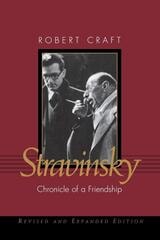
Stravinsky
Chronicle of a FriendshipRobert Craft
Vanderbilt University Press, 1994
For nearly the last twenty-five years of Igor Stravinsky's incredibly full life, the noted musician, conductor, and writer Robert Craft was his closest colleague and friend, a trusted member of his household, and an important part of all of the composer's activities. Throughout these years, Craft kept a detailed diary, impressive in its powers of observation and characterization. That diary forms the basis for Stravinsky: Chronicle of a Friendship, now released in a substantially revised and expanded new edition.
This edition includes nearly twice as many illustrations and more than 35% entirely new textual material. In addition, Craft adds an evocative "Postlude" in which he summarily brings matters forward to the death of Vera Stravinsky, several years after that of the Maestro.