Results by title
522 books match the query 'Gender' and 42 start with s

School Talk
Gender and Adolescent CultureEder, Donna
Rutgers University Press, 1995
KACTIS revealed many social and ethical issues, launching Eder into more research, this time learning from Navajo and Kenyan storytellers how children can understand ethics and diversity through practices used in oral cultures. She borrowed non-Western concepts of learning as she crafted a service-learning project, Storytelling as Reflecting Time (START), which became the basis of a service-learning course, Knowledge and Community, taught to sociology majors and honor students.
The approach is so effective that Eder cannot accommodate all of the requests she receives for START, which is conducted both in the classroom and through extracurricular activities throughout Bloomington. She works with the Hutton Philanthropic Initiative, where students use storytelling to interact with community children in a meaningful way. Students in her Community Building Across Generations course take their storytelling to a nursing home and a program for children whose families are escaping domestic violence.
Eder also mentors other instructors on campus who are interested in service-learning.

School Talk
Gender and Adolescent CultureEder, Donna
Rutgers University Press, 1995
KACTIS revealed many social and ethical issues, launching Eder into more research, this time learning from Navajo and Kenyan storytellers how children can understand ethics and diversity through practices used in oral cultures. She borrowed non-Western concepts of learning as she crafted a service-learning project, Storytelling as Reflecting Time (START), which became the basis of a service-learning course, Knowledge and Community, taught to sociology majors and honor students.
The approach is so effective that Eder cannot accommodate all of the requests she receives for START, which is conducted both in the classroom and through extracurricular activities throughout Bloomington. She works with the Hutton Philanthropic Initiative, where students use storytelling to interact with community children in a meaningful way. Students in her Community Building Across Generations course take their storytelling to a nursing home and a program for children whose families are escaping domestic violence.
Eder also mentors other instructors on campus who are interested in service-learning.
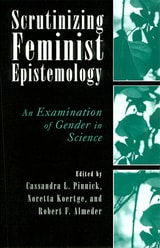
Scrutinizing Feminist Epistemology
An Examination of Gender in SciencePinnick, Cassandra
Rutgers University Press, 2003
This volume presents the first systematic evaluation of a feminist epistemology of sciences’ power to transform both the practice of science and our society. Unlike existing critiques, this book questions the fundamental feminist suggestion that purging science of alleged male biases will advance the cause of both science and by extension, social justice.
The book is divided into four sections: the strange status of feminist epistemology, testing feminist claims about scientific practice, philosophical and political critiques of feminist epistemology, and future prospects of feminist epistemology. Each of the essays¾most of which are original to this text¾ directly confronts the very idea that there could be a feminist epistemology or philosophy of science. Rather than attempting to deal in detail with all of the philosophical views that fall under the general rubric of feminist epistemology, the contributors focus on positions that provide the most influential perspectives on science. Not all of the authors agree amongst themselves, of course, but each submits feminist theories to careful scrutiny. Scrutinizing Feminist Epistemology provides a timely, well-rounded, and much needed examination of the role of gender in scientific research.

Searching for Feminist Superheroes
Gender, Sexuality, and Race in Marvel ComicsSam Langsdale
University of Texas Press, 2024
How superhero narratives in the margins of the mainstream tell innovative, feminist stories.
It’s no secret that superhero comics and their related media perpetuate a model of a straight, white, male hero at the expense of representing women and other minorities, but other narratives exist. Searching for Feminist Superheroes recognizes that female-led superhero comics, with diverse casts of characters and inclusive storytelling, exist on the margins of the mainstream superhero genre. But rather than focusing on these stories as marginalized, Sam Langsdale’s work on heroes such as Spider-Woman, America Chavez, and Ironheart locates the margins as a site of innovation and productivity, which have enabled the creation of feminist superhero texts.
Employing feminist and intersectional philosophies in an analysis of these comics, Langsdale suggests that feminist superheroes have the potential to contribute to a social imagination that is crucial in working toward a more just world. At a time when US popular culture continues to manifest as a battleground between oppressive and progressive social norms, Searching for Feminist Superheroes demonstrates that a fight for a better world is worthwhile.

Security Disarmed
Critical Perspectives on Gender, Race, and MilitarizationMorgen, Sandra
Rutgers University Press, 2008
In Security Disarmed, scholars, policy planners, and activists come together to think critically about the human cost of violence and viable alternatives to armed conflict. Arranged in four parts--alternative paradigms of security, cross-national militarization, militarism in the United States, and pedagogical and cultural concerns--the book critically challenges militarization and voices an alternative encompassing vision of human security by analyzing the relationships among gender, race, and militarization. This collection of essays evaluates and resists the worldwide crisis of militarizationùincluding but going beyond American military engagements in the twenty-first century.

Seeking Rights from the Left
Gender, Sexuality, and the Latin American Pink TideElisabeth Jay Friedman
Duke University Press, 2018
Contributors: Sonia E. Alvarez, María Constanza Diaz, Rachel Elfenbein, Elisabeth Jay Friedman, Niki Johnson, Victoria Keller, Edurne Larracoechea Bohigas, Amy Lind, Marlise Matos, Shawnna Mullenax, Ana Laura Rodríguez Gustá, Diego Sempol, Constanza Tabbush, Gwynn Thomas, Catalina Trebisacce, Annie Wilkinson
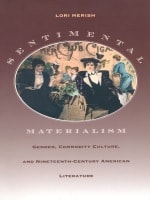
Sentimental Materialism
Gender, Commodity Culture, and Nineteenth-Century American LiteratureLori Merish
Duke University Press, 2000
The phenomenon of female consumption was capitalism’s complement to male production: It created what Merish calls the “Other Protestant Ethic,”a feminine and sentimental counterpart to Max Weber’s ethic of hard work, economic rationality, and self-control. In addition, driven by the culture’s effort to civilize the “cannibalistic” practices of ethnic, class, and national otherness, appropriate female consumerism, marked by taste and refinement, identified certain women and their families as proper citizens of the United States. The public nature of consumption, however, had curiously conflicting effects: While the achievement of cultured material circumstances facilitated women’s civic agency, it also reinforced stereotypes of domestic womanhood.
Sentimental Materialism’s inquiry into middle-class consumption and accompanying ideals of womanhood will appeal to readers in a variety of disciplines, including American studies, cultural studies, feminist theory, and cultural history.

Seventh-day Adventism in Crisis
Gender and Sectarian Change in an Emerging ReligionLaura L. Vance
University of Illinois Press, 1999
Tracing the views of the church through its official and unofficial publications and through interviews with dozens of Adventist informants, Laura Vance reveals a significant shift around the turn of the century in women's roles advocated by the church: from active participation in the functioning, spiritual leadership, teaching, and evangelism of Adventism to an insistence on homemaking as a woman's sole proper vocation. These changes in attitude, Vance maintains, are inextricably linked to Adventism's shift from sect to church: in effect, to its maturation as a denomination.
Vance suggests that the reemergence of women in positions of influence within the church in recent decades should be viewed not as a concession to secular feminist developments but rather as a return to Adventism's earlier conception of gender roles. By examining changes in the movement's relationship with the world and with its own history, Seventh-day Adventism in Crisis offers a probing examination of how a sect founded on the leadership of women came to define women's roles in ways that excluded them from active public participation and leadership in the church.
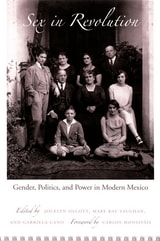
Sex in Revolution
Gender, Politics, and Power in Modern MexicoJocelyn Olcott, Mary Kay Vaughan, and Gabriela Cano, eds.
Duke University Press, 2006
Concentrating on episodes and phenomena that occurred between 1915 and 1950, the contributors deftly render experiences ranging from those of a transgendered Zapatista soldier to upright damas católicas and Mexico City’s chicas modernas pilloried by the press and male students. Women refashioned their lives by seeking relief from bad marriages through divorce courts and preparing for new employment opportunities through vocational education. Activists ranging from Catholics to Communists mobilized for political and social rights. Although forced to compromise in the face of fierce opposition, these women made an indelible imprint on postrevolutionary society.
These essays illuminate emerging practices of femininity and masculinity, stressing the formation of subjectivity through civil-society mobilizations, spectatorship and entertainment, and locales such as workplaces, schools, churches, and homes. The volume’s epilogue examines how second-wave feminism catalyzed this revolutionary legacy, sparking widespread, more radically egalitarian rural women’s organizing in the wake of late-twentieth-century democratization campaigns. The conclusion considers the Mexican experience alongside those of other postrevolutionary societies, offering a critical comparative perspective.
Contributors. Ann S. Blum, Kristina A. Boylan, Gabriela Cano, María Teresa Fernández Aceves, Heather Fowler-Salamini, Susan Gauss, Temma Kaplan, Carlos Monsiváis, Jocelyn Olcott, Anne Rubenstein, Patience Schell, Stephanie Smith, Lynn Stephen, Julia Tuñón, Mary Kay Vaughan

Sex on Stage
Gender and Sexuality in Post-War British TheatreAndrew Wyllie
Intellect Books, 2009

Sexing Empire
Bodies, Gender, and Desire in Colonial and Postcolonial Power RelationsBen Cowan, Nicole M. Guidotto-Hernández, and Jason Ruiz, special issue editors
Duke University Press, 0
From steamships to steam rooms and sweat lodges to sweatshops, processes of pleasures and desire have shaped the regulation and classification of bodies in a wide variety of colonial settings. On beaches and online, and in boardrooms, temples, and taverns, sexual practices have always influenced imperial power relations. In the many places and relationships where colonialism still affects economics, sex and sexuality remain a driving—if sometimes hidden—force. The contributors to this provocative issue contemplate empire as a global process involving sexualized subjects and objects, with essays that consider the history of sex and (or in) empire across several disciplines. Their topics include a "bewitched" nun in colonial Peru, contemporary call-center workers in the Philippines, and General Douglas MacArthur’s mixed-race Filipina mistress, among many others.
Ben Cowan is assistant professor of world history at George Mason University. Nicole M. Guidotti-Hernández is associate professor of American studies at the University of Texas at Austin and the author of Unspeakable Violence: Remapping U.S. and Mexican National Imaginaries, also published by Duke University Press. Jason Ruiz is assistant professor of American studies at the University of Notre Dame and the author of Americans in the Treasure House: Travel to Porfirian Mexico and the Cultural Politics of Empire.
Contributors: Laura Briggs, Keith Camacho, Ben Cowan, Emmanuel David, Vernadette Vicuña Gonzalez, Nicole M. Guidotti-Hernández, Elizabeth Mesok, Rachel Sarah O’Toole, Katrina Phillips, Jason Ruiz
Sexual Generations
Star Trek: The Next Generation and GenderRobin Roberts
University of Illinois Press, 1999
The incisive and innovative readings in Sexual Generations provide food for thought about how the final frontier can clarify pressing questions of our own space and time.

Sexual Visions
Images Of Gender In Science And Medicine Between The Eighteenth And Twentieth CenturiesLudmilla Jordanova
University of Wisconsin Press, 1993
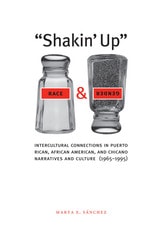
Shakin' Up Race and Gender
Intercultural Connections in Puerto Rican, African American, and Chicano Narratives and Culture (1965–1995)By Marta E. Sánchez
University of Texas Press, 2006
The second phase of the civil rights movement (1965-1973) was a pivotal period in the development of ethnic groups in the United States. In the years since then, new generations have asked new questions to cast light on this watershed era. No longer is it productive to consider only the differences between ethnic groups; we must also study them in relation to one another and to U.S. mainstream society.
In "Shakin' Up" Race and Gender, Marta E. Sánchez creates an intercultural frame to study the historical and cultural connections among Puerto Ricans, African Americans, and Chicanos/as since the 1960s. Her frame opens up the black/white binary that dominated the 1960s and 1970s. It reveals the hidden yet real ties that connected ethnics of color and "white" ethnics in a shared intercultural history. By using key literary works published during this time, Sánchez reassesses and refutes the unflattering portrayals of ethnics by three leading intellectuals (Octavio Paz, Daniel Patrick Moynihan, and Oscar Lewis) who wrote about Chicanos, African Americans, and Puerto Ricans. She links their implicit misogyny to the trope of La Malinche from Chicano culture and shows how specific characteristics of this trope—enslavement, alleged betrayal, and cultural negotiation—are also present in African American and Puerto Rican cultures. Sánchez employs the trope to restore the agency denied to these groups. Intercultural contact—encounters between peoples of distinct ethnic groups—is the theme of this book.

Shamans of the Foye Tree
Gender, Power, and Healing among Chilean MapucheBy Ana Mariella Bacigalupo
University of Texas Press, 2007
Drawing on anthropologist Ana Mariella Bacigalupo's fifteen years of field research, Shamans of the Foye Tree: Gender, Power, and Healing among Chilean Mapuche is the first study to follow shamans' gender identities and performance in a variety of ritual, social, sexual, and political contexts.
To Mapuche shamans, or machi, the foye tree is of special importance, not only for its medicinal qualities but also because of its hermaphroditic flowers, which reflect the gender-shifting components of machi healing practices. Framed by the cultural constructions of gender and identity, Bacigalupo's fascinating findings span the ways in which the Chilean state stigmatizes the machi as witches and sexual deviants; how shamans use paradoxical discourses about gender to legitimatize themselves as healers and, at the same time, as modern men and women; the tree's political use as a symbol of resistance to national ideologies; and other components of these rich traditions.
The first comprehensive study on Mapuche shamans' gendered practices, Shamans of the Foye Tree offers new perspectives on this crucial intersection of spiritual, social, and political power.
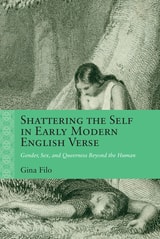
Shattering the Self in Early Modern English Verse
Gender, Sex, and Queerness Beyond the HumanGina Filo
Northwestern University Press, 2026
Rejecting the ideals of stability and sexual mastery demanded of masculine subjects, early modern English poets threw the limits of bodies and selves into question to embrace erotic experiences of genderqueer and transspecies embodiment and affiliation. Through close readings of still-canonical and lesser-read writers including William Shakespeare, John Donne, and Thomas Traherne, Gina Filo shows how these experimental encounters at the limits of the human were inextricable parts of the early modern literary and sexual imaginaries.
In its exploration of nonnormative forms of erotic attachment and embodiment, Shattering the Self in Early Modern English Verse: Gender, Sex, and Queerness Beyond the Human contributes to the burgeoning fields of early modern trans and ecocritical studies while also drawing on contemporary queer theory. Filo neither seeks to naively recuperate a fantasized past nor cedes relationality, sociality, or generativity to the normative. Instead, she shows how the embrace of erotic possibility, flexible, unstable subjectivities, and querying of the limits of “the human” were core features of early modern poetics, reconfiguring our understanding of English literary history and queer relationality today.
Shaw's Daughters
Dramatic and Narrative Constructions of GenderJ. Ellen Gainor
University of Michigan Press, 1992
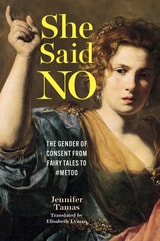
She Said No
The Gender of Consent from Fairy Tales to #MeTooJennifer Tamas
University of Delaware Press, 2027
She Said NO investigates the gender inequality in the authority to speak—and therefore to refuse—that prevailed in the establishment and interpretation of the French classics. By selecting authors deemed essential to French cultural heritage and erasing the works of women writers, this biased canon has systematically undervalued female agency—even in well-known works by both men and women, such as Beauty and the Beast, The Princess of Clèves, and "Little Red Riding Hood." With this book, Jennifer Tamas fills a striking gap in early modern French studies by conceptualizing consent in a society where being a woman made it structurally difficult to say "no." Yet, women did refuse. The history Tamas explores is one of forgotten, erased, misunderstood, or inadmissible refusals, and how they have been obscured. The #MeToo movement has brought questions of female agency and consent to the fore, and this book retraces an "archive of refusal" to serve as a source of inspiration for contemporary feminist discourse and to change our reception of the French canon.
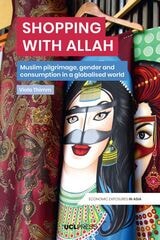
Shopping with Allah
Muslim Pilgrimage, Gender and Consumption in a Globalized WorldViola Thimm
University College London, 2023
Shopping with Allah illustrates the ways in which religion is mobilized in package tourism and how spiritual, economic, and gendered practices are combined in a form of tourism where the goal is not purely leisure but also ethical and spiritual cultivation. Drawing on extensive ethnographic fieldwork in Malaysia, the United Arab Emirates, and Oman, Thimm sheds light on how Islam and gender frame Malaysian religious tourism and pilgrimage to the Arabian Peninsula and raises many issues that are of great importance beyond these regional contexts.
This book also offers an innovative methodological-analytical toolkit to research mobility and intersectionality across sociogeographic scales. By bringing methodological holism into a fruitful engagement with the antiracist-feminist framework intersectionality, Thimm argues that hierarchical relationships, such as marginalization, power, and empowerment, can shift for an individual or a social group depending upon the social sphere.
Sightlines
Race, Gender, and Nation in Contemporary Australian TheatreHelen Gilbert
University of Michigan Press, 1998

Sin fronteras
Inclusive Spanish Grammar GuidebookLiana Stepanyan, María Mercedes Fages Agudo, Carolina Castillo Larrea, Goretti Prieto Botana
Amherst College Press, 2024
Siren Songs
Gender, Audiences, and Narrators in the OdysseyLillian Eileen Doherty
University of Michigan Press, 1995
Siren Songs synthesizes audience-oriented and narratological approaches, and examines the relationships among three kinds of audiences: internal, implied, and actual. The author prefaces her own reading of the Odyssey with an analysis of the issues posed by the earlier feminist readings on which she builds. Should the Odyssey be read as a "closed" text, that is, as one whose meaning is highly determined, or as an "open" text whose contradictions and ambiguities undercut its overt meanings?
Siren Songs presents a feminist critique of the Odyssey in an accessible manner aimed at a more general audience. All Greek is translated, and critical terminology is clearly defined.
Lillian Eileen Doherty is Associate Professor of Classics, University of Maryland, College Park.

Skyscraper Cinema
Architecture and Gender in American FilmMerrill Schleier
University of Minnesota Press, 2008
Schleier analyzes cinematic works in which skyscrapers are an integral component, interpreting the iconography and spatial practices in these often fictional modern buildings, especially on concepts of gender. Organized chronologically and thematically, she offers close readings of films including Safety Last, Skyscraper Souls, Wife vs. Secretary, Baby Face, The Fountainhead, and Desk Set. Opening with the humorous antics of Harold Lloyd, the premier skyscraper actor of the silent era, the book moves through the disillusionment of the Depression era, in which skyscrapers are employed as players in moralistic, class-conscious stories, to post–World War II and its reimagining of American political and economic values and ends with the complicated prosperity of the 1950s and the lives of white-collar workers and their spouses.
Taking inspiration from Walter Benjamin’s Arcades Project, among works of other critical theorists, Schleier creates in this book a model for understanding architecture as a purveyor of desire and class values and, ultimately, contributes broadly to thinking on the rich intersection of the built environment, cinema, and gender.

Slave Trade and Abolition
Gender, Commerce, and Economic Transition in LuandaVanessa S. Oliveira
University of Wisconsin Press, 2022
Vanessa S. Oliveira traces how existing commercial networks adapted to changes in the Atlantic slave trade during the first half of the nineteenth century. Slave Trade and Abolition reveals how women known as donas (a term adapted from the title granted to noble and royal women in the Iberian Peninsula) were often important cultural brokers. Acting as intermediaries between foreign and local people, they held high socioeconomic status and even competed with the male merchants who controlled the trade. Oliveira provides rich evidence to explore the many ways this Luso-African community influenced its society. In doing so, she reveals an unexpectedly nuanced economy with regard to the dynamics of gender and authority.

Smile of Discontent
Humor, Gender, and Nineteenth-Century British FictionEileen Gillooly
University of Chicago Press, 1999
Gillooly shows how such humor became, for mostly female writers at the time, an unobtrusive and prudent means of expressing discontent with a culture that was ideologically committed to restricting female agency and identity. If the aggression and emotional distance of irony and satire mark them as "masculine," then for Gillooly, the passivity, indirection, and sympathy of the humor she discusses render it "feminine." She goes on to disclose how the humorous tactics employed by writers from Burney to Wharton persist in the work of Barbara Pym, Anita Brookner, and Penelope Fitzgerald.
The book won the Barbara Perkins and George Perkins Award given by the Society for the Study of Narrative Literature.
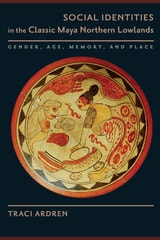
Social Identities in the Classic Maya Northern Lowlands
Gender, Age, Memory, and PlaceBy Traci Ardren
University of Texas Press, 2015
Using new archaeological data from four major cities of the Classic Maya world, this book explores how gender, age, familial and community memories, and the experience of living in an urban setting interacted to form social identities.
Social Identities in the Classic Maya Northern Lowlands plumbs the archaeological record for what it can reveal about the creation of personal and communal identities in the Maya world. Using new primary data from her excavations at the sites of Yaxuna, Chunchucmil, and Xuenkal, and new analysis of data from Dzibilchaltun in Yucatan, Mexico, Traci Ardren presents a series of case studies in how social identities were created, shared, and manipulated among the lowland Maya.
Ardren argues that the interacting factors of gender, age, familial and community memories, and the experience of living in an urban setting were some of the key aspects of Maya identities. She demonstrates that domestic and civic spaces were shaped by gender-specific behaviors to communicate and reinforce gendered ideals. Ardren discusses how child burials disclose a sustained pattern of reverence for the potential of childhood and the power of certain children to mediate ancestral power. She shows how small shrines built a century after Yaxuna was largely abandoned indicate that its remaining residents used memory to reenvision their city during a time of cultural reinvention. And Ardren explains how Chunchucmil’s physical layout of houses, plazas, and surrounding environment denotes that its occupants shared an urban identity centered in the movement of trade goods and economic exchange. Viewing this evidence through the lens of the social imaginary and other recent social theory, Ardren demonstrates that material culture and its circulations are an integral part of the discourse about social identity and group membership.

Space, Place, and Gender
Doreen Massey
University of Minnesota Press, 1994
Spanish Women Writers and the Essay
Gender, Politics, and the SelfKathleen M. Glenn and Mercedes Mazquirán de Rodríguez
University of Missouri Press, 1998
Never before has a book examined Spanish women and their mastery of the essay. In the groundbreaking collection Spanish Women Writers and the Essay, Kathleen M. Glenn and Mercedes Mazquiarán de Rodríguez help to rediscover the neglected genre, which has long been considered a "masculine" form. Taking a feminist perspective, the editors examine why Spanish women have been so drawn to the essay through the decades, from Concepción Arenal's nineteenth-century writings to the modern works of Rosa Montero.
Spanish women, historically denied a public voice, have discovered an outlet for their expression via the essay. As essayists, they are granted the authority to address subjects they personally deem important, discuss historical and sociopolitical issues, and denounce female subordination. This genre, which attracts a different audience than does the novel or poem, allows Spanish women writers to engage in a direct dialogue with their readers.
Featuring twelve critical investigations of influential female essayists, Spanish Women Writers and the Essay illustrates Spanish women writers' command of the genre, their incorporation of both the ideological and the aesthetic into one concise form, and their skillful use of various strategies for influencing their readers. This fascinating study, which provides English translations for all quotations, will appeal to anyone interested in nineteenth- and twentieth-century Spanish literature, comparative literature, feminist criticism, or women's studies.
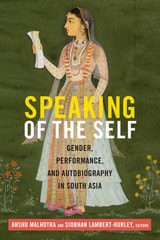
Speaking of the Self
Gender, Performance, and Autobiography in South AsiaAnshu Malhotra and Siobhan Lambert-Hurley, editors
Duke University Press, 2015
Contributors: Asiya Alam, Afshan Bokhari, Uma Chakravarti, Kathryn Hansen, Siobhan Lambert-Hurley, Anshu Malhotra, Ritu Menon, Shubhra Ray, Shweta Sachdeva Jha, Sylvia Vatuk
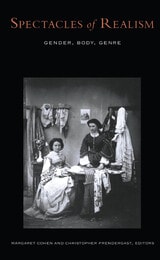
Spectacles Of Realism
Gender, Body, GenreMargaret Cohen
University of Minnesota Press, 1995
A rethinking of realism that reveals its relevance to sexual and cultural politics.
Despite rumors of its demise in literary theory and practice, realism persists. Why this is, and how realism is relevant to current interdisciplinary debates in gender studies and cultural studies, are the questions underlying Spectacles of Realism. With particular reference to nineteenth-century French culture, the contributors explore the role realism has played in the social construction of gender and sexuality. Among their subjects are nineteenth-century physiologies, photographs, caricatures, and Balzac’s Comédie humaine; the ethnographic claims of Goncourt’s naturalism and the historical claims of Zola’s; and the allure of exotica displayed at new museums and international expositions.
Contributors: April Alliston, Princeton U; Emily Apter, UCLA; Charles Bernheimer, U of Pennsylvania; Rhonda Garelick; Judith Goldstein, Vassar; Anne Higonnet, Wellesley; Roger Huss, Queen Mary and Westfield College; Dorothy Kelly, Boston U; Diana Knight, U of Nottingham; Jann Matlock, Harvard U; Linda Nochlin, NYU; Patrick O’Donovan, King’s College; Vanessa Schwartz, American U; Naomi Segal, U of Reading; Barbara Vinken, NYU.
Spectatorship
Shifting Theories of Gender, Sexuality, and MediaEdited by Roxanne Samer and William Whittington
University of Texas Press, 2017
Media platforms continually evolve, but the issues surrounding media representations of gender and sexuality have persisted across decades. Spectator: The University of Southern California Journal of Film and Television Criticism has published groundbreaking articles on gender and sexuality, including some that have become canonical in film studies, since the journal’s founding in 1982. This anthology collects seventeen key articles that will enable readers to revisit foundational concerns about gender in media and discover models of analysis that can be applied to the changing media world today.
Spectatorship begins with articles that consider issues of spectatorship in film and television content and audience reception, noting how media studies has expanded as a field and demonstrating how theories of gender and sexuality have adapted to new media platforms. Subsequent articles show how new theories emerged from that initial scholarship, helping to develop the fields of fandom, transmedia, and queer theory. The most recent work in this volume is particularly timely, as the distinctions between media producers and media spectators grow more fluid and as the transformation of media structures and platforms prompts new understandings of gender, sexuality, and identification. Connecting contemporary approaches to media with critical conversations of the past, Spectatorship thus offers important points of historical and critical departure for discussion in both the classroom and the field.

Spirituality, Gender, and the Self in Renaissance Italy
Angela Merici and the Company of St. Ursula (1474–1540)Querciolo Mazzonis
Catholic University of America Press, 2007

Splintered Sisterhood
Gender and Class in the Campaign against Woman SuffrageSusan E. Marshall
University of Wisconsin Press, 1997
When Tennessee became the thirty-sixth and final state needed to ratify the Nineteenth Amendment in August 1920, giving women the right to vote, one group of women expressed bitter disappointment and vowed to fight against “this feminist disease.” Why this fierce and extended opposition? In Splintered Sisterhood, Susan Marshall argues that the women of the antisuffrage movement mobilized not as threatened homemakers but as influential political strategists.
Drawing on surviving records of major antisuffrage organizations, Marshall makes clear that antisuffrage women organized to protect gendered class interests. She shows that many of the most vocal antisuffragists were wealthy, educated women who exercised considerable political influence through their personal ties to men in politics as well as by their own positions as leaders of social service committees. Under the guise of defending an ideal of “true womanhood,” these powerful women sought to keep the vote from lower-class women, fearing it would result in an increase in the “ignorant vote” and in their own displacement from positions of influence. This book reveals the increasingly militant style of antisuffrage protest as the conflict over female voting rights escalated. Splintered Sisterhood adds a missing piece to the history of women’s rights activism in the United States and illuminates current issues of antifeminism.
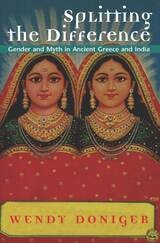
Splitting the Difference
Gender and Myth in Ancient Greece and IndiaWendy Doniger
University of Chicago Press, 1999
Myth, Doniger argues, responds to the complexities of the human condition by multiplying or splitting its characters into unequal parts, and these sloughed and cloven selves animate mythology's prodigious plots of sexuality and mortality. Doniger's comparisons show that ultimately differences in gender are more significant than differences in culture; Greek and Indian stories of doubled women resemble each other more than they do tales of doubled men in the same culture. In casting Hindu and Greek mythologies as shadows of each other, Doniger shows that culture is sometimes but the shadow of gender.

State of Virginity
Gender, Religion, and Politics in an Early Modern Catholic StateUlrike Strasser
University of Michigan Press, 2006
Winner: 2005 Book Award from the Society for the Study of Early Modern Women; Selected by the German Studies Association as one of the top five books of 2004 in early modern history
"A fresh, original study of gender roles and religious ideology in the early modern Catholic state. . . . Using a rich array of archival sources, Strasser explores ways in which an increasingly centralized Bavarian government in Munich inaugurated marriage and convent reforms and a civil religion based on the veneration of the Virgin Mary. Her carefully selected case studies show how church and state collaborated to produce a shared discourse and consistent policies proscribing extramarital sex, and excluding those without property from marriage. "
Ulrike Strasser is Associate Professor of History, Affiliate Faculty in Women's Studies, and Core Faculty in Religious Studies at the University of California, Irvine.

Stately Bodies
Literature, Philosophy, and the Question of GenderAdriana Cavarero
University of Michigan Press, 2002
She examines bodily metaphor in political discourse and in fictional depictions of politics, including Sophocles' Antigone, Plato's Timaeus, Livy, John of Salisbury, Shakespeare's Hamlet, and Hobbes' Leviathan. An appendix explores two texts by women that disrupt these notions: Maria Zambrano's Tomb of Antigone and Ingeborg Bachmann's Undine Goes.
Cavarero exposes the problematic nature of the mind/body dualism that has been essential in Western thought. Her insight that the expelled, depoliticized body is a female one becomes an instrument for decoding many paradoxical tropes of the political body. For instance, Cavarero revisits Antigone as the tragedy in which a body that is displaced, bleeding, and matrilinear allows the construction of a political order where misogynous rationality rules. Throughout the book, Cavarero argues that women have been cast by male thinkers into the realm of the corporeal as nonpolitical, and also suggests that this nonpolitical position is also a source of knowledge and power, that politics is a masculine pursuit that should not be admired or envied.
Adriana Cavarero is Professor of Philosophy, University of Verona, and frequently is Visiting Professor. New York University. Her books Relating Narratives: Storytelling and Selfhood and In Spite of Plato: A Feminist Rewriting of Ancient Philosophy were published by Routledge.
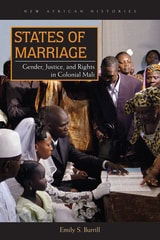
States of Marriage
Gender, Justice, and Rights in Colonial MaliEmily S. Burrill
Ohio University Press, 2015

Strained Sisterhood
Gender and Class in the Boston Female Anti-Slavery SocietyDebra Gold Hansen
University of Massachusetts Press, 1993
Debra Gold Hansen explores the origins of the equality-versus-difference debate by examining the Boston Female Anti-Slavery Society, which disbanded in 1840 over this very issue. After establishing a historical framework for women's lives in early nineteenth-century Boston, Hansen analyzes the membership of the Society along the lines of race, religion, and socioeconomic status. Through her findings, she concludes that many of the issues that estranged female abolitionists in antebellum Boston continue to divide women today, testifying not to the strength of the bonds between women but to the fragility of those ties.
Strange Affinities
The Gender and Sexual Politics of Comparative RacializationGrace Kyungwon Hong and Roderick A. Ferguson, eds.
Duke University Press, 2011
Contributors
Victor Bascara
Lisa Marie Cacho
M. Bianet Castellanos
Martha Chew Sánchez
Roderick A. Ferguson
Grace Kyungwon Hong
Helen H. Jun
Kara Keeling
Sanda Mayzaw Lwin
Jodi Melamed
Chandan Reddy
Ruby C. Tapia
Cynthia Tolentino

Strange Bodies
Gender and Identity in the Novels of Carson McCullersSarah Gleeson-White
University of Alabama Press, 2003
Adapts Mikhail Bakhtin's theory of the grotesque, as well as the latest in gender and psychoanalytic theory, to the major works of acclaimed southern writer Carson McCullers.
This innovative reconsideration of the themes of Carson McCullers's fiction argues that her work has heretofore suffered under the pall of narrow gothic interpretations, obscuring a more subversive agenda. By examining McCullers’s major novels—The Heart is a Lonely Hunter, Reflections in a Golden Eye, The Member of the Wedding, and The Ballad of the Sad Café—Gleeson-White locates a radical and specific form of the grotesque in the author's fiction: the liberating and redemptive possibilities of errant gender roles and shifting sexuality. She does this by employing Bakhtin's theory of the grotesque, which is both affirming and revolutionary, and thereby moves McCullers's texts beyond the 'gloom and doom' with which they have been charged for over fifty years.
The first chapter explores female adolescence by focusing on McCullers's tomboys in the context of oppressive southern womanhood. The second chapter analyzes McCullers's fascinating struggle to depict homosexual desire outside of traditional stereotypes. Gleeson-White then examines McCullers's portrayals of feminine and masculine gender through the tropes of cross-dressing, transvestism, and masquerade. The final chapter takes issue with earlier readings of androgyny in the texts to suggest a more useful concept McCullers herself called "the hybrid." Underpinning the whole study is the idea of a provocative, dynamic form of the grotesque that challenges traditional categories of normal and abnormal.
Because the characters and themes of McCullers's fiction were created in the 1940s and 1950s, a time of tension between the changing status of women and the southern ideal of womanhood, they are particularly fertile ground for a modern reexamination of this nature. Gleeson-White's study will be valued by scholars of American literature and gender and queer studies, by students of psychology, by academic libraries, and by readers of Carson McCullers. Strange Bodies is a thoughtful, highly credible analysis that adds dimension to the study of southern literature.

Styling Masculinity
Gender, Class, and Inequality in the Men's Grooming IndustryBarber, Kristen
Rutgers University Press, 2016

Survival at Treblinka
Geography, Gender, and Social Networks in Jewish ResistanceChad S.A. Gibbs
University of Wisconsin Press, 2026
On August 2, 1943, prisoners at the Nazi extermination camp Treblinka, located in occupied Poland, launched an uprising against their captors, during which hundreds successfully escaped while guards killed as many in the process. In this groundbreaking work, Chad S.A. Gibbs draws upon recently discovered sources and novel research methods to fundamentally reassess Jewish resistance at Treblinka—both before and during the revolt.
Using the testimonies of revolt survivors, prior escapees, those who passed through the camp, and a handful of bystander witnesses and former SS guards, Gibbs sheds new light on the events of August 2 as well as many prior acts of resistance. Critical to these new interpretations of the revolt are the actions of women prisoners, who here assume a central place in this story for the first time.