Results by title
86 books match the query 'Gerontology' and 6 start with s
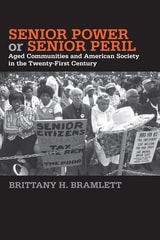
Senior Power or Senior Peril
Aged Communities and American Society in the Twenty-First CenturyBrittany H Bramlett
Temple University Press, 2015
As the Baby Boomer generation ages, the number of senior citizens as a proportion of the overall electorate is going to reach record numbers. This fact prompted Brittany Bramlett to ask: When senior citizens make up a large proportion of the local population, are they politically more powerful, or are they perhaps more powerless?
In Senior Power or Senior Peril, Bramlett examines the assertions that the increasing number of older adult-concentrated communities across the United States form a growing bloc of senior power that will influence the redistribution of particularized welfare benefits to older adults at the expense of younger people. However, others suggest that political influence declines with old age. Bramlett uses interviews and on-site research at various senior communities to explore what qualities make an aged community politically unique, and the impact of the local aged context on residents' political knowledge, safety-net policy attitudes, efficacy, and political activity.
This path-breaking book identifies the political behaviors, attitudes, and political consciousness of both older and younger residents as it recounts the perceived and actual political power of seniors.
In the series The Social Logic of Politics, edited by Scott McClurg
[more]

Social Patterns in Normal Aging
Findings from the Duke Longitudinal StudiesErdman Palmore
Duke University Press, 1981
Erdman Palmore has written a comprehensive, systematic summary of all extant findings on social patterns in normal aging learned from the landmark Duke Longitudinal Studies in aging. Palmore discusses the implications of these findings for major issues in gerontology and answers such questions as: Do elderly people reduce their social activity? Do they come to resemble one another or become more different as they age? Do major events in later life produce stress resulting in physical and/or mental illnesses? Does sexual activity maintain or reduce life satisfaction and longevity? Palmore's conclusions challenge many current ideas and prejudices widely held about people over the age of 65.
[more]
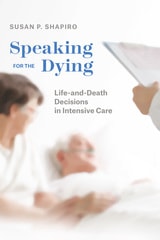
Speaking for the Dying
Life-and-Death Decisions in Intensive CareSusan P. Shapiro
University of Chicago Press, 2019
Seven in ten Americans over the age of age of sixty who require medical decisions in the final days of their life lack the capacity to make them. For many of us, our biggest, life-and-death decisions—literally—will therefore be made by someone else. They will decide whether we live or die; between long life and quality of life; whether we receive heroic interventions in our final hours; and whether we die in a hospital or at home. They will determine whether our wishes are honored and choose between fidelity to our interests and what is best for themselves or others. Yet despite their critical role, we know remarkably little about how our loved ones decide for us.
Speaking for the Dying tells their story, drawing on daily observations over more than two years in two intensive care units in a diverse urban hospital. From bedsides, hallways, and conference rooms, you will hear, in their own words, how physicians really talk to families and how they respond. You will see how decision makers are selected, the interventions they weigh in on, the information they seek and evaluate, the values and memories they draw on, the criteria they weigh, the outcomes they choose, the conflicts they become embroiled in, and the challenges they face. Observations also provide insight into why some decision makers authorize one aggressive intervention after the next while others do not—even on behalf of patients with similar problems and prospects. And they expose the limited role of advance directives in structuring the process decision makers follow or the outcomes that result.
Research has consistently found that choosing life or death for another is one of the most difficult decisions anyone can face, sometimes haunting families for decades. This book shines a bright light on a role few of us will escape and offers steps that patients and loved ones, health care providers, lawyers, and policymakers could undertake before it is too late.
[more]

Staging Ageing
Theatre, Performance and the Narrative of DeclineMichael Mangan
Intellect Books, 2013
How can plays and performances, past and present, inform our understanding of ageing? Drawing primarily on the Western dramatic canon, on contemporary British theater, on popular culture, and on paratheatrical practices, Staging Ageing investigates theatrical engagement with ageing from the Greek chorus to Reminiscence Theater. It also explores the relationship of the plays, performances, and practices to the material, social, and ideological conditions that produced them. A seminal work on the cultural past and present of ageing, the book will find grateful audiences not only among scholars but also among theater and health care professionals.
[more]
Studies in the Economics of Aging
Edited by David A. Wise
University of Chicago Press, 1994
Studies in the Economics of Aging is the fourth book in a series from the National Bureau of Economic Research that addresses economic issues in aging and retirement. Building on the research in The Economics of Aging (1989), Issues in the Economics of Aging (1990), and Topics in the Economics of Aging (1992), this volume examines elderly population growth and government spending, life expectancy and health, saving for retirement and housing values, aging in Germany and Taiwan, and the utilization of nursing home and other long-term care.
[more]
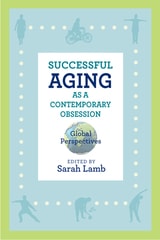
Successful Aging as a Contemporary Obsession
Global PerspectivesLamb, Sarah
Rutgers University Press, 2017
In recent decades, the North American public has pursued an inspirational vision of successful aging—striving through medical technique and individual effort to eradicate the declines, vulnerabilities, and dependencies previously commonly associated with old age. On the face of it, this bold new vision of successful, healthy, and active aging is highly appealing. But it also rests on a deep cultural discomfort with aging and being old.
The contributors to Successful Aging as a Contemporary Obsession explore how the successful aging movement is playing out across five continents. Their chapters investigate a variety of people, including Catholic nuns in the United States; Hindu ashram dwellers; older American women seeking plastic surgery; aging African-American lesbians and gay men in the District of Columbia; Chicago home health care workers and their aging clients; Mexican men foregoing Viagra; dementia and Alzheimer sufferers in the United States and Brazil; and aging policies in Denmark, Poland, India, China, Japan, and Uganda. This book offers a fresh look at a major cultural and public health movement of our time, questioning what has become for many a taken-for-granted goal—aging in a way that almost denies aging itself.
The contributors to Successful Aging as a Contemporary Obsession explore how the successful aging movement is playing out across five continents. Their chapters investigate a variety of people, including Catholic nuns in the United States; Hindu ashram dwellers; older American women seeking plastic surgery; aging African-American lesbians and gay men in the District of Columbia; Chicago home health care workers and their aging clients; Mexican men foregoing Viagra; dementia and Alzheimer sufferers in the United States and Brazil; and aging policies in Denmark, Poland, India, China, Japan, and Uganda. This book offers a fresh look at a major cultural and public health movement of our time, questioning what has become for many a taken-for-granted goal—aging in a way that almost denies aging itself.
[more]