Results by title
98 books match the query 'Government' and 4 start with s

Service and Procedures in Bureaucracy
A Case StudyRoy G. Francis and Robert C. Stone
University of Minnesota Press, 1956
Service and Procedures in Bureaucracy was first published in 1956. Minnesota Archive Editions uses digital technology to make long-unavailable books once again accessible, and are published unaltered from the original University of Minnesota Press editions.
Large, complex systems of organization, such as government bureaus, giant corporations, and massive trade unions, play a decisive role in the daily lives of millions of people and exert an important influence upon national and even international affairs. This gives major sociological significance to the bureaucratic organizations of such groups.
The research reported here was undertaken to test two widespread beliefs about modern, largescale organizations, and the findings point to modifications in what has been regarded as the classic sociological concept of bureaucracy.
Does the personnel in bureaucracies commonly substitute rule-following, preoccupation with procedure, for the intended service purpose of the organization? And are bureaucracies characterized by impersonality, that is, detachment of office from individual, so that relations are between offices rather than between individuals? These are the questions the authors sought to answer in their study of the Louisiana Division of Employment Security. They observed employees working at their jobs, conducted interviews, administered questionnaires, and studied the official documents and records of the organization.
Here is a picture of bureaucracy in real life that will provide valuable insight to those actively concerned with administration and personnel problems, as well as to students in the social sciences.

Sport and the Law
Historical and Cultural IntersectionsSamuel O. Regalado
University of Arkansas Press, 2014
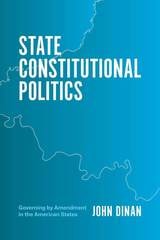
State Constitutional Politics
Governing by Amendment in the American StatesJohn Dinan
University of Chicago Press, 2018
With State Constitutional Politics, John Dinan looks at the various occasions in American history when state constitutional amendments have served as instruments of governance. Among other things, amendments have constrained state officials in the way they levy taxes and spend money; enacted policies unattainable through legislation on issues ranging from minimum wage to the regulation of marijuana; and updated understandings of rights, including religious liberty, equal protection, and the right to bear arms. In addition to comprehensively chronicling the ways amendments shape politics in the states, Dinan also assesses the consequences of undertaking changes in governance through amendments rather than legislation or litigation. For various reasons, including the greater stability and legitimacy of changes achieved through the amendment process, he argues that it might be a more desirable way of achieving change.
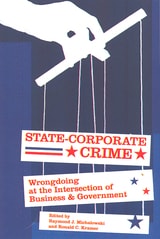
State-Corporate Crime
Wrongdoing at the Intersection of Business and GovernmentMichalowski, Raymond J
Rutgers University Press, 2006
Despite growing attention to crimes by those in positions of trust, however, violations in business and similar wrongdoing in government are still often treated as fundamentally separate problems. In State-Corporate Crime, Raymond J. Michalowski and Ronald C. Kramer bring together fifteen essays to show that those in positions of political and economic power frequently operate in collaboration, and are often all too willing to sacrifice the well-being of the many for the private profit and political advantage of the few.
Drawing on case studies including the explosion of the space shuttle Challenger, Ford Explorer rollovers, the crash of Valujet flight 592, nuclear weapons production, and war profiteering, the essays bear frank witness to those who have suffered, those who have died, and those who have contributed to the greatest human and environmental devastations of our time. This book is a much needed reminder that the most serious threats to public health, security, and safety are not those petty crimes that appear nightly on local news broadcasts, but rather are those that result from corruption among the wealthiest and most powerful members of society.