Results by title
90 books match the query 'Growth' and 10 start with s
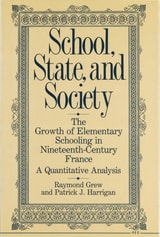
School, State, and Society
The Growth of Elementary Schooling in Nineteenth-Century France--A Quantitative AnalysisRaymond Grew and Patrick J. Harrigan
University of Michigan Press, 1992
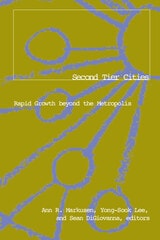
Second Tier Cities
Rapid Growth beyond the MetropolisAnn Markusen
University of Minnesota Press, 1999
Analyzes and compares the rapid growth of medium-sized cities.
Over the past thirty years, transnational investment, trade, and government policies have encouraged the decentralization of national economies, disrupting traditional patterns of urban and regional growth. Many smaller cities-such as Seattle, Washington; Campinas, Brazil; Oita, Japan; and Kumi, Korea-have grown markedly faster than the largest metropolitan regions. These “second tier cities” are home to specialized industrial complexes that have taken root, provided significant job growth, and attracted mobile capital and labor.
The culmination of an ambitious five-year, fourteen-city research project conducted by an international team of economists and geographers, Second Tier Cities examines the potential of these new regions to balance uneven regional development, create good, stable jobs, and moderate hyper-urbanization. Comparing across national borders, the contributors describe four types of second tier cities: Marshallian industrial districts, hub-and-spoke cities, satellite platforms, and government-anchored complexes. They find that both industrial and regional policies have been important contributors to the rise of second tier cities, though the former often trump the latter. Lessons for local, national, and international policymakers are drawn. The authors are critical of devolution and argue that it must be accompanied by strong labor and environmental standards and mechanisms to overcome differential regional resource endowments.Contributors: Clelio Campolina Diniz, U Federal de Minas Gerais, Brazil; Masatomi Funaba, Kobe U of Commerce, Japan; Elyse Golob, NYC Economic Development Goup; Mia Gray, Cambridge U; Jun Ho Jeong, Oxford U; Sam Ock Park, Seoul National U; Mohammad Razavi; Fabiana Borges T. Santos, U Federal de Minas Gerais, Brazil; and Masayuki Sasaki, Kanzawa U, Japan.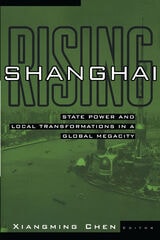
Shanghai Rising
State Power and Local Transformations in a Global MegacityXiangming Chen
University of Minnesota Press, 2009
Analyzing a Chinese city’s dazzling rise to global megacity status
Until around 1990, Shanghai was China’s premier but sluggish industrial center. Now at the beginning of the twenty-first century, the joint impact of global forces and state power has turned Shanghai into a dynamic megacity. Shanghai’s remarkable growth in economy, infrastructure, and global presence has prompted questions about the Shanghai “miracle.” This collection places the city’s unprecedented rise in a rare comparative examination of U.S. cities, as well as with Asian megacities Singapore and Hong Kong, providing a nuanced account of how Shanghai’s politics, economy, society, and space have been transformed by macro- and micro-level forces.
Contributors: Stephen W. K. Chiu, Chinese U of Hong Kong; K. C. Ho, National U of Singapore; John D. Kasarda, U of North Carolina; Hanlong Lu, Shanghai Academy of Social Sciences; Tai-lok Lui, Chinese U of Hong Kong; Ann R. Markusen, U of Minnesota; Anthony M. Orum, U of Illinois, Chicago; Yuan Ren, Fudan U Shanghai; Saskia Sassen, Columbia U; Jiaming Sun, Texas A&M U, Commerce; Fulong Wu, Cardiff U; Pingkang Yu, George Washington U; Tingwei Zhang, U of Illinois, Chicago; Zhenhua Zhou, Development Research Center, Shanghai Municipal Government.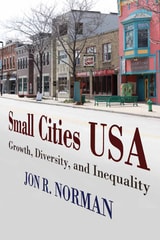
Small Cities USA
Growth, Diversity, and InequalityNorman, Jon R
Rutgers University Press, 2012
Drawing on an assessment of eighty small cities between 1970 and 2000, Norman considers the factors that have altered the physical, social, and economic landscapes of such places. These cities are examined in relation to new patterns of immigration, shifts in the global economy, and changing residential preferences. Small Cities USA presents the first large-scale comparison of smaller cities over time in the United States, showing that small cities that have prospered over time have done so because of diverse populations and economies. These "glocal" cities, as Norman calls them, are doing well without necessarily growing into large metropolises.
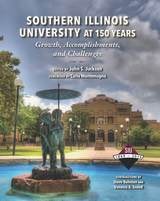
Southern Illinois University at 150 Years
Growth, Accomplishments, and ChallengesEdited by John S. Jackson with a Foreword by Carlo Montemagno and Contributions by Steve Buhman and Vanessa A. Sneed
Southern Illinois University Press, 2019
Chapters reflect on SIU’s successful athletics program, the various colleges and departments within the university, the diverse holdings and collections of the library, the unique innovative research enterprises, and special programs such as the Paul Simon Public Policy Institute and Touch of Nature Environmental Center.
Although SIU may be a typical large public university in many ways, its unique location, history, and culture have made it a distinct institution of higher education. Located close to the Shawnee National Forest and Giant City State Park, the landscape is an indelible part of SIU, contributing to both the beauty of the university grounds and the campus culture.
The university’s sesquicentennial provides a wonderful opportunity to revisit all that makes SIU amazing. Illustrated with 306 photographs of theater and music performances, art, sports, past and present students, faculty, staff, administration, politicians, community members, successful alums, distinguished visitors, and patrons of the university buildings, and landscapes, Southern Illinois University at 150 Years captures the university’s story in all its vivid color.

Sprawl
A Compact HistoryRobert Bruegmann
University of Chicago Press, 2005
In his incisive history of the expanded city, Bruegmann overturns every assumption we have about sprawl. Taking a long view of urban development, he demonstrates that sprawl is neither recent nor particularly American but as old as cities themselves, just as characteristic of ancient Rome and eighteenth-century Paris as it is of Atlanta or Los Angeles. Nor is sprawl the disaster claimed by many contemporary observers. Although sprawl, like any settlement pattern, has undoubtedly produced problems that must be addressed, it has also provided millions of people with the kinds of mobility, privacy, and choice that were once the exclusive prerogatives of the rich and powerful.
The first major book to strip urban sprawl of its pejorative connotations, Sprawl offers a completely new vision of the city and its growth. Bruegmann leads readers to the powerful conclusion that "in its immense complexity and constant change, the city-whether dense and concentrated at its core, looser and more sprawling in suburbia, or in the vast tracts of exurban penumbra that extend dozens, even hundreds, of miles-is the grandest and most marvelous work of mankind."
“There are scores of books offering ‘solutions’ to sprawl. Their authors would do well to read this book.”—Witold Rybczynski, Slate
St. Louis
Evolution Of American Urban LandscapeERIC SANDWEISS
Temple University Press, 2001
In this book, Eric Sandweiss scrutinizes the everyday landscape -- streets, houses, neighborhoods, and public buildings -- as it evolved in a classic American city. Bringing to life the spaces that most of us pass without noticing, he reveals how the processes of dividing, trading, improving, and dwelling upon land are acts that reflect and shape social relations. From its origins as a French colonial settlement in the eighteenth century to the present day, St. Louis offers a story not just about how our past is diagrammed in brick and asphalt, but also about the American city's continuing viability as a place where the balance of individual rights and collective responsibilities can be debated, demonstrated and adjusted for generations to come.

St. Thomas and the Rites of Man
A Historical Study of the Summa Theologiae, Tertia Pars, Question 83, Articles 4 & 5Niels Krogh Rasmussen
Catholic University of America Press, 2026

Structural Impediments to Growth in Japan
Edited by Magnus Blomström, Jennifer Corbett, Fumio Hayashi, and Anil Kashyap
University of Chicago Press, 2003
In this, the first book-length academic treatment of this important issue, a team of notable contributors present nine papers, offering a comprehensive assessment of those economic difficulties and addressing a range of specific issues, from financial restructuring and the impact of the aging Japanese population to corporate behavior, public lending, employment practices, and innovative capacity. In each paper, contributors clearly identify and outline problems and concerns, carefully pose provocative questions, and in many instances present concrete suggestions for improvement.
The resulting volume is a timely and important examination of critical issues for Japan's stalling economy, packed with both telling data and expert analysis and offering valuable perspectives on Japan's current obstacles.
Sustaining Cities
Urban Policies, Practices, and PerceptionsKrause, Linda
Rutgers University Press, 2012
What has happened to cities after the global economic recession? Sustaining Cities answers this question by explaining how failed governmental policies contributed to urban problems and offering best practices for solving them.
From social scientists and urban planners to architects and literary and film critics, the authors of this unique collection suggest real responses to this crisis. Could the drastic declines in housing markets have been avoided? Yes, if we reframe our housing values. Do you want to attract corporate investment to your town? You might want to think twice about doing so. The extinction of the “Celtic Tiger” may be charted in statistics, but the response in popular Irish mystery novels is much more compelling. China, while not immune to market vicissitudes, still booms, but at a considerable cost to its urban identities.
Whether constructing a sustainable social framework for Mexican mega-cities or a neighborhood in London, these nine essays consider some strikingly similar strategies. And perhaps, as the contributors suggest, it’s time to look beyond the usual boundaries of urban, suburban, and exurban to forge new links among these communities that will benefit all citizens. Accessible to anyone with an interest in how cities cope today, Sustaining Cities presents a cautionary tale with a hopeful ending.