Results by title
89 books match the query 'Historic sites' and 8 start with s
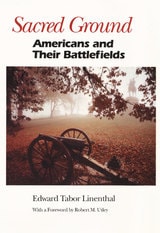
Sacred Ground
AMERICANS AND THEIR BATTLEFIELDSEdward Tabor Linenthal
University of Illinois Press, 1991
famous battlefields through patriotic rhetoric, monument building, physical
preservation, and battle reenactment. But each site is also a place where
different groups of Americans come to compete for ownership of cherished
national stories and to argue about the meaning of war, the importance
of martial sacrifice, and the significance of preserving the nation's
patriotic landscape.
From the anniversary speeches at Lexington and Concord that shaped the
image of the minuteman to Alamo Day speeches invoking the Texas "freedom
fighters" of 1836 in support of the contras in Nicaragua; from passionate
arguments over the placement of Confederate monuments at Gettysburg to
confrontations between militant American Indian Movement and "Custer
loyalists" during the Little Bighorn centennial in 1976; from the
treatment of the USS Arizona at Pearl Harbor to continuing attempts
to maintain the purity of these places in the face of commercialization---Sacred
Ground details the ongoing struggles to define, control, and subvert
patriotic faith as expressed at these ceremonial sites.
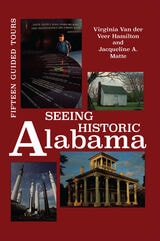
Seeing Historic Alabama
Fifteen Guided ToursVirginia Van der Veer Hamilton
University of Alabama Press, 1996
Revised and updated.
A trusted guide to Alabama's historic treasures and cultural landmarks.
Don’t drive anywhere in this state without taking along this useful, handy guide. Originally published in 1982, Professor Hamilton’s much acclaimed Seeing Historic Alabama: Fifteen Guided Tours was enthusiastically received around the state. Reviewers throughout Alabama praised her work, her artist’s eye for landscape and architecture, as well as her “historian’s devotion to fact and motorist’s appreciation for specific directions.” This praise extended beyond the state lines to publications in the greater Southeast, which recommend the volume to readers planning travel to or through Alabama.
Hamilton and Matte's thoroughly revised and updated edition of Seeing Historic Alabama introduces readers to the history of Alabama by way of visits to the buildings and sites where historic events took place, from prehistoric time to the present. Its aim is to appeal to a wide range of readers and travelers—natives and residents of Alabama, students of all ages, newcomers to the state, and tourists. This guide offers tours arranged in geographical segments that can be taken in a few hours, in a day trip, or over the course of several days. A handy guide to keep at ready in the glove compartment for easy reference wherever you travel.
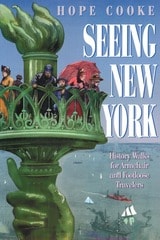
Seeing New York
History Walks for Armchair and Footloose TravelersHope Cooke
Temple University Press, 1995
Since the 1700s, various ethnic and immigrant groups have been shifting and negotiating their place in New York City. Hope Cooke also struggled to find a "correlation of space" and "sense of belonging" when she returned to the city after spending her adult life living in a place in the Himalayas, the Queen of Sikkim (a tiny kingdom near Nepal). Abroad for so long, she returned with an urgent need to rediscover this city, to "find her way home."
It was not always a comfortable journey for Cooke: "On the days I felt secure, Manhattan's maelstrom was pure energy. On shaky days, the boundlessness made me yearn for limits, or, failing that, at least a vantage point." The book that has emerged is an entertaining and integrated account of New York City's social history, architecture, physical space, and culture. Starting with the American Indian settlements and the early days when the southern-most tip of Manhattan held little more than a bleak outpost of Dutch fur traders, Cooke tracks the economic development and journeys north, from the Village's beginnings as a refuge from dreaded summer fevers to the present day Dominican enclave of Washington Heights.
Written for armchair enthusiasts and walkabout adventurers, this book travels fourteen of the city's distinct and significant neighborhoods. Cooke's guide will make a historical sleuth out of local residents and tourists alike. Her off-the-beaten-path insights and witty observations help decode the urban landscape and reveal how social changes have reworked the city's terrain. Enhancing the narrative are 140 illustrations, including old engravings, maps, and current photographs.
In the series Critical Perspectives on the Past, edited by Susan Porter Benson, Stephen Brier, and Roy Rosenzweig.
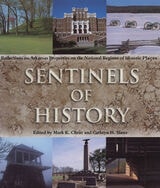
Sentinels of History
Reflections on Arkansas Properties on the National Register of Historic PlacesMark Christ
University of Arkansas Press, 2000
Shadowed Ground
America’s Landscapes of Violence and TragedyBy Kenneth E. Foote
University of Texas Press, 2003
Winner, John Brinckerhoff Jackson Prize, Association of American Geographers, 1997
Shadowed Ground explores how and why Americans have memorialized—or not—the sites of tragic and violent events spanning three centuries of history and every region of the country. For this revised edition, Kenneth Foote has written a new concluding chapter that looks at the evolving responses to recent acts of violence and terror, including the destruction of the Branch Davidian compound at Waco, Texas, the Oklahoma City bombing, the Columbine High School massacre, and the terrorist attacks of 9/11.
Simming
Participatory Performance and the Making of MeaningScott Magelssen
University of Michigan Press, 2014
At an ecopark in Mexico, tourists pretend to be illegal migrants, braving inhospitable terrain and the U.S. Border Patrol as they attempt to cross the border. At a living history museum in Indiana, daytime visitors return after dark to play fugitive slaves on the Underground Railroad. In the Mojave Desert, the U.S. Army simulates entire provinces of Iraq and Afghanistan, complete with bustling villages, insurgents, and Arabic-speaking townspeople, to train soldiers for deployment to the Middle East. At a nursing home, trainees put on fogged glasses and earplugs, thick bands around their finger joints, and sandbag harnesses to simulate the effects of aging and to gain empathy for their patients.
These immersive environments in which spectator-participants engage in simulations of various kinds—or “simming”—are the subject of Scott Magelssen’s book. His book lays out the ways in which simming can provide efficacy and promote social change through affective, embodied testimony. Using methodology from theater history and performance studies (particularly as these fields intersect with cultural studies, communication, history, popular culture, and American studies), Magelssen explores the ways these representational practices produce, reify, or contest cultural and societal perceptions of identity.
Sites, Bodies and Stories
Imagining Indonesian HistoryEdited by Susan Legêne, Bambang Purwanto, and Henk Schulte Nordholt
National University of Singapore Press, 2015
Contemporary heritage formation in Indonesia is intrinsically linked to a canon of Indonesian art and culture developed during Dutch colonial rule, institutionalized within Indonesia’s heritage infrastructure and in the Netherlands, and echoed in museums and exhibitions throughout the world. The authors in this volume acknowledge colonial legacies but argue against a colonial determinism, considering instead how contemporary heritage initiatives can lead to new interpretations of the past.
Sweet Cane
The Architecture of the Sugar Works of East FloridaLucy B. Wayne
University of Alabama Press, 2010
From the late eighteenth century to early 1836, the heart of the Florida sugar industry was concentrated in East Florida, between the St. Johns River and the Atlantic Ocean. Producing the sweetest sugar, molasses, and rum, at least 22 sugar plantations dotted the coastline by the 1830s. This industry brought prosperity to the region—employing farm hands, slaves, architects, stone masons, riverboats and their crews, shop keepers, and merchant traders. But by January 1836, Native American attacks of the Second Seminole War, intending to rid the Florida frontier of settlers, devastated the whole sugar industry.
Although sugar works again sprang up in other Florida regions just prior to the Civil War, the competition from Louisiana and the Caribbean blocked a resurgence of sugar production for the area. The sugar industry would never regain its importance in East Florida—only two of the original sugar works were ever rebuilt. Today, remains of this once thriving industry are visible in a few parks. Some are accessible but others lie hidden, slowly disintegrating and almost forgotten. Archaeological, historical, and architectural research in the last decade has returned these works to their once prominent place in Florida’s history, revealing the beauty, efficiency of design, as well as early industrial engineering. Equally important is what can be learned of the lives of those associated with the sugar works and the early plantation days along the East Florida frontier