Results by title
69 books match the query 'Homosexuality and literature' and 9 start with s
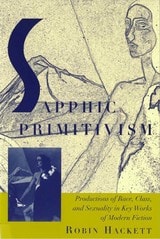
Sapphic Primitivism
Productions of Race, Class, and Sexuality in Key Works of Modern FictionHackett, Robin
Rutgers University Press, 2003
In this book, Robin Hackett examines portrayals of race, class, and sexuality in modernist texts by white women to argue for the existence of a literary device that she calls “Sapphic primitivism.” The works vary widely in their form and content and include Olive Schreiner’s proto-modernist exploration of New Womanhood, The Story of an African Farm; Virginia Woolf’s high modernist “play-poem,” The Waves; Sylvia Townsend Warner’s historical novel, Summer Will Show; and Willa Cather’s Southern pastoral, Sapphira and the Slave Girl. In each, blackness and working-class culture are figured to represent sexual autonomy, including lesbianism, for white women. Sapphic primitivism exposes the ways several classes of identification were intertwined with the development of homosexual identities at the turn of the century. Sapphic primitivism is not, however, a means of disguising lesbian content. Rather, it is an aesthetic displacement device that simultaneously exposes lesbianism and exploits modern, primitivist modes of self-representation. Hackett’s revelations of the mutual interests of those who study early twentieth-century constructions of race and sexuality and twenty-first-century feminists doing anti-racist and queer work are a major contribution to literary studies and identity theory.

Sappho in Early Modern England
Female Same-Sex Literary Erotics, 1550-1714Harriette Andreadis
University of Chicago Press, 2001
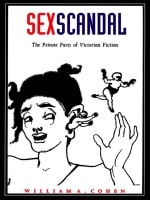
Sex Scandal
The Private Parts of Victorian FictionWilliam A. Cohen
Duke University Press, 1996
Scandal, then as now, makes public the secret indiscretions of prominent people, engrossing its audience in salacious details that violate the very code of propriety it aims to enforce. In narratives ranging from Great Expectations to the Boulton and Park sodomy scandal of 1870–71, from Eliot’s and Trollope’s novels about scandalous women to Oscar Wilde’s writing and his trials for homosexuality, Cohen shows how, in each instance, sexuality appears couched in coded terms. He identifies an assortment of cunning narrative techniques used to insinuate sex into Victorian writing, demonstrating that even as such narratives air the scandalous subject, they emphasize its unspeakable nature.
Written with an eye toward the sex scandals that still whet the appetites of consumers of news and novels, this work is suggestive about our own modes of imagining sexuality today and how we arrived at them. Sex Scandal will appeal to scholars and general readers interested in Victorian literature, the history of sexuality, gender studies, nineteenth-century Britain, and gay, lesbian, and queer studies.
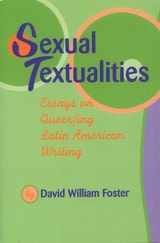
Sexual Textualities
Essays on Queer/ing Latin American WritingBy David William Foster
University of Texas Press, 1997
Since the 1991 publication of his groundbreaking book Gay and Lesbian Themes in Latin American Writing, David William Foster has proposed a series of theoretical and critical principles for the analysis of Latin American culture from the perspectives of the queer. This book continues that project with a queer reading of literary and cultural aspects of Latin American texts.
Moving beyond its predecessor, which provided an initial inventory of Latin American gay and lesbian writing, Sexual Textualities analyzes questions of gender representation in Latin American cultural productions to establish the interrelationships, tensions, and irresolvable conflicts between heterosexism and homoeroticism. The topics that Foster addresses include Eva Peron as a cultural/sexual icon, feminine pornography, Luis Humberto Hermosillo's classic gay film Doña Herlinda y su hijo, homoerotic writing and Chicano authors, Matias Montes Huidobro's Exilio and the representation of gay identity, representation of the body in Alejandra Pizarnik's poetry, and the crisis of masculinity in Argentine fiction from 1940 to 1960.

Shared Secrets
The Queer World of Newbery Medalist Charles J. FingerElizabeth Findley Shores
University of Arkansas Press, 2021
Winner, 2023 Booker Worthern Literary Prize
For nearly a century, British expatriate Charles Joseph Finger (1867–1941) was best known as an award-winning author of children’s literature. In Shared Secrets, Elizabeth Findley Shores relates Finger’s untold story, exploring the secrets that connected the author to an international community of twentieth-century queer literati.
As a young man, Finger reveled in the easy homosociality of his London polytechnical school, where he launched a student literary society in the mold of the city’s private men’s clubs. Throughout his life, as he wandered from England to Patagonia to the United States, he tried to recreate similarly open spaces—such as Gayeta, his would-be art colony in Arkansas. But it was through his idiosyncratic magazine All’s Well that he constructed his most successful social network, writing articles filled with coded signals and winking asides for an inner circle of understanding readers.
Capitalizing on the publishing opportunities of the day, Finger used every means available to express his twin loves—literature and men. He produced an enormous body of work, and his short, semiautobiographical fiction won some critical acclaim. Ultimately, the children’s book that won Finger a Newbery Medal ushered him into the public eye, ending his development as an author of serious queer literature.
Shared Secrets is both the story of Finger’s remarkable, adventurous life and a rare look at a community of gay writers and artists who helped shaped twentieth-century American culture, even as they artfully concealed their own identities.

Stagestruck
Theater, AIDS, and the Marketing of Gay AmericaSarah Schulman
Duke University Press, 1998
Closely recounting her discovery of the ways in which Rent took materials from her own novel, Schulman takes us on her riveting and infuriating journey through the power structures of New York theater and media, a journey she pursued to seek legal restitution and make her voice heard. Then, to provide a cultural context for the emergence of Rent—which Schulman experienced first-hand as a weekly theater critic for the New York Press at the time of Rent’s premiere—she reveals in rich detail the off- and off-off-Broadway theater scene of the time. She argues that these often neglected works and performances provide more nuanced and accurate depictions of the lives of gay men, Latinos, blacks, lesbians and people with AIDS than popular works seen in full houses on Broadway stages. Schulman brings her discussion full circle with an incisive look at how gay and lesbian culture has become rapidly commodified, not only by mainstream theater productions such as Rent but also by its reduction into a mere demographic made palatable for niche marketing. Ultimately, Schulman argues, American art and culture has made acceptable a representation of “the homosexual” that undermines, if not completely erases, the actual experiences of people who continue to suffer from discrimination or disease. Stagestruck’s message is sure to incite discussion and raise the level of debate about cultural politics in America today.
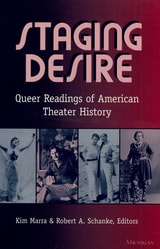
Staging Desire
Queer Readings of American Theater HistoryKim Marra and Robert A. Schanke, Editors
University of Michigan Press, 2002
Essays cover the careers of major figures Clyde Fitch, Rachel Crothers, Mercedes de Acosta, Djuna Barnes, Cole Porter, Lorenz Hart, George Kelly, William Inge, James "Acorn" Oaks, Adam "Vagabond" Badeau, Eric Bentley, Loie Fuller, Robert Edmond Jones, and Jean Rosenthal. Grounded in research into the history of sexuality, the book engages central problems of terminology and evidence in analyzing sexual practices of the past and the modes of articulation of sexuality in theater, conditioned by American culture's peculiar anxieties about both.
Kim Marra is Associate Professor of Theatre Arts, University of Iowa. Robert A. Schanke is Professor of Theatre, Central College, Iowa. They edited Passing Performances: Queer Readings of Leading Players in American Theater History, a previous volume in this series.
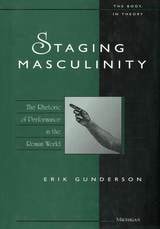
Staging Masculinity
The Rhetoric of Performance in the Roman WorldErik Gunderson
University of Michigan Press, 2000

Such Is My Love
A Study of Shakespeare's SonnetsJoseph Pequigney
University of Chicago Press, 1985