Results by title
56 books match the query 'Homosexuality in literature' and 4 start with s
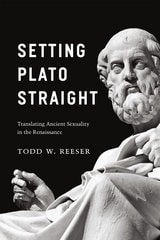
Setting Plato Straight
Translating Ancient Sexuality in the RenaissanceTodd W. Reeser
University of Chicago Press, 2015
In Setting Plato Straight, Todd W. Reeser undertakes the first sustained and comprehensive study of Renaissance textual responses to Platonic same-sex sexuality. Reeser mines an expansive collection of translations, commentaries, and literary sources to study how Renaissance translators transformed ancient eros into non-erotic, non-homosexual relations. He analyzes the interpretive lenses translators employed and the ways in which they read and reread Plato’s texts. In spite of this cleansing, Reeser finds surviving traces of Platonic same-sex sexuality that imply a complicated, recurring process of course-correction—of setting Plato straight.
Sexual Textualities
Essays on Queer/ing Latin American WritingBy David William Foster
University of Texas Press, 1997
Since the 1991 publication of his groundbreaking book Gay and Lesbian Themes in Latin American Writing, David William Foster has proposed a series of theoretical and critical principles for the analysis of Latin American culture from the perspectives of the queer. This book continues that project with a queer reading of literary and cultural aspects of Latin American texts.
Moving beyond its predecessor, which provided an initial inventory of Latin American gay and lesbian writing, Sexual Textualities analyzes questions of gender representation in Latin American cultural productions to establish the interrelationships, tensions, and irresolvable conflicts between heterosexism and homoeroticism. The topics that Foster addresses include Eva Peron as a cultural/sexual icon, feminine pornography, Luis Humberto Hermosillo's classic gay film Doña Herlinda y su hijo, homoerotic writing and Chicano authors, Matias Montes Huidobro's Exilio and the representation of gay identity, representation of the body in Alejandra Pizarnik's poetry, and the crisis of masculinity in Argentine fiction from 1940 to 1960.
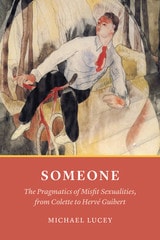
Someone
The Pragmatics of Misfit Sexualities, from Colette to Hervé GuibertMichael Lucey
University of Chicago Press, 2019
In Someone, Michael Lucey considers characters from twentieth-century French literary texts whose sexual forms prove difficult to conceptualize or represent. The characters expressing these “misfit” sexualities gravitate towards same-sex encounters. Yet they differ in subtle but crucial ways from mainstream gay or lesbian identities—whether because of a discordance between gender identity and sexuality, practices specific to a certain place and time, or the fleetingness or non-exclusivity of desire. Investigating works by Simone de Beauvoir, Colette, Jean Genet, and others, Lucey probes both the range of same-sex sexual forms in twentieth-century France and the innovative literary language authors have used to explore these evanescent forms.
As a portrait of fragile sexualities that involve awkward and delicate maneuvers and modes of articulation, Someone reveals just how messy the ways in which we experience and perceive sexuality remain, even to ourselves.
South Africa and the Dream of Love to Come
Queer Sexuality and the Struggle for FreedomBrenna M. Munro
University of Minnesota Press, 2012
After apartheid, South Africa established a celebrated new political order that imagined the postcolonial nation as belonging equally to the descendants of indigenous people, colonizing settlers, transported slaves, indentured laborers, and immigrants. Its constitution, adopted in 1996, was the first in the world to include gays and lesbians as full citizens. Brenna M. Munro examines the stories that were told about sexuality, race, and nation throughout the struggle against apartheid in order to uncover how these narratives ultimately enabled gay people to become imaginable as fellow citizens. She also traces how the gay, lesbian, or bisexual person appeared as a stock character in the pageant of nationhood during the transition to democracy. In the process, she offers an alternative cultural history of South Africa.
Munro asserts that the inclusion of gay people made South Africans feel “modern”—at least for a while. Being gay or being lesbian was reimagined in the 1990s as distinctly South African, but the “newness” that made these sexualities apt symbols for a transformed nation can also be understood as foreign and un-African. Indeed, a Western-style gay identity is often interpreted through the formula “gay equals modernity equals capitalism.” As South Africa’s reentrance into the global economy has failed to bring prosperity to the majority of its citizens, homophobic violence has been on the rise.
Employing a wide array of texts—including prison memoirs, poetry, plays, television shows, photography, political speeches, and the postapartheid writings of Nobel Laureates Nadine Gordimer and J. M. Coetzee—Munro reports on how contemporary queer activists and artists are declining to remain ambassadors for the “rainbow nation” and refusing to become scapegoats for the perceived failures of liberation and liberalism.