Results by title
192 books match the query 'Humor' and 13 start with s
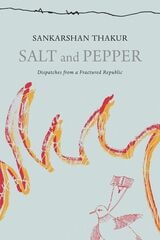
Salt and Pepper
Selected Literary ColumnsSankarshan Thakur
Seagull Books, 2026
Salt and Pepper is a collection of literary columns that defy convention—acerbic, tender, and unrelenting in their gaze. Written between the margins of news and national spectacle, these pieces are not topical commentary but something far more enduring: political satire that reads like poetry, reportage that mutates into parable, lament, and fable. In these dispatches from a fractured republic, written over the past decade, journalist Sankarshan Thakur captures the surreal absurdities and deep disquiet of an India caught between thunderous assertion and muffled dissent. Governments speak in acronyms, mobs chant in hashtags, silence acquires a sound—and memory becomes an act of resistance. These are chronicles of a society slipping into curated amnesia, of belonging turned conditional, and of patriotism twisted into performance.
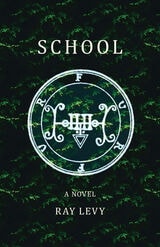
School
A NovelRay Levy
University of Alabama Press, 2023
Both an exorcism of contemporary academia and a comedic portrait of an artist seeking the means to survive.
At once angry and jubilant, Ray Levy’s School is a curse on a dying system and an incantation for transforming pain into a vessel for capacious, creative selfhood.
A dissertation manuscript possessed by the spirit of Marquis de Sade; a lecture on psychoanalysis delivered as stand-up comedy by a dysphoric graduate student; a review of a found-footage horror movie that’s also a YouTube video of a conference presentation on French theory; an interview with an avant-garde filmmaker that’s really an invocation for conjuring your demon brother; oversharing and withholding, chanting and channeling, School is a slapstick roast of Derrida’s corpse and a mystical vision of a life in which you have not lost.
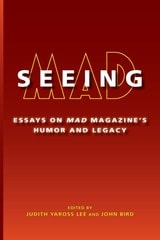
Seeing MAD
Essays on MAD Magazine's Humor and LegacyJudith Yaross Lee
University of Missouri Press, 2021
Mad magazine stands near the heart of post-WWII American humor, but at the periphery in scholarly recognition from American cultural historians, including humor specialists. This book fills that gap, with perceptive, informed, engaging, but also funny essays by a variety of scholars. The chapters, written by experts on humor, comics, and popular culture, cover the genesis of Mad; its editors and prominent contributors; its regular features and departments and standout examples of their contents; perspectives on its cultural and political significance; and its enduring legacy in American culture.

Serious Larks
The Philosophy of Ted CohenTed Cohen
University of Chicago Press, 2018
This collection, edited and introduced by philosopher Daniel Herwitz, brings together some of Cohen’s best work to capture the unique style that made Cohen one of the most beloved philosophers of his generation. Among the perceptive, engaging, and laugh-out-loud funny reflections on movies, sports, art, language, and life included here are Cohen’s classic papers on metaphor and his Pushcart Prize–winning essay on baseball, as well as memoir, fiction, and even poetry. Full of free-spirited inventiveness, these Serious Larks would be equally at home outside Thoreau’s cabin on the waters of Walden Pond as they are here, proving that intelligence, sensitivity, and good humor can be found in philosophical writing after all.
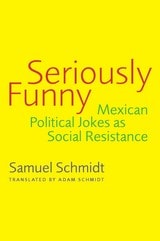
Seriously Funny
Mexican Political Jokes as Social ResistanceSamuel Schmidt, Translated by Adam Schmidt
University of Arizona Press, 2014
Now available in English for the first time, Seriously Funny is a groundbreaking work. Its goal is to examine the ways in which political humor—including nicknames, anagrams, poems, and parodies of religious prayers, in addition to jokes—has developed and operated in one country over more than four centuries. Although political humor thrives in Mexico, it is often cleverly encoded so that it doesn’t appear to be critical of government policies or officials. But, writes Samuel Schmidt, that is precisely its purpose: to question the actions and assumptions of the party in power. Schmidt argues persuasively that political jokes are acts of minor rebellion: their objective is not to overthrow a government but to correct its mistakes.
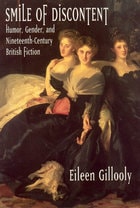
Smile of Discontent
Humor, Gender, and Nineteenth-Century British FictionEileen Gillooly
University of Chicago Press, 1999
Gillooly shows how such humor became, for mostly female writers at the time, an unobtrusive and prudent means of expressing discontent with a culture that was ideologically committed to restricting female agency and identity. If the aggression and emotional distance of irony and satire mark them as "masculine," then for Gillooly, the passivity, indirection, and sympathy of the humor she discusses render it "feminine." She goes on to disclose how the humorous tactics employed by writers from Burney to Wharton persist in the work of Barbara Pym, Anita Brookner, and Penelope Fitzgerald.
The book won the Barbara Perkins and George Perkins Award given by the Society for the Study of Narrative Literature.
Sneaking Out
By Prudence Mackintosh
University of Texas Press, 2002
From the endless battles of sibling rivalry to the endless worries about getting indifferent students into—and then graduated from—college, raising boys is the adventure of a lifetime for any mother. Prudence Mackintosh has not only survived the adventure but has also written about it with her signature wit and style. Her essays about life with sons Jack, Drew, and William have entertained the readers of Texas Monthly and other prominent magazines for nearly three decades, offering solace to similarly beleaguered parents and a knowing chuckle to everyone who enjoys watching the real-life sitcom of a fundamentally happy, intact family.
Sneaking Out completes the story that Mackintosh began in her earlier books Thundering Sneakers and Retreads. In this collection of new and previously published essays, she recounts life with her adolescent sons as they race headlong to first jobs, first driver's licenses, first girlfriends, and first flights away from the family nest. She also follows them into the college years, when both parents and sons have to find a new balance in holding on and letting go. Along the way, she offers wise and witty reflections on being a woman at midlife, supporting her sons through the beginning of their adult lives and her parents through the end of theirs.
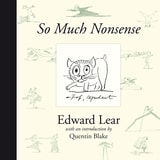
So Much Nonsense
Edward Lear
Bodleian Library Publishing, 2007
Which they ate with a runcible spoon;
And hand in hand, on the edge of the sand,
They danced by the light of the moon,
The moon,
The moon,
They danced by the light of the moon.
The Owl and the Pussycat is only the most familiar of Edward Lear’s numerous nonsense verses, which have delighted millions worldwide for the last two centuries. Now his beloved verse and drawings are compiled here in a handsomely produced volume of classic material.
Leariana runs rampant in this enchanting treasury; readers encounter such indelible Lear creations as “snail mail,” while drawings of the Stripy Bird and images of the heroic and irrepressible Foss in heraldic poses are scattered throughout. Lear’s zany illustrations are reproduced here in their full vibrancy, and the goofily delightful art, including his illustrated nonsense alphabets, infuses Lear’s fanciful phrases and humorously incomprehensible limericks with their original liveliness and irresistible spirit. Rarely has the powerful charm and timeless appeal of Edward Lear’s work been available in such a beautifully produced edition, and So Much Nonsense is a gift that will unleash the imaginations of young and old alike.
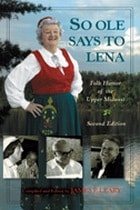
So Ole Says to Lena
Folk Humor of the Upper MidwestCompiled and edited by James P. Leary
University of Wisconsin Press, 2002
In the land of beer, cheese, and muskies—where the polka is danced and winter is unending and where Lutherans and Catholics predominate—everybody is ethnic, the politics are clean, and the humor is plentiful. This collection includes jokes, humorous anecdotes, and tall tales from ethnic groups (Woodland Indians, French, Cornish, Germans, Irish, Scandinavians, Finns, and Poles) and working folk (loggers, miners, farmers, townsfolk, hunters, and fishers). Dig into the rich cultural context supplied by the notes and photographs, or just laugh at the hundreds of jokes gathered at small-town cafes, farm tables, job sites, and church suppers. This second edition includes an afterword and indexes of motifs and tale types.
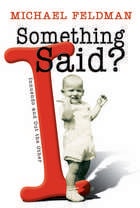
Something I Said?
Innuendo and Out the OtherMichael Feldman
University of Wisconsin Press, 2004
What we have here is another mighty slim volume from Michael Feldman, best known (when known at all) for his public radio show "Whad'ya Know" (sic). Feldman, who spouts off about things he knows "not much" about weekly, here writes them down:
· how to get your own radio show and what you can do with it once you do
· paranoia
· marriage (or as Feldman likes to refer to it, "a long-term bad relationship")
· Hitler
· SUVs
· child-rearing (although it sounds like it's the author who is being reared)
· a number of short pieces on places he and his crew have visited for their "remote possibilities"
· more references to "gentiles" than absolutely necessary (seems to be an issue for Feldman, although he is tickled with the
notion that, to a Mormon, he is one)
· some attempts to misrepresent scientific or social research for humorous purposes
· many personal revelations that prove the examined life is not necessarily worth living either
· and pages and pages of fluff.
Mr. Feldman has not been compared, to our knowledge, to S. J. Perlman.
But here is some of what Michael Feldman says in Something I Said:
"The paranoid no longer is: paranoia has outlived its usefulness when everybody is out to get us."
"Take the phrase 'no problem': I can use it, although it is the very opposite of my two-word world view ('Nothing works')."
"Whatever latitude beauty may have in the eye of the beholder, funny is not readily apparent to all, and, who knows, they may be right. More importantly, they may be bigger."
Includes a music CD by Michael Feldman and John Sieger.
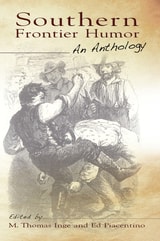
Southern Frontier Humor
An AnthologyEdited by M. Thomas Inge & Ed Piacentino
University of Missouri Press, 2010
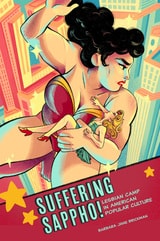
Suffering Sappho!
Lesbian Camp in American Popular CultureBarbara Jane Brickman
Rutgers University Press, 2024
Offering the first major consideration of lesbian camp in American popular culture, Suffering Sappho! traces a larger-than-life lesbian menace across midcentury media forms to propose five prototypical queer icons—the sicko, the monster, the spinster, the Amazon, and the rebel. On the pages of comics and sensational pulp fiction and the dramas of television and drive-in movies, Barbara Jane Brickman discovers evidence not just of campy sexual deviants but of troubling female performers, whose failures could be epic but whose subversive potential could inspire.
Supplemental images of interest related to this title: George and Lomas; Connie Minerva; Cat On Hot Tin; and Beulah and Oriole.


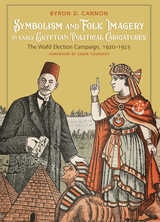
Symbolism and Folk Imagery in Early Egyptian Political Caricatures
The Wafd Election Campaign, 1920–1923Byron D. Cannon, Foreword by Samir Toubassy
University of Utah Press, 2019
Art is politics and politics is art in this study of post–World War I caricature art in Egypt and Egyptian politics. This book explores the complex meaning and significance of caricature art drawn to support the ascendant Egyptian Wafdpolitical party and its push for independence from British colonial control. The works of previously neglected Egyptian lithographers are also explored, especially those who adopted sophisticated European techniques while experimenting with a variety of new styles during a remarkable period in Egyptian history.
Caricature art by Wafd party artists was almostsui generis. It is distinguished especially by its sincere use of iconic, folkloric imagery, intended to rally nationalistic sentiments among an emerging Egyptian electorate that included many nonliterate citizens. Cannon’s research breathes new life into an influential yet largely forgotten artistic movement in Egypt, one that deserves recognition for its contribution to Egypt’s share of modern Middle East cultural history. Includes full color reproductions.