Results by title
101 books match the query 'Identity (Psychology)' and 5 start with s
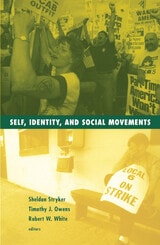
Self, Identity, and Social Movements
Sheldon Stryker
University of Minnesota Press, 2000
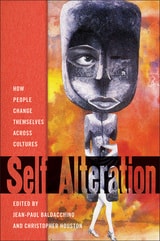
Self-Alteration
How People Change Themselves across CulturesJean-Paul Baldacchino
Rutgers University Press, 2024

Sexuality and the Politics of Ethos in the Writing Classroom
Zan Meyer Goncalves
Southern Illinois University Press, 2005
Applying the complexities of literacy development and personal ethos to the teaching of composition, Zan Meyer Goncalves challenges writing teachers to consider ethos as a series of identity performances shaped by the often-inequitable social contexts of their classrooms and communities. Using the rhetorical experiences of students who identify as lesbian, gay, bisexual, and/or transgender, she proposes a new way of thinking about ethos that addresses the challenges of social justice, identity, and transfer issues in the classroom.
Goncalves offers an innovative approach to teaching identity performance theory bound by social contexts. She applies this new approach to theories of specificity and intersectionality, illustrating how teachers can help students redefine the relationship between their social identities and their writing. She also addresses bringing social activism and identity politics into the classroom, helping writers make transfers across rhetorical contexts and linking students' interests to public conversations.
Theoretical and practical, Sexuality and the Politics of Ethos in the Writing Classroom provides teachers of first-year and advanced composition studies with useful, detailed assignments based in specific identity performance. Goncalves offers techniques to subvert oppressive language practices, while encouraging students to recognize themselves as writers, citizens, and active participants in their own educations and communities.
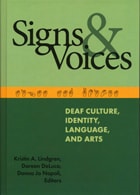
Signs and Voices
Deaf Culture, Identity, Language, and ArtsKristin A. Lindgren
Gallaudet University Press, 2008
Cochlear implants, mainstreaming, genetic engineering, and other ethical dilemmas confronting deaf people mandated a new, wide-ranging examination of these issues, fulfilled by Signs and Voices: Deaf Culture, Identity, Language, and Arts. This collection, carefully chosen from the 2004 Signs and Voices Conference, the Presidential Forum on American Sign Language at the Modern Language Association Convention, and other sources, addresses all of the factors now changing the cultural landscape for deaf people. To ensure quality and breadth of knowledge, editors Kristin A. Lingren, Doreen DeLuca, and Donna Jo Napoli selected the work of renowned scholars and performers Shannon Allen, H-Dirksen L. Bauman, Adrian Blue, Brenda Jo Brueggemann, Teresa Blankmeyer Burke, Peter Cook, David P. Corina, Michael Davidson, Kristen Harmon, Tom Humphries, Sotaro Kita, Heather Knapp, Robert G. Lee, Irene W. Leigh, Kenny Lerner, Carole Neidle, Peter Novak, AslI Özyürek, David M. Perlmutter, Anne Senghas, and Ronnie Wilbur.
Signs and Voices is divided into three sections—Culture and Identity, Language and Literacy, and American Sign Language in the Arts—each of which focuses on a particular set of theoretical and practical concerns. Also, the included DVD presents many of the performances from the Arts section. Taken together, these essays and DVD point to new directions in a broad range of fields, including cognitive science, deaf studies, disability studies, education, linguistics, literary criticism, philosophy, and psychology. This extraordinary showcase of innovative and rigorous cross-disciplinary study will prove invaluable to everyone interested in the current state of the Deaf community.

Slave of Allah
Zacarias Moussaoui Vs the USAKatherine C. Donahue
Pluto Press, 2007
The book begins with his arrest and moves to the courtroom, telling the tale of Moussaoui's struggle with his defense lawyers and raising questions about his ability to be "represented" given his national and personal identity. Donahue explores his background in France as the son of Moroccan immigrants and follows him to London, Afghanistan, and Malaysia as he joins the growing fraternity of an Islam without borders. He acquires an extra-national identity in which his loyalty is no longer constituted by his national identity, but by his allegiance to fundamental Islam.