Results by title
54 books match the query 'Indians in literature' and 6 start with s
Seeing Red
Anger, Sentimentality, and American IndiansCari M. Carpenter
The Ohio State University Press, 2008
Self-Determined Stories
The Indigenous Reinvention of Young Adult LiteratureMandy Suhr-Sytsma
Michigan State University Press, 2018
Selling the Indian
Commercializing and Appropriating American Indian CulturesCarter Jones Meyer
University of Arizona Press, 2001
For more than a hundred years, outsiders enamored of the perceived strengths of American Indian cultures have appropriated and distorted elements of them for their own purposes—more often than not ignoring the impact of the process on the Indians themselves. This book contains eight original contributions that consider the selling of American Indian culture and how it affects the Native community. It goes beyond studies of “white shamanism” to focus on commercial ventures, challenging readers to reconsider how Indian cultures have been commercialized in the twentieth century.
Some selections examine how Indians have been displayed to the public, beginning with a “living exhibit” of Cocopa Indians at the 1904 Louisiana Purchase Exposition and extending to contemporary stagings of Indian culture for tourists at Tillicum Village near Seattle. Other chapters range from the Cherokees to Puebloan peoples to Indians of Chiapas, Mexico, in an examination of the roles of both Indians and non-Indian reformers in marketing Native arts and crafts.
These articles show that the commercialization and appropriation of American Indian cultures have been persistent practices of American society over the last century and constitute a form of cultural imperialism that could contribute to the destruction of American Indian culture and identity. They offer a means toward understanding this complex process and provide a new window on Indian-white interactions.
CONTENTS
Part I: Staging the Indian
1. The “Shy” Cocopa Go to the Fair, Nancy J. Parezo and John W. Troutman
2. Command Performances: Staging Native Americans at Tillicum Village, Katie N. Johnson and Tamara Underiner
3. Savage Desires: The Gendered Construction of the American Indian in Popular Media, S. Elizabeth Bird
4. “Beyond Feathers and Beads”: Interlocking Narratives in the Music and Dance of Tokeya Inajin (Kevin Locke), Pauline Tuttle
Part II: Marketing the Indian
5. “The Idea of Help”: White Women Reformers and the Commercialization of Native American Women’s Arts, Erik Trump
6. Saving the Pueblos: Commercialism and Indian Reform in the 1920s, Carter Jones Meyer
7. Marketing Traditions: Cherokee Basketry and Tourist Economies, Sarah H. Hill
8. Crafts, Tourism, and Traditional Life in Chiapas, Mexico: A Tale Related by a Pillowcase, Chris Goertzen

Sherman Alexie
A Collection of Critical EssaysJeff Berglund
University of Utah Press, 2010
Sherman Alexie is, by many accounts, the most widely read American Indian writer in the United States and likely in the world. A literary polymath, Alexie's nineteen published books span a variety of genres and include his most recent National Book Award-winning The Absolutely True Diary of a Part-Time Indian.
Now, for the first time, a volume of critical essays is devoted to Alexie's work both in print and on the big screen. Editors Jeff Berglund and Jan Roush have assembled twelve leading scholars of American Indian literature to provide new perspectives on a writer with his finger on the pulse of America.
Interdisciplinary in their approach to Alexie's work, these essays cover the writer's entire career, and are insightful and accessible to scholars and lay readers alike. This volume is a worthy companion to the work of one of our nations's most recognized contemporary voices.
Speak to Me Words
Essays on Contemporary American Indian PoetryEdited by Dean Rader and Janice Gould
University of Arizona Press, 2003
Speak to Me Words is a stimulating blend of classic articles and original pieces that reflect the energy of modern American Indian literary studies. Highlighting various aspects of poetry written by American Indians since the 1960s, it is a wide-ranging collection that balances the insights of Natives and non-Natives, men and women, old and new voices. Included here are such landmark articles as "Answering the Deer" by Paula Gunn Allen, "Herbs of Healing" by Carter Revard, and "Song, Poetry and Language—Expression and Perception" by Simon Ortiz—all pieces that have shaped how we think about Native poetry. Among the contributions appearing for the first time are Elaine Jahner writing on Paula Gunn Allen's use of formal structures; Robert Nelson addressing pan-Indian tropes of emergence, survival, return, and renewal; and Janet McAdams focusing on Carter Revard's "angled mirrors." Although many Native writers may disregard distinctions between genres, together these writings help readers see the difference between American Indian poetry and other forms of Native literature.
These essays are as broad, encompassing, and provocative as Native poetry itself, branching off from and weaving back into one another. In showing how American Indian poetry redefines our social order and articulates how Indian communities think about themselves, these writers establish a new foundation for the study—and enjoyment—of this vital art.
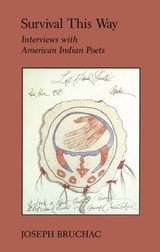
Survival This Way
Interviews with American Indian PoetsJoseph Bruchac
University of Arizona Press, 1987