Results by title
220 books match the query 'Individual Artists' and 7 start with s

Salted Earth
Poetics of Place and Migration through Four Journeys in Search of SaltKaty Beinart
Intellect Books, 2026
While histories of salt have long emphasized its central role in trade, power, and capitalism, is that the only way to understand this everyday substance? In Salted Earth, artist and researcher Katy Beinart offers a fresh perspective, exploring the poetics of salt. Through a series of journeys to South Africa, Lithuania and Russia, Portugal, and Haiti, Beinart and her collaborators investigate the everyday rituals and cultural meanings of salt in diverse contexts. In her work, salt becomes a medium through which large-scale histories of migration, trade, empire, slavery, and colonialism—as well as deeply personal relationships, emotional geographies, memory, and intercultural connections—are symbolized and reimagined.
Drawing on fiction, poetry, and visual art, alongside family history, travel writing, trade archives, and artistic process, Beinart builds a rich, interdisciplinary portrait of salt as both a material and a cultural symbol. These journeys and embodied artistic practices open a sensorial and situated way of understanding material entanglements, where knowledge emerges through movement, encounter, and acts of making. Salted Earth offers valuable insights for students and researchers in art, creative writing, cultural history and geography, memory studies, and across the wider fields of aesthetics and the humanities.
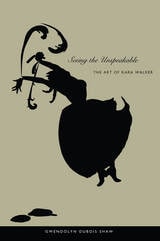
Seeing the Unspeakable
The Art of Kara WalkerGwendolyn DuBois Shaw
Duke University Press, 2004
Examining Walker’s striking silhouettes, evocative gouache drawings, and dynamic prints, Gwendolyn DuBois Shaw analyzes the inspiration for and reception of four of Walker’s pieces: The End of Uncle Tom and the Grand Allegorical Tableau of Eva in Heaven, John Brown, A Means to an End, and Cut. She offers an overview of Walker’s life and career, and contextualizes her art within the history of African American visual culture and in relation to the work of contemporary artists including Faith Ringgold, Carrie Mae Weems, and Michael Ray Charles. Shaw describes how Walker deliberately challenges viewers’ sensibilities with radically de-sentimentalized images of slavery and racial stereotypes. This book reveals a powerful artist who is questioning, rather than accepting, the ideas and strategies of social responsibility that her parents’ generation fought to establish during the civil rights era. By exploiting the racist icons of the past, Walker forces viewers to see the unspeakable aspects of America’s racist past and conflicted present.
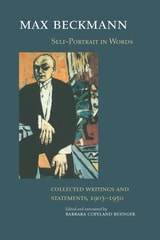
Self-Portrait in Words
Collected Writings and Statements, 1903-1950Max Beckmann
University of Chicago Press, 1997
"Barbara Copeland Buenger . . . has done an excellent job of editing and annotating Beckmann's voluminous private and public writings."—Andrea Barnet, New York Times Book Review
Sleeping Beauty
A One-Artist DictionaryJohn Sparagana and Mieke Bal
University of Chicago Press, 2008
Bal contributes twenty-six essays, one for each letter of the alphabet, which borrow their organizing principle from the dictionary but reach far beyond the utilitarian purpose of a reference volume. Each one enters deeply into Sparagana’s work, illuminating concepts from Abstract to Zestful that inform, underlie, and lend meaning to the exquisitely ruined images he creates by crinkling glossy images from fashion magazines until their sheen disappears and they become soft and elastic. Unmooring the magazine page from its familiar context, these beautiful rags are rendered poetic by Sparagana’s unique art of subtraction, which physically rubs away not only ink and material, but also transience and commercial usefulness.
Just as Sparagana’s work intervenes in existing images, so, too, do Bal’s explorations qualify existing concepts. But together, in this inaugural volume in the new series Project Tango: Artists and Writers Together, they have given rise to something wholly new: a prophetic one-artist dictionary that simultaneously reenvisions the untapped interactions of images with words and the potential forms of the book itself.
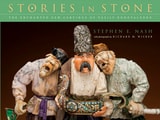
Stories in Stone
The Enchanted Gem Carvings of Vasily KonovalenkoStephen E. Nash
University Press of Colorado, 2016
Part art catalogue and part life history, Stories in Stone tells the tale of Konovalenko’s impressive works, explaining their conception, creation, and symbolism. Each handcrafted figure depicts a scene from life in the Soviet Union—a bowman hunting snow geese, a woman reposing in a hot spring surrounded by ice, peasants spinning wool, a pair of gulag prisoners sawing lumber—painstakingly rendered in precious stones and metals. The materials used to make the figurines are worth millions of dollars, but as cultural artifacts, the sculptures are priceless. Author Stephen Nash draws upon oral history and archival research to detail the life of their creator, revealing a rags-to-riches and life-imitates-art narrative full of Cold War intrigue, Communist persecution, and capitalist exploitation.
Augmented by Richard M. Wicker’s exquisite and revelatory photographs of sixty-five Konovalenko sculptures from museums, state agencies, and private collections around the world, Stories in Stone is a visually stunning glimpse into a unique corner of Russian art and cultural history, the craft and science of gem carving, and the life of a Russian artist and immigrant who loved people everywhere.
Co-published with the Denver Museum of Nature & Science, home to the most significant collection of Russian gem-carving sculptures by Vasily Konovalenko in the world.
Storytellers of Art Histories
Living and Sustaining a Creative LifeEdited by Yasmeen Siddiqui and Alpesh Kantilal Patel
Intellect Books, 2021
With a focus on gender, race (including whiteness), class, sexuality, and transnationality—all of which are often marginalized in dominant art histories—each individual has provided short, often personal contributions detailing how they become passionate about their practice. The contributors’ offerings are varied and surprising, appealing equally to people enmeshed in the field through their work as well as those with a beginner’s interest. Their pieces take various forms—epistolary, children’s fable, interview, coauthored narrative, pastiche, memoir, manifesto, and apology—and a number of the essays perform in their structure or content the theories they explore about publishing, curating, and archival work.
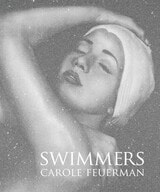
Swimmers
Carole FeuermanCarole Feuerman
The Artist Book Foundation, 2014
Realist sculptor Carole A. Feuerman's human-figure sculptures express a refreshing perspective on the mundane but intensely personal activities of modern life. her powers of observation and versatility find unique expression through various materials that include marble, bronze, vinyl, and painted resins, while she incorporates both ancient and contemporary methods in the creation of her works. Swimmers: Carole Feuerman is a gorgeous and shimmering glimpse at transitory, contemplative moments in time, often captured in a veil of clear resin that replicates tumbling water droplets.
In his astute and insightful essay, John Yau describes Feuerman's exquisitely rendered figures as subjects "caught in a moment of transition that radiates an intense eroticism." She evokes an inward life for her figures that invites our speculation, while revealing a mysterious chasm between them and the viewer that can never be plumbed. We cannot know their thoughts and perhaps that is exactly the point. Feuerman fuses the tactile nature of her sculpture with a visual verisimilitude that provides us a fleeting glimpse into private and isolated environments—women stepping out of the shower, in the rain, or swimming—that suggest a meditative bliss.