Results by title
130 books match the query 'Indonesia' and 13 start with s
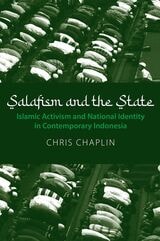
Salafism and the State
Islamic Activism and National Identity in Contemporary IndonesiaChris Chaplin
National University of Singapore Press, 2021
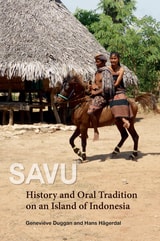
Savu
History and Oral Tradition on an Island of IndonesiaGeneviève Duggan and Hans Hägerdal
National University of Singapore Press, 2018

Secrets Need Words
Indonesian Poetry, 1966–1998Harry Aveling
Ohio University Press, 2001
Short listed for the 2007 New South Wales Premier's Translation Prize
The period from 1966 to 1999 represents a distinct era in Indonesian history. Throughout the “New Order” regime of President Suharto, the policies of economic development and political stability were dominant. However, the public opinion of personal expression was consistently under suspicion, and indeed dissent was severely punished.
Secrets Need Words traces the development of Indonesian poetry throughout this entire period. Texts are presented both in the original Indonesian and in careful, stylistically sensitive English translations.
In this anthology of contemporary work by Indonesian poets, the renowned translator and editor Harry Aveling presents a series of ongoing analyses detailing the political and social shifts that have influenced the work of particular poets.
Professor Aveling's analyses, along with the poems themselves, demonstrate how the poets responded to the power of the state in a variety of ways ranging from direct confrontation to withdrawal into personal and private realms characterized by fantasy and the use of heavily rhythmic language.
Secrets Need Words will be of interest to scholars of Indonesia and comparative literature, and will be for many years to come a basic text for scholarship and teaching. But it also offers all readers of poetry an opportunity to explore a new, complex, and exciting body of literature from one of the world's largest nations.
Shadows of Empire
Colonial Discourse and Javanese TalesLaurie J. Sears
Duke University Press, 1996
Though Javanese shadow theater (wayang) has existed for hundreds of years, our knowledge of its history, performance practice, and role in Javanese society only begins with Dutch documentation and interpretation in the nineteenth century. Analyzing the Mahabharata and Ramayana tales in relation to court poetry, Islamic faith, Dutch scholarship, and nationalist journals, Sears shows how the shadow theater as we know it today must be understood as a hybrid of Javanese and Dutch ideas and interests, inseparable from a particular colonial moment. In doing so, she contributes to a re–envisioning of European histories that acknowledges the influence of Asian, African, and New World cultures on European thought—and to a rewriting of colonial and postcolonial Javanese histories that questions the boundaries and content of history and story, myth and allegory, colonialism and culture.
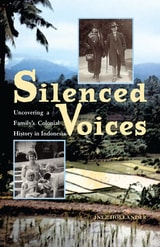
Silenced Voices
Uncovering a Family’s Colonial History in IndonesiaInez Hollander
Ohio University Press, 2008
Like a number of Netherlanders in the post–World War II era, Inez Hollander only gradually became aware of her family’s connections with its Dutch colonial past, including a Creole great-grandmother. For the most part, such personal stories have been, if not entirely silenced, at least only whispered about in Holland, where society has remained uncomfortable with many aspects of the country’s relationship with its colonial empire.
Unlike the majority of memoirs that are soaked in nostalgia for tempo dulu, Hollander’s story sets out to come to grips with her family’s past by weaving together personal records with historical and literary accounts of the period. She seeks not merely to locate and preserve family memories, but also to test them against a more disinterested historical record. Hers is a complicated and sometimes painful personal journey of realization, unusually mindful of the ways in which past memories and present considerations can be intermingled when we seek to understand a difficult past. Silenced Voices is an important contribution to the literature on how Dutch society has dealt with its recent colonial history.
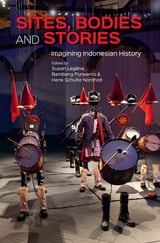
Sites, Bodies and Stories
Imagining Indonesian HistoryEdited by Susan Legêne, Bambang Purwanto, and Henk Schulte Nordholt
National University of Singapore Press, 2015
Contemporary heritage formation in Indonesia is intrinsically linked to a canon of Indonesian art and culture developed during Dutch colonial rule, institutionalized within Indonesia’s heritage infrastructure and in the Netherlands, and echoed in museums and exhibitions throughout the world. The authors in this volume acknowledge colonial legacies but argue against a colonial determinism, considering instead how contemporary heritage initiatives can lead to new interpretations of the past.
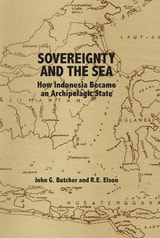
Sovereignty and the Sea
How Indonesia Became an Archipelagic StateJohn G. Butcher and R. E. Elson
National University of Singapore Press, 2017
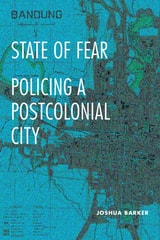
State of Fear
Policing a Postcolonial CityJoshua Barker
Duke University Press, 2024
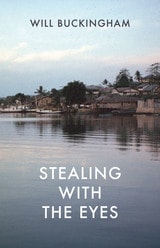
Stealing with the Eyes
Imaginings and Incantations in IndonesiaWill Buckingham
Haus Publishing, 2018
Through his encounters with these remarkable craftsmen—which in relating her also interweaves with Tanimbarese history, myth, and philosophy dating back to ancient times— we are shown the forces at play in all of our lives: the struggle between the powerful and the powerless, the tension between the past and the future, and how to make sense of a world that is in constant flux.
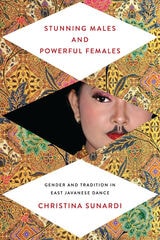
Stunning Males and Powerful Females
Gender and Tradition in East Javanese DanceChristina Sunardi
University of Illinois Press, 2015
Christina Sunardi ventures into the regency of Malang in east Java to study and perform with dancers. Through formal interviews and casual conversation, Sunardi learns about their lives and art. Her work shows how performers continually transform dance traditions to negotiate, and renegotiate, the boundaries of gender and sex--sometimes reinforcing lines of demarcation, sometimes transgressing them, and sometimes doing both simultaneously. But Sunardi's investigation moves beyond performance. It expands notions of the spiritual power associated with female bodies and feminine behavior, and the ways women, men, and waria (males who dress and live as female) access the magnetic power of femaleness.
A journey into understudied regions and ideas, Stunning Males and Powerful Females reveals how performances seemingly fixed by tradition are instead dynamic environments for cultural negotiation and change surrounding questions of sex and gender.
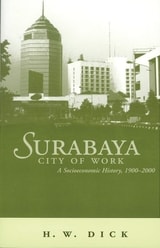
Surabaya, City of Work
A Socioeconomic History, 1900–2000Howard Dick
Ohio University Press, 2002
Surabaya is Indonesia’s second largest city but is not well known to the outside world. Yet in 1900, Surabaya was a bigger city than Jakarta and one of the main commercial centers of Asia. Collapse of sugar exports during the 1930s depression, followed by the Japanese occupation, revolution, and independence, brought on a long period of stagnation and retreat from the international economy. Not until the export boom of the 1990s did Surabaya regain prominence as Southeast Asia’s leading non–capital–city industrial area.
Previous thinking on Indonesia is being reassessed in light of recent political and economic upheaval. Surabaya, City of Work offers an alternative to the Jakarta-centric focus of most writing on the country. It is a multifaceted view of a fascinating and complex city in the dimensions of time and space, economy and society, and the current transition toward decentralization makes it highly topical.
Exploration of this eventful economic history gives new insight into Indonesia’s modern economic development. Industrialization is recognized as being associated with rapid urbanization, but this is the first study of Indonesia from an explicitly urban perspective. Surabaya, City of Work takes a broad approach that links industrialization to socioeconomic trends, the increasing role of government, changing land use, and trade patterns.
This well–illustrated local history encompassing national events and trends will be a central work on Indonesia for years to come.
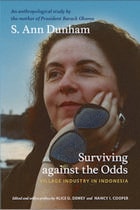
Surviving against the Odds
Village Industry in IndonesiaS. Ann Dunham
Duke University Press, 2009
President Barack Obama’s mother, S. Ann Dunham, was an economic anthropologist and rural development consultant who worked in several countries including Indonesia. Dunham received her doctorate in 1992. She died in 1995, at the age of 52, before having the opportunity to revise her dissertation for publication, as she had planned. Dunham’s dissertation adviser Alice G. Dewey and her fellow graduate student Nancy I. Cooper undertook the revisions at the request of Dunham’s daughter, Maya Soetoro-Ng. The result is Surviving against the Odds, a book based on Dunham’s research over a period of fourteen years among the rural metalworkers of Java, the island home to nearly half Indonesia’s population. Surviving against the Odds reflects Dunham’s commitment to helping small-scale village industries survive; her pragmatic, non-ideological approach to research and problem solving; and her impressive command of history, economic data, and development policy. Along with photographs of Dunham, the book includes many pictures taken by her in Indonesia.
After Dunham married Lolo Soetoro in 1967, she and her six-year-old son, Barack Obama, moved from Hawai‘i to Soetoro’s home in Jakarta, where Maya Soetoro was born three years later. Barack returned to Hawai‘i to attend school in 1971. Dedicated to Dunham’s mother Madelyn, her adviser Alice, and “Barack and Maya, who seldom complained when their mother was in the field,” Surviving against the Odds centers on the metalworking industries in the Javanese village of Kajar. Focusing attention on the small rural industries overlooked by many scholars, Dunham argued that wet-rice cultivation was not the only viable economic activity in rural Southeast Asia.
Surviving against the Odds includes a preface by the editors, Alice G. Dewey and Nancy I. Cooper, and a foreword by her daughter Maya Soetoro-Ng, each of which discusses Dunham and her career. In his afterword, the anthropologist and Indonesianist Robert W. Hefner explores the content of Surviving against the Odds, its relation to anthropology when it was researched and written, and its continuing relevance today.
Systemic Silencing
Activism, Memory, and Sexual Violence in IndonesiaKatharine E. McGregor
University of Wisconsin Press, 2023