Results by title
101 books match the query 'Intellectuals' and 5 start with s
Scenes From Postmodern Life
Beatriz Sarlo
University of Minnesota Press, 2001
[more]
Spirit and System
Media, Intellectuals, and the Dialectic in Modern German CultureDominic Boyer
University of Chicago Press, 2005
Combining ethnography, history, and social theory, Dominic Boyer's Spirit and System exposes how the shifting fortunes and social perceptions of German intellectuals in the nineteenth and twentieth centuries influenced Germans' conceptions of modernity and national culture.
Boyer analyzes the creation and mediation of the social knowledge of "German-ness" from nineteenth-century university culture and its philosophies of history, to the media systems and redemptive public cultures of the Third Reich and the German Democratic Republic, to the present-day experiences of former East German journalists seeking to explain life in post-unification Germany. Throughout this study, Boyer reveals how dialectical knowledge of "German-ness"—that is, knowledge that emphasizes a cultural tension between an inner "spirit" and an external "system" of social life —is modeled unconsciously upon intellectuals' self-knowledge as it tracks their fluctuation between alienation and utopianism in their interpretations of nation and modernity.
Boyer analyzes the creation and mediation of the social knowledge of "German-ness" from nineteenth-century university culture and its philosophies of history, to the media systems and redemptive public cultures of the Third Reich and the German Democratic Republic, to the present-day experiences of former East German journalists seeking to explain life in post-unification Germany. Throughout this study, Boyer reveals how dialectical knowledge of "German-ness"—that is, knowledge that emphasizes a cultural tension between an inner "spirit" and an external "system" of social life —is modeled unconsciously upon intellectuals' self-knowledge as it tracks their fluctuation between alienation and utopianism in their interpretations of nation and modernity.
[more]
Stanley Fish, America's Enfant Terrible
The Authorized BiographyGary A. Olson
Southern Illinois University Press, 2016
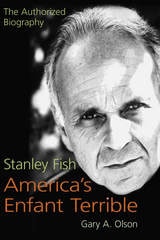
One of the twentieth century’s most original and influential literary theorists, Stanley Fish is also known as a fascinatingly atypical, polarizing public intellectual; a loud, cigar-smoking contrarian; and a lightning rod for both the political right and left. The truth and the limitations of this reputation are explored in Stanley Fish, America’s Enfant Terrible by Gary A. Olson. At once a literary biography and a traditional life story, this engrossing volume details Fish’s vibrant personal life and his remarkably versatile career.
Born into a tumultuous family, Fish survived life with an emotionally absent father and a headstrong mother through street sports and troublemaking as much as through his success at a rigorous prep school. As Olson shows, Fish’s escape from the working-class neighborhoods of 1940s and 1950s Providence, Rhode Island, came with his departure for the university life at the University of Pennsylvania and then Yale. His meteoric rise through the academic ranks at a troubled Vietnam-era UC-Berkeley was complemented by a 1966 romp through Europe that included drag racing through the streets of Seville in his Alfa Romeo. He went on to become an internationally prominent scholar at Johns Hopkins before moving to Duke, where he built a star-studded academic department that became a key site in the culture and theory wars of the 1980s and 1990s. Olson discusses Fish’s tenure as a highly visible dean at the University of Illinois at Chicago who clashed publicly with the state legislature. He also covers Fish’s most remarkable and controversial books, including Fish’s masterpiece, Surprised by Sin: The Reader in "Paradise Lost," which was a critical sensation and forever changed the craft of literary criticism, as well as Professional Correctness and Save the World on Your Own Time, two books that alienated Fish from most liberal-minded professors in English studies.
Olson concludes his biography of Fish with an in-depth analysis of the contradictions between Fish’s public persona and his private personality, examining how impulses and events from Fish’s childhood shaped his lifelong practices and personality traits. Also included are a chronology of the major events of Fish’s life and never-before-published photos.
Based on hundreds of hours of recorded interviews with friends, enemies, colleagues, former students, family members, and Fish himself, along with material from the Stanley Fish archive, Stanley Fish, America’s Enfant Terrible is a clearly written narrative of the life of an important and controversial scholar.
[more]
Street Archives and City Life
Popular Intellectuals in Postcolonial TanzaniaEmily Callaci
Duke University Press, 2017
In Street Archives and City Life Emily Callaci maps a new terrain of political and cultural production in mid- to late twentieth-century Tanzanian urban landscapes. While the postcolonial Tanzanian ruling party (TANU) adopted a policy of rural socialism known as Ujamaa between 1967 and 1985, an influx of youth migrants to the city of Dar es Salaam generated innovative forms of urbanism through the production and circulation of what Callaci calls street archives. These urban intellectuals neither supported nor contested the ruling party's anti-city philosophy; rather, they navigated the complexities of inhabiting unplanned African cities during economic crisis and social transformation through various forms of popular texts that included women's Christian advice literature, newspaper columns, self-published pulp fiction novellas, and song lyrics. Through these textual networks, Callaci shows how youth migrants and urban intellectuals in Dar es Salaam fashioned a collective ethos of postcolonial African citizenship. This spirit ushered in a revolution rooted in the city and its networks—an urban revolution that arose in spite of the nation-state's pro-rural ideology.
[more]
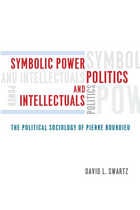
Symbolic Power, Politics, and Intellectuals
The Political Sociology of Pierre BourdieuDavid L. Swartz
University of Chicago Press, 2013
Power is the central organizing principle of all social life, from culture and education to stratification and taste. And there is no more prominent name in the analysis of power than that of noted sociologist Pierre Bourdieu. Throughout his career, Bourdieu challenged the commonly held view that symbolic power—the power to dominate—is solely symbolic. He emphasized that symbolic power helps create and maintain social hierarchies, which form the very bedrock of political life. By the time of his death in 2002, Bourdieu had become a leading public intellectual, and his argument about the more subtle and influential ways that cultural resources and symbolic categories prevail in power arrangements and practices had gained broad recognition.
[more]