Results by title
123 books match the query 'Internet' and 8 start with s
Science Communication Online
Engaging Experts and Publics on the InternetAshley Rose Mehlenbacher
The Ohio State University Press, 2019
Bringing together genre studies and the rhetoric of science, Mehlenbacher examines a range of new forms of science communication that challenge traditional presumptions about experts and nonexperts—including Twitter and Reddit AMAs, crowdfunding proposals such as Kickstarter and Experiment.com, civic-minded databases such as Safecast, and the PLOS blogging network. Science Communication Online illustrates the unique features of these genres and connects them to their rhetorical functions and the larger context leading to their emergence and evolution—from the democratization of science, challenges to expertise and expert status, and new political economies. Science Communication Online captures the important moment we find ourselves in now—one not defined by science and society but science in society.
Shareveillance
The Dangers of Openly Sharing and Covertly Collecting DataClare Birchall
University of Minnesota Press, 2017
Cracking open the politics of transparency and secrecy
In an era of open data and ubiquitous dataveillance, what does it mean to “share”? This book argues that we are all “shareveillant” subjects, called upon to be transparent and render data open at the same time as the security state invests in practices to keep data closed. Drawing on Jacques Rancière’s “distribution of the sensible,” Clare Birchall reimagines sharing in terms of a collective political relationality beyond the veillant expectations of the state.

Slender Man Is Coming
Creepypasta and Contemporary Legends on the InternetTrevor J. Blank
Utah State University Press, 2018
As narrative texts are copied across online forums, they undergo modification, annotation, and reinterpretation by new posters in a folkloric process of repetition and variation. Though by definition legends deal largely with belief and possibility, the crowdsourced mythos behind creepypasta and Slender Man suggests a distinct awareness of fabrication. Slender Man is therefore a new kind of creation: one intentionally created as a fiction but with the look and feel of legend.
Slender Man Is Coming offers an unprecedented folkloristic take on Slender Man, analyzing him within the framework of contemporary legend studies, “creepypastas,” folk belief, and children’s culture. This first folkloric examination of the phenomenon of Slender Man is a must-read for anyone interested in folklore, horror, urban legends, new media, or digital cultures.
Contributors: Timothy H. Evans, Andrea Kitta, Mikel J. Koven, Paul Manning, Andrew Peck, Jeffrey A. Tolbert, Elizabeth Tucker

Smart Health Technologies for the COVID-19 Pandemic
Internet of medical things perspectivesChinmay Chakraborty
The Institution of Engineering and Technology, 2022

Social Knowledge Creation in the Humanities
Volume 1Edited by Alyssa Arbuckle, Aaron Mauro, and Daniel Powell
Iter Press, 2017
The ubiquity of social media has transformed the scope and scale of scholarly communication in the arts and humanities. The consequences of this new participatory and collaborative environment for humanities research has allowed for fresh approaches to communicating research. Social Knowledge Creation takes up the norms and customs of online life to reorient, redistribute, and oftentimes flatten traditional academic hierarchies. This book discusses the implications of how humanists communicate with the world and looks to how social media shapes research methods. This volume addresses peer-review, open access publishing, tenure and promotion, mentorship, teaching, collaboration, and interdisciplinarity as a comprehensive introduction to these rapidly changing trends in scholarly communication, digital pedagogy, and educational technology. Collaborative structures are rapidly augmenting disciplinary focus of humanities curriculum and the public impact of humanities research teams with new organizational and disciplinary thinking. Social Knowledge Creation represents a particularly dynamic and growing field in which the humanities seeks to find new ways to communicate the legacy and traditions of humanities based inquiry in a 21st century context.
New Technologies in Medieval and Renaissance Studies Volume 7.
Edited by Alyssa Arbuckle, Aaron Mauro, and Daniel Powell
Social Knowledge Creation in the Humanities
Volume 2Edited by Aaron Mauro
Iter Press, 2022
While these countervailing influences are all around us, the essays collected in this volume represent a humanistic ethics of generosity, compassion, and care. Social knowledge creation refreshingly returns to humanist values, emphasizing that people matter more than networks, facts matter more than opinion, and ideas matter more than influence. As a result, the speed and scale of digital culture has challenged humanists from many disciplines to more clearly define the values of education, collaboration, and new knowledge in pursuit of human justice and equality. In short, online culture has presented a new opportunity to define how and why the humanities matter in the age of social media.
Social Media in South India
Shriram Venkatraman
University College London, 2017
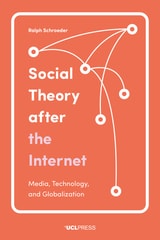
Social Theory After the Internet
Media, Technology, and GlobalizationRalph Schroeder
University College London, 2018