Results by title
35 books match the query 'Deserts'
10 Moons And 13 Horses
PoemsGary Short
University of Nevada Press, 2004
Short knows Nevada’s austere landscape, its ephemeral beauty, and its stoic people as few writers in any genre do. He also understands the complexities of the human soul and the contradictions of love. So he tells of how his mother, dying of cancer, revisits a day thirty years in the past when her sons trapped a trout and kept it in their father’s horse trough and how now, in her mind’s eye, she carries the boxed-in fish to the stream to release it, “a moment/of having, not loss.” And of how the feathers of a dead owl in a long-dead oak tree have blown loose, “caught and leafed out/from each taloned twig and limb . . . each feather/a separate flight, shining to live.” This is rich and wondrous poetry, deeply moving, unforgettable.
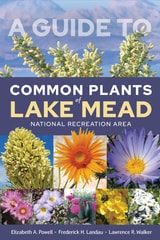
A Guide to Common Plants of Lake Mead National Recreation Area
Elizabeth A. Powell
University of Nevada Press, 2023
A Guide to Common Plants of Lake Mead National Recreation Area is the definitive book for weekend explorers and botanists alike who venture into LMNRA ready to discover the many wonders of the local flora. The authors highlight 183 plants that hikers are most likely to encounter along popular trails, washes, and surrounding hot springs, helping the area’s millions of annual visitors identify and enjoy these common plants. This guide includes photos and descriptions of each plant, along with a map of LMNRA.
The authors also provide a primer on plant ecology, including a guide to plant structures, desert adaptations and life forms, plant-to-plant interactions, and plant-animal interactions. Plants are grouped by life forms, such as tree, shrub, cactus, or grass, and by flower color within the wildflower section. The guide will encourage readers to pause and look carefully at each plant they encounter, giving them an enriched experience during their exploration.
A Natural History of the Mojave Desert
Lawrence R. Walker and Frederick H. Landau
University of Arizona Press, 2018
A Natural History of the Mojave Desert explores how a combination of complex geology, varied geography, and changing climate has given rise to intriguing flora and fauna—including almost 3,000 plant species and about 380 terrestrial vertebrate animal species. Of these, one quarter of the plants and one sixth of the animals are endemic.
The authors, who, combined, have spent more than six decades living in and observing the Mojave Desert, offer a scientifically insightful and personally observed understanding of the desert. They invite readers to understand how the Mojave Desert looks, sounds, feels, tastes, and smells. They prompt us to understand how humans have lived in this desert where scant vegetation and water have challenged humans, past and present.
A Natural History of the Mojave Desert provides a lively and informed guide to understanding how life has adapted to the hidden riverbeds, huge salt flats, tiny wetlands, and windswept hills that characterize this iconic desert.
Arab/American
Landscape, Culture, and Cuisine in Two Great DesertsGary Paul Nabhan
University of Arizona Press, 2008
Arc and the Sediment
a NovelChristine Allen-Yazzie
Utah State University Press, 2007
This tale, though dark and difficult, is infused with tart, twisted humor. Confused, disheveled, self-deprecating, and self-destructive, Gretta is also sharp and funny. Here, first-time novelist Christine Allen-Yazzie breaks apart her own narrative arc but with gritty reality seals it near-shut again, if in rearrangement, drawing us into Gretta's wrestling match with herself, her husband, her addiction, and the road.
The Arc and the Sediment received an honorable mention from the James Jones First Novel Competition, and it won the Utah Arts Council Annual Writing Competiton Publishing Prize.
Aridland Springs in North America
Ecology and ConservationEdited by Lawrence E. Stevens and Vicky J. Meretsky; Foreword by Gary Paul Nabhan
University of Arizona Press, 2008
Aridland Springs in North America offers a much-needed comprehensive synthesis of aridland springs ecology. Stevens and Meretsky have assembled chapters from numerous and diverse experts from the fields of geology, hydrology, geomorphology, water quality, ecosystem dynamics, water law, and conservation biology. Through analyses and case studies, these contributors provide an in-depth overview of these topics and address issues critical for improving the knowledge and conservation of springs. This volume goes beyond examining the ecological importance of aridland springs to provide practical and productive ideas for their preservation. The authors facilitate future research by cultivating a language with which to collectively describe and study springs ecosystems, creating the beginnings of a comprehensive springs classification system. This book could not be more timely, as groundwater depletion throughout the continent is rapidly decimating these vital sources of life.
CONTENTS
Prologue
Gary P. Nabhan
1 Springs Ecosystem Ecology And Conservation
Lawrence E. Stevens And Vicky J. Meretsky
2 The Demise Of Desert Springs
Peter J. Unmack And W. L. Minckley*
3 The Hydrology Of Desert Springs In North America
David K. Kreamer And Abe Springer
4 A Comprehensive Springs Classification System: Integrating Geomorphic, Hydrogeochemical, And Ecological Criteria
Abraham E. Springer, Lawrence E. Stevens, Diana E. Anderson, Roderic A. Parnell1, David K. Kreamer, Lisa Levin, And Stephen P. Flora1
5 Quaternary Cauldron Springs As Paleoecological Archives
C. Vance Haynes Jr.
6 The Extreme Environment, Trophic Structure, And Ecosystem Dynamics Of A Large Fishless Desert Spring: Montezuma Well, Arizona
Dean W. Blinn
7 Combining Ecological Research And Conservation: A Case Study In Cuatro Ciénegas, Coahuila, México
Dean A. Hendrickson, Jane C. Marks, Angie Moline, Eric Dinger, Adam Cohen
8 The Desert Fan Palm Oasis
James W. Cornett
9 Spring-Supported Vegetation Along The Colorado River, Colorado Plateau: Floristics, Vegetation Structure And Environment
John R. Spence
10 Mechanisms Of Change In Seep/Spring Plant Communities On The Southern Colorado Plateau
Vicky J. Meretsky
11 Biodiversity And Productivity At An Undisturbed Spring In Comparison With Adjacent Grazed Riparian And Upland Habitats
Bianca S. Perla And Lawrence E. Stevens
12 Plant Diversity Influenced By Indigenous Management Of Freshwater Springs: Flora Of Quitovac, Sonora, Mexico
Gary Paul Nabhan
13 Historic And Prehistoric Ethnobiology Of Desert Springs
Amadeo M. Rea
14 Vegetation Dynamics Of Great Basin Springs: Potential Effects Of Groundwater Withdrawal
Duncan Patten, Leigh Rouse, Juliet Stromberg
15 The Knowles Canyon Hanging Garden, Glen Canyon National Recreation Area, Eight Years After Burning: Changes In Vegetation And Soil Biota
Tim B. Graham
16 Between The Cracks: Water Law And Spring Conservation In Arizona
Nancy Nelson
17 Ep
Blue Corn Tongue
Poems in the Mouth of the DesertAmber McCrary
University of Arizona Press, 2025
In a voice that is jubilant, irreverent, sometimes scouring, sometimes heartfelt, and always unmistakably her own, Amber McCrary remaps the deserts of Arizona through the blue corn story of a young Diné woman figuring out love and life with an O’odham man. Reflecting experiences of Indigenous joy, pain, and family, these shapeshifting poems celebrate the love between two Native partners, a love that flourishes alongside the traumas they face in the present and the past. From her ethereal connection with her saguaro muse, Hosh, to the intricate tapestry of her relationships with Diné relatives and her awakening to the complex world of toxic masculinity, McCrary brings together DIY zine aesthetics, life forms of juniper and mountains, and the beauty of Diné Bizaad to tell of the enduring bonds between people and place.
Journeying from the Colorado Plateau to the Sonoran Desert and back again, Blue Corn Tongue invokes the places, plants, and people of Diné Bikéyah and O’odham jeweḍ in a deeply honest exploration of love, memory, and intimacy confronting the legacy of land violence in these desert homelands.
Bountiful Deserts
Sustaining Indigenous Worlds in Northern New SpainCynthia Radding
University of Arizona Press, 2022
Common understandings drawn from biblical references, literature, and art portray deserts as barren places that are far from God and spiritual sustenance. In our own time, attention focuses on the rigors of climate change in arid lands and the perils of the desert in the northern Mexican borderlands for migrants seeking shelter and a new life.
Bountiful Deserts foregrounds the knowledge of Indigenous peoples in the arid lands of northwestern Mexico, for whom the desert was anything but barren or empty. Instead, they nurtured and harvested the desert as a bountiful and sacred space. Drawing together historical texts and oral testimonies, archaeology, and natural history, author Cynthia Radding develops the relationships between people and plants and the ways that Indigenous people sustained their worlds before European contact through the changes set in motion by Spanish encounters, highlighting the long process of colonial conflicts and adaptations over more than two centuries. This work reveals the spiritual power of deserts by weaving together the cultural practices of historical peoples and contemporary living communities, centered especially on the Yaqui/Yoeme and Mayo/Yoreme.
Radding uses the tools of history, anthropology, geography, and ecology to paint an expansive picture of Indigenous worlds before and during colonial encounters. She re-creates the Indigenous worlds in both their spiritual and material realms, bringing together the analytical dimension of scientific research and the wisdom of oral traditions in its exploration of different kinds of knowledge about the natural world.
Published in cooperation with the William P. Clements Center for Southwest Studies, Southern Methodist University
Coastal Deserts
Their Natural and Human EnvironmentsDavid H.K. Amiran
University of Arizona Press, 1973
Cornerstone at the Confluence
Navigating the Colorado River Compact's Next CenturyEdited by Jason Anthony Robison
University of Arizona Press, 2022
No fewer than forty million people have come to rely on the Colorado River system in modern times—a river system immersed in an unprecedented, unrelenting megadrought for more than two decades. Attempting to navigate this “new normal,” policymakers are in the midst of negotiating new management rules for the river system, a process coinciding with the compact’s centennial that must be completed by 2026.
Animated by this remarkable confluence of events, Cornerstone at the Confluence leverages the centennial year to reflect on the compact and broader “Law of the River” to envision the future. It is a volume inviting dialogue about how the Colorado River system’s flows should be apportioned given climate change, what should be done about environmental issues such as ecosystem restoration and biodiversity protection, and how long-standing issues of water justice facing Native American communities should be addressed.
In one form or another, all these topics touch on the concept of “equity” embedded within the compact—a concept that tees up what is perhaps the foundational question confronted by Cornerstone at the Confluence: Who should have a seat at the table of Colorado River governance?
Desert Survival Skills
By David Alloway
University of Texas Press, 2000
Remote desert locations, including the Chihuahuan Desert of northern Mexico, southern Texas, New Mexico, and Arizona, draw adventurers of all kinds, from the highly skilled and well prepared to urban cowboys who couldn't lead themselves (much less a horse!) to water. David Alloway's goal in this book is to help all of them survive when circumstances beyond their control strand them in the desert environment. In simple, friendly language, enlivened with humor and stories from his own extensive experience, Alloway here offers a practical, comprehensive handbook for both short-term and long-term survival in the Chihuahuan and other North American deserts.
Dune Country
A Naturalist's Look at the Plant Life of Southwestern Sand DunesJanice Emily Bowers
University of Arizona Press, 1998
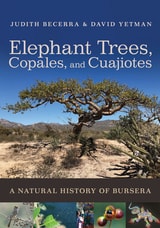
Elephant Trees, Copales, and Cuajiotes
A Natural History of BurseraJudith Becerra and David Yetman; Foreword by Exequiel Ezcurra
University of Arizona Press, 2024
In the United States, Bursera is represented by the short, contorted, and aromatic elephant tree of the hot Sonoran Desert and the stately and colorful gumbo limbo of southern Florida, while in the torrid lowlands of southern Mexico, the engines of evolution have produced forests dominated by dozens of species of Bursera, each with a peculiar ecological slot. This evolutionary tableau presents a complicated sex life that puzzles scientists. Recent research also reveals a gripping narrative of an epic struggle between trees and the insects that would subsist on their leaves: the insects seeking to exploit a food resource, the trees reacting with ever-changing, dramatic counter strategies. In addition to the fascinating and intricate workings of the genus’s ecological adaptations, burseras play a formative role in the lives of indigenous populations. Native peoples relish the plants’ aromatic resin, workable wood, and often colorful bark as a source for endless human applications.
Written in an engaging style, enhanced with two hundred color photographs, and complete with a compendium of species descriptions, this book will be an essential reference on a significant North American plant.
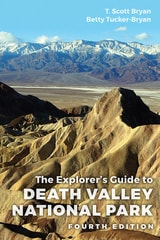
Explorer's Guide to Death Valley National Park, Fourth Edition
T. Scott Bryan
University Press of Colorado, 2020
Originally published in 1995, soon after Death Valley National Park became the fifty-third park in the US park system, The Explorer’s Guide to Death Valley National Park was the first complete guidebook available for this spectacular area. Now in its fourth edition, this is still the only book that includes all aspects of the park. Much more than just a guidebook, it covers the park’s cultural history, botany and zoology, hiking and biking opportunities, and more. Information is provided for all of Death Valley’s visitors, from first-time travelers just learning about the area to those who are returning for in-depth explorations.
This new edition features a number of important changes—including information on the boundary and wilderness changes that resulted from the Dingell Act of 2019, the reopened Keane Wonder Mine area, the devastating flash flooding of Scotty’s Castle, scenic river designations, the Inn and Ranch resorts, renovated and now operated as the Oasis at Death Valley—as well as new maps and updated color photos. With extensive input from National Park Service resource management, law enforcement, and interpretive personnel, as well as a thorough bibliography for suggested reading, The Explorer’s Guide to Death Valley National Park, Fourth Edition is the most up-to-date, accurate, and comprehensive guide available for this national treasure.
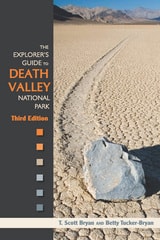
Explorer's Guide to Death Valley National Park, Third Edition
T. Scott Bryan and Betty Tucker Bryan
University Press of Colorado, 2015
Originally published in 1995, soon after Death Valley National Park became the fifty-third park in the U.S. park system, The Explorer's Guide to Death Valley National Park was the first complete guidebook available for this spectacular area.
Now in its third edition, this is still the only book that includes all aspects of the park. Much more than just a guidebook, it covers the park's cultural history, botany and zoology, hiking and biking opportunities, and more. Information is provided for all of Death Valley's visitors, from first-time travelers just learning about the area to those who are returning for in-depth explorations.
The book includes updated point-to-point logs for every road within and around the park, as well as more accurate map than those in any other publication. With extensive input from National Park Service resource management, law enforcement, and interpretive personnel, as well as a thorough bibliography for suggested reading, The Explorer's Guide to Death Valley National Park, Third Edition is the most up-to-date, accurate, and comprehensive guide available for this national treasure.
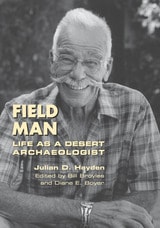
Field Man
Life as a Desert ArchaeologistJulian D. Hayden; Edited by Bill Broyles and Diane E. Boyer
University of Arizona Press, 2012
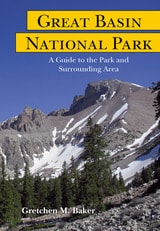
Great Basin National Park
A Guide to the Park and Surrounding AreaGretchen M. Baker
Utah State University Press, 2012
Great Basin National Park is in large part a high-alpine park, but it sits in one of America’s driest, least populated, and most isolated deserts. That contrast is one facet of the diversity that characterizes this region. Within and outside the park are phenomenal landscape features, biotic wonders, unique environments, varied historic sites, and the local colors of isolated towns and ranches. Vast Snake and Spring Valleys, bracketing the national park, are also subjects of one of the West's most divisive environment contests, over what on the surface seems most absent but underground is abundant enough for sprawling Las Vegas to covet it—water.
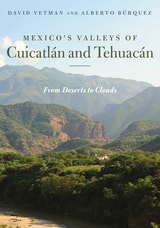
Mexico’s Valleys of Cuicatlán and Tehuacán
From Deserts to CloudsDavid Yetman and Alberto Búrquez
University of Arizona Press, 2023
Through firsthand experience and engaging prose, the authors provide a synthesis of the geology, ecology, history, and cultures of the valleys, showing their importance and influence as Mesoamerican arteries for environmental and cultural interchange through Mexico. It also reveals the extraordinary plant life that draws from habitats ranging from deserts to tropical forests.
The authors, both experts in their respective fields, begin with a general description of the geography of the valleys, followed by an introduction to climate and hydrology, a look at the valleys’ often bewildering geology. The book delves into cultural and linguistic backgrounds of the valleys and discusses archaeological sites that that encapsulate the valleys’ fascinating history prior to the arrival of Europeans. The book concludes by describing the flora that makes the region so singular.

Mezcal
By Charles Bowden
University of Texas Press, 1988
Praise for Mezcal:
"Mezcal is also a lyrical meditation upon the ultimate strength of the land, specifically the desert Southwest, and how that land prevails and endures despite every effort of modern industry and development to rape and savage it in the name of progress. Mezcal lingers in the mind as only the very best books manage to do."—Harry Crews
"The author . . . excavates his own tormented life—and its relation to the land he loves—in a series of powerful, imagistic autobiographical essays. Like the desert he cherishes, this memoir is harsh yet lovely, full of sour self-truth. . . . A potent presentation of the wounds of one man's life, packed with indelible impressions; but there's little healing here, making this a bitter if beautiful read."—Kirkus Review
"In Mezcal . . . Bowden drops the journalistic veil, exploring the ecology of his interior landscape at least as thoroughly as the changing scenery that surrounds him. . . . Others—Aldo Leopold, Edward Abbey—have already staked inviolate claims on the Southwestern deserts. But Bowden owns the complex terrain where, like a mezcal-inspired mirage, the Sonoran sun-belt overlaps the gray convolutions of the American mind."—Los Angeles Times
Mystic Bones
Mark C. Taylor
University of Chicago Press, 2007
The desert has long been a theme in Mark C. Taylor’s work, from his inquiries into the religious significance of Las Vegas to his writings on earthworks artist Michael Heizer. At once haunted by absence and loss, the desert, for Taylor, is a place of exile and wandering, of temptation and tribulation. Bones, in turn, speak to his abiding interest in remnants, ruins, ritual, and immanence. Taylor combines his fascination in the detritus of the desert and its philosophical significance with his work in photography in Mystic Bones.
A collection of remarkably elegant close-up images of weathered bones—remains of cattle, elk, and deer skeletons gathered from the desert of the American West—Mystic Bones pairs each photograph with a philosophical aphorism. These images are buttressed by a major essay, “Rubbings of Reality,” in which Taylor explores the use of bones in the religious rituals of native inhabitants of the Western desert and, more broadly, the appearance of bones in myth and religious reality.
Meditating on the way in which bones paradoxically embody both the personal and the impersonal—at one time they are our very substance, but eventually they become our last remnants, anonymous, memorializing oblivion—Taylor here suggests ways in which natural processes can be thought of as art, and bones as art objects. Bones, Taylor writes, “draw us elsewhere.” To follow their traces beyond the edge of the human is to wander into ageless times and open spaces where everything familiar becomes strange.
By revealing beauty hidden in the most unexpected places, these haunting images refigure death in a way that allows life to be seen anew. A bold new work from a respected philosopher of religion, Mystic Bones is Taylor’s his most personal statement of after-God theology.
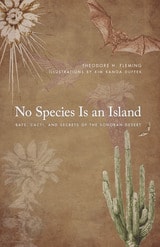
No Species Is an Island
Bats, Cacti, and Secrets of the Sonoran DesertTheodore H. Fleming; Illustrations by Kim Kanoa Duffek
University of Arizona Press, 2017
The Sonoran Desert is the most biologically diverse desert in the world. Four species of columnar cacti, including the iconic saguaro and organ pipe, are among its most conspicuous plants. No Species Is an Island describes Theodore H. Fleming’s eleven-year study of the pollination biology of these species at a site he named Tortilla Flats in Sonora, Mexico, near Kino Bay.
Now Fleming shares the surprising results of his intriguing work. Among the novel findings are one of the world’s rarest plant-breeding systems in a giant cactus; the ability of the organ pipe cactus to produce fruit with another species’ pollen; the highly specialized moth-cactus pollination system of the senita cactus; and the amazing lifestyle of the lesser long-nosed bat, the major nocturnal pollinator of three of these species.
These discoveries serve as a primer on how to conduct ecological research, and they offer important conservation lessons for us all. Fleming highlights the preciousness of the ecological web of our planet—Tortilla Flats is a place where cacti and migratory bats and birds connect such far-flung habitats as Mexico’s tropical dry forest, the Sonoran Desert, and the temperate rain forests of southeastern Alaska. Fleming offers an insightful look at how field ecologists work and at the often big surprises that come from looking carefully at a natural world where no species stands alone.

Ocean Power
Poems from the DesertOfelia Zepeda
University of Arizona Press, 1995
Poet Ofelia Zepeda centers these poems on her own experiences growing up in a Tohono O'odham family, where desert climate profoundly influenced daily life, and on her perceptions as a contemporary Tohono O'odham woman. One section of poems deals with contemporary life, personal history, and the meeting of old and new ways. Another section deals with winter and human responses to light and air. The final group of poems focuses on the nature of women, the ocean, and the way the past relationship of the O'odham with the ocean may still inform present day experience. These fine poems will give the outside reader a rich insight into the daily life of the Tohono O'odham people.
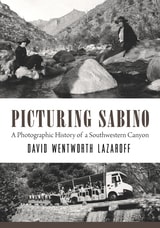
Picturing Sabino
A Photographic History of a Southwestern CanyonDavid Wentworth Lazaroff
University of Arizona Press, 2023
The story is vividly told through numerous historical photographs, lively anecdotes, and an engaging text, informed by decades of research by David Wentworth Lazaroff. Along the way the reader makes the acquaintance of ordinary picnickers as well as influential citizens who helped to reshape the canyon, while witnessing the canyon’s evolving relationship with its growing urban neighbor. The book will fascinate readers who are already familiar with Sabino Canyon, as well as anyone with an interest in local or regional history, or in historical photography.
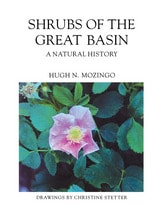
Shrubs Of The Great Basin
A Natural HistoryHugh N. Mozingo
University of Nevada Press, 1987
Mozingo presents the life histories of more than sixty species of both common and unusual shrubs, and discusses how shrubs grow, reproduce, and adapt to the extreme weather conditions that are part of daily life in the Great Basin. Drawings by Christine Stetter.
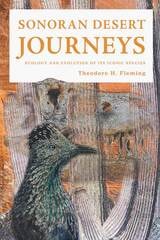
Sonoran Desert Journeys
Ecology and Evolution of Its Iconic SpeciesTheodore H. Fleming
University of Arizona Press, 2022
In Sonoran Desert Journeys ecologist Theodore H. Fleming discusses two remarkable journeys. First, Fleming offers a brief history of our intellectual and technical journey over the past three centuries to understand the evolution of life on Earth. Next, he applies those techniques on a journey of discovery about the evolution and natural history of some of the Sonoran Desert’s most iconic animals and plants. Fleming details the daily lives of a variety of reptiles, birds, mammals, and plants, describing their basic natural and evolutionary histories and addressing intriguing issues associated with their lifestyles and how they cope with a changing climate. Finally, Fleming discusses the complexity of Sonoran Desert conservation.
This book explores the evolution and natural history of iconic animals and plants of the northern Sonoran Desert through the eyes of a curious naturalist and provides a model of how we can coexist with the unique species that call this area home.
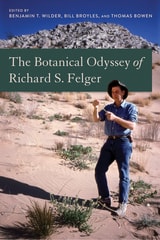
The Botanical Odyssey of Richard S. Felger
Edited by Benjamin T. Wilder, Bill Broyles, and Thomas Bowen
University of Arizona Press, 2026
This work is a vibrant tribute to Richard Stephen Felger, who was one of the most influential scientists of the American Southwest and northwestern Mexico. Known as a desert botanist, Felger’s work transcended regional boundaries, blending rigorous fieldwork with global ecological vision. This work offers an intimate and multifaceted portrait of a man whose tireless advocacy for biodiversity and biocultural conservation shaped generations of desert scientists..
Edited by Benjamin T. Wilder, Bill Broyles, and Thomas Bowen, this book is both a celebration and a resource. The work is separated into four parts. With humor, insight, and deep empathy, Felger’s own voice leads the journey in part 1, recounting his most memorable field experiences with masterful prose and sly wit. Part 2 brings together heartfelt reflections from colleagues who worked alongside Felger in the field, revealing the eccentric brilliance and relentless curiosity that defined his career. Part 3 explores his family history and the unconventional path that shaped his life’s work, while part 4 presents a comprehensive bibliography of his most important publications. The book contains four maps that help take you around the world on Felger’s journeys, and fifty images selected from the thousands of slides from his archive that further transport and anchor you in the adventure.
Felger’s own voice, paired with reflections from twenty colleagues, creates a rich, multifaceted narrative, offering readers a rare glimpse into the life of a scientific icon whose legacy continues to inspire desert researchers and conservationists across the globe.
Contributors
James Aronson
Thomas Bowen
Bill Broyles
Alberto Búrquez
Susan Davis Carnahan
Mark Alan Dimmitt
Exequiel Ezcurra
Gil Gillenwater
Russ Kleinman
Angelina Martínez-Yrízar
Gregory McNamee
Cathy Moser Marlett
Gary Paul Nabhan
Wallace J. Nichols
William R. Norris
Humberto Romero Morales
Sue Rutman
Silke Schneider
Jeffrey Seminoff
Jane Spinti
Benjamin T. Wilder
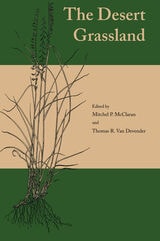
The Desert Grassland
Edited by Mitchel P. McClaran and Thomas R. Van Devender
University of Arizona Press, 1995
Leading experts in geography, biology, botany, zoology, and geoscience present new research on the desert grassland and review a vast amount of earlier work. They reveal that present-day grasses once grew in the ice-age forests that existed in these areas before the climate dried and the trees vanished and how the intensity and frequency of fire can influence the plant and animal species of the grassland. They also document how the influence of humans—from Amerindians to contemporary ranchers, public land managers, and real estate developers—has changed the relative abundance of woody and herbaceous species and how the introduction of new plants and domesticated animals to the area has also affected biodiversity. The book concludes with a review of the attempts, both failed and successful, to reestablish plants in desert grasslands affected by overgrazing, drought, and farm abandonment.
Meticulously researched and copiously illustrated, The Desert Grassland is a major contribution to ecological literature. For advanced lay readers as well as students and scholars of history, geography, and ecology, it will be a standard reference work for years to come.
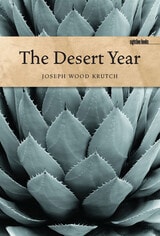
The Desert Year
Joseph Wood Krutch
University of Iowa Press, 1952
Now back in print, Joseph Wood Krutch’s Burroughs Award–winning The Desert Year is as beautiful as it is philosophically profound. Although Krutch—often called the Cactus Walden—came to the desert relatively late in his life, his curiosity and delight in his surroundings abound throughout The Desert Year, whether he is marveling at the majesty of the endless dry sea, at flowers carpeting the desert floor, or at the unexpected appearance of an army of frogs after a heavy rain.
Krutch’s trenchant observations about life prospering in the hostile environment of Arizona’s Sonoran Desert turn to weighty questions about humanity and the precariousness of our existence, putting lie to Western denials of mind in the “lower” forms of life: “Let us not say that this animal or even this plant has ‘become adapted’ to desert conditions. Let us say rather that they have all shown courage and ingenuity in making the best of the world as they found it. And let us remember that if to use such terms in connection with them is a fallacy then it can only be somewhat less a fallacy to use the same terms in connection with ourselves.”
This edition contains 33 exacting drawings by noted illustrator Rudolf Freund. Closely tied to Krutch’s uncluttered text, the drawings tell a story of ineffable beauty.

The Lizard Woman
Frank Waters
Ohio University Press, 1985
“The novel was begun in 1926, when I was twenty-four years old and working as a telephone engineer in Imperial Valley, on the California-Baja California border. During my stay there I made a horseback trip down into the little-known desert interior of Lower California. After having lived all of my early years in the high Rockies of California, I was unprepared for the vast sweep of sunstruck desert with its flat wastes, clumps of cacti, and barren parched-rock ranges. Its emotional impact was so profound, I was impelled to give voice to it with pencil and paper.”
— Frank Waters
First published in 1930 under the title Fever Pitch, The Lizard Woman is Frank Waters’ first novel. It foreshadows a theme central to Waters’ later work: that we must attune our spirits to the land to fully understand our places in the natural order.
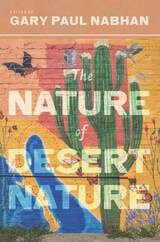
The Nature of Desert Nature
Edited by Gary Paul Nabhan
University of Arizona Press, 2020
Nabhan invites a prism of voices—friends, colleagues, and advisors from his more than four decades of study of deserts—to bring their own perspectives. Scientists, artists, desert contemplatives, poets, and writers bring the desert into view and investigate why these places compel us to walk through their sands and beneath their cacti and acacia. We observe the spines and spears, stings and songs of the desert anew. Unexpected. Surprising. Enchanting. Like the desert itself, each essay offers renewed vocabulary and thoughtful perceptions.
The desert inspires wonder. Attending to history, culture, science, and spirit, The Nature of Desert Nature celebrates the bounty and the significance of desert places.
Contributors
Thomas M. Antonio
Homero Aridjis
James Aronson
Tessa Bielecki
Alberto Búrquez Montijo
Francisco Cantú
Douglas Christie
Paul Dayton
Alison Hawthorne Deming
Father David Denny
Exequiel Ezcurra
Thomas Lowe Fleischner
Jack Loeffler
Ellen McMahon
Rubén Martínez
Curt Meine
Alberto Mellado Moreno
Paul Mirocha
Gary Paul Nabhan
Ray Perotti
Larry Stevens
Stephen Trimble
Octaviana V. Trujillo
Benjamin T. Wilder
Andy Wilkinson
Ofelia Zepeda
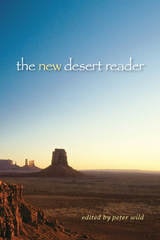
The New Desert Reader
Wild, Peter
University of Utah Press, 2006
A slow change in outlook dominates the book, as attitudes shift from viewing the desert as a place to be despised or exploited to an appreciation of it as a special place, an arena of highly complex natural communities, and a wild refuge for the human body and soul. Comprehensive and brightly informative, The New Desert Reader will be invaluable to anyone interested in the history, literature, and beauty of North America’s treasured desert places.
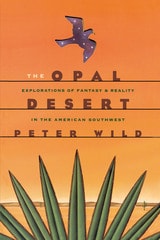
The Opal Desert
Explorations of Fantasy and Reality in the American SouthwestBy Peter Wild
University of Texas Press, 1999
The opalescent deserts of the American Southwest have become romantic icons in the public imagination through the words of writers, the images of artists and photographers, and the visual storytelling of filmmakers. In this spirited, personal, beautifully written book, Peter Wild explores the lives and works of sixteen writers whose words have shaped our visions of the opal desert.
Wild begins with Cabeza de Vaca, whose Relación of his desert wanderings sent treasure-hungry Spaniards searching for cities of gold. He goes on to discuss the works of both widely read and lesser-known nineteenth- and twentieth-century authors, including such luminaries as Mary Austin, Joseph Wood Krutch, Edward Abbey, Ann Zwinger, and Charles Bowden. He links all the writers as explorers of one kind or another, searching for tangible or intangible treasures, some finding and some losing their dreams in the opal desert.

The Secret Life Of John C. Van Dyke
Selected LettersDavid W. Teague
University of Nevada Press, 1997
The author of The Desert, the book that made the American landscape accessible to the mainstream mind, was much less like his fellow environmental prophets John Muir and Henry David Thoreau than he would have had us believe. Van Dyke claimed to have wandered "alone on horseback for thousands of miles through the American Southwest and northern Mexico," as readers of The Desert—now in the millions since the book was published in 1901—were told. He did not. In The Secret Life of John C. Van Dyke, Teague and Wild unmask the desert saint with Van Dyke’s own recently discovered letters. These letters depict a privileged, patrician, and pampered member of the upper-class. His incriminating correspondence reveals that he saw most of the desert from plush railroad cars and grand hotel rooms. In the introduction, the editors clear up many misconceptions scholars currently hold about Van Dyke’s ecological principles, about his outdoorsmanship, and about his trip through the desert itself. As the centennial of the publication of The Desert approaches, this lively collection of letters helps set the record straight. The John C. Van Dyke unveiled in The Secret Life is a more varied character than we had supposed—still worthy of much admiration for his remarkable accomplishments, but still mysterious, and not the man we thought him to be.
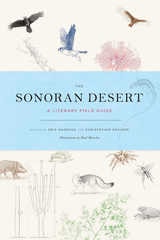
The Sonoran Desert
A Literary Field GuideEdited by Eric Magrane and Christopher Cokinos, Illustrations by Paul Mirocha
University of Arizona Press, 2016
Both literary anthology and hands-on field guide, The Sonoran Desert is a groundbreaking book that melds art and science. It captures the stunning biodiversity of the world’s most verdant desert through words and images. More than fifty poets and writers—including Christopher Cokinos, Alison Hawthorne Deming, Ken Lamberton, Eric Magrane, Jane Miller, Gary Paul Nabhan, Alberto Ríos, Ofelia Zepeda, and many others—have composed responses to key species of this striking desert. Each creative contribution is joined by an illustration by award-winning artist Paul Mirocha and scientific information about the creature or plant authored by the book’s editors.
From the saguaro to the mountain lion, from the black-tailed jackrabbit to the mesquite, the species represented here have evoked compelling and creative responses from each contributor. Just as writers such as Edward Abbey and Ellen Meloy have memorialized the desert, this collection is sure to become a new classic, offering up the next generation of voices of this special and beautiful place, the Sonoran Desert.
Where Clouds Are Formed
Ofelia Zepeda
University of Arizona Press, 2008
Zepeda is as clear-eyed about the past as she is about the present. She recalls waiting for the school bus on a cold morning inside her father’s truck, listening to the sounds of the engine, the windshield wipers, and the “soft rain on the hood.” She remembers celebrating Mass on the “cold dirt floor of the Winter Solstice.” In the present, she sees both the frustration and the humor in a woman she observes trying to eat pancakes with one hand while her other resides in a cast: “Watching her, I realize eating pancakes is a two-handed job.”
Whatever she sees, she filters through her second set of eyes, which keep the past always present. She tells of traveling to Waw Giwulig, the most sacred mountain of the Tohono O’odham, to ask for blessings—and forgiveness. She writes that one should always bring music to the mountains, “so they are generous with the summer rains.” And, still, “the scent of burning wood / holds the strongest memory. / Mesquite, cedar, piñon, juniper, . . . / we catch the scent of burning wood; / we are brought home.” It is a joy to see the world afresh through her eyes.