Results by title
50 books match the query 'Justice, Administration of' and 3 start with s

Seeking Spatial Justice
Edward W. Soja
University of Minnesota Press, 2010
In 1996, the Los Angeles Bus Riders Union, a grassroots advocacy organization, won a historic legal victory against the city’s Metropolitan Transit Authority. The resulting consent decree forced the MTA for a period of ten years to essentially reorient the mass transit system to better serve the city’s poorest residents. A stunning reversal of conventional governance and planning in urban America, which almost always favors wealthier residents, this decision is also, for renowned urban theorist Edward W. Soja, a concrete example of spatial justice in action.
In Seeking Spatial Justice, Soja argues that justice has a geography and that the equitable distribution of resources, services, and access is a basic human right. Building on current concerns in critical geography and the new spatial consciousness, Soja interweaves theory and practice, offering new ways of understanding and changing the unjust geographies in which we live. After tracing the evolution of spatial justice and the closely related notion of the right to the city in the influential work of Henri Lefebvre, David Harvey, and others, he demonstrates how these ideas are now being applied through a series of case studies in Los Angeles, the city at the forefront of this movement. Soja focuses on such innovative labor–community coalitions as Justice for Janitors, the Los Angeles Alliance for a New Economy, and the Right to the City Alliance; on struggles for rent control and environmental justice; and on the role that faculty and students in the UCLA Department of Urban Planning have played in both developing the theory of spatial justice and putting it into practice.
Effectively locating spatial justice as a theoretical concept, a mode of empirical analysis, and a strategy for social and political action, this book makes a significant contribution to the contemporary debates about justice, space, and the city.
[more]
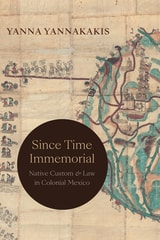
Since Time Immemorial
Native Custom and Law in Colonial MexicoYanna Yannakakis
Duke University Press, 2023
In Since Time Immemorial Yanna Yannakakis traces the invention of Native custom, a legal category that Indigenous litigants used in disputes over marriage, self-governance, land, and labor in colonial Mexico. She outlines how, in the hands of Native litigants, the European category of custom—social practice that through time takes on the normative power of law—acquired local meaning and changed over time. Yannakakis analyzes sources ranging from missionary and Inquisition records to Native pictorial histories, royal surveys, and Spanish and Native-language court and notarial documents. By encompassing historical actors who have been traditionally marginalized from legal histories and highlighting spaces outside the courts like Native communities, parishes, and missionary schools, she shows how imperial legal orders were not just imposed from above but also built on the ground through translation and implementation of legal concepts and procedures. Yannakakis argues that, ultimately, Indigenous claims to custom, which on the surface aimed to conserve the past, provided a means to contend with historical change and produce new rights for the future.
[more]
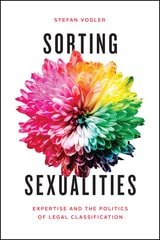
Sorting Sexualities
Expertise and the Politics of Legal ClassificationStefan Vogler
University of Chicago Press, 2021
In Sorting Sexualities, Stefan Vogler deftly unpacks the politics of the techno-legal classification of sexuality in the United States. His study focuses specifically on state classification practices around LGBTQ people seeking asylum in the United States and sexual offenders being evaluated for carceral placement—two situations where state actors must determine individuals’ sexualities. Though these legal settings are diametrically opposed—one a punitive assessment, the other a protective one—they present the same question: how do we know someone’s sexuality?
In this rich ethnographic study, Vogler reveals how different legal arenas take dramatically different approaches to classifying sexuality and use those classifications to legitimate different forms of social control. By delving into the histories behind these diverging classification practices and analyzing their contemporary reverberations, Vogler shows how the science of sexuality is far more central to state power than we realize.
In this rich ethnographic study, Vogler reveals how different legal arenas take dramatically different approaches to classifying sexuality and use those classifications to legitimate different forms of social control. By delving into the histories behind these diverging classification practices and analyzing their contemporary reverberations, Vogler shows how the science of sexuality is far more central to state power than we realize.
[more]