Results by title
71 books match the query 'Language and culture' and 8 start with s
Shakespeare from the Margins
Language, Culture, ContextPatricia Parker
University of Chicago Press, 1996
Combining feminist and historical approaches with attention to the "matter" of language as well as of race and gender, Parker's brilliant "edification from the margins" illuminates much that has been overlooked, both in Shakespeare and in early modern culture. This book, a reexamination of popular and less familiar texts, will be indispensable to all students of Shakespeare and the early modern period.
Shakespeare's Noise
Kenneth Gross
University of Chicago Press, 2001
Kenneth Gross explores Shakespeare's deep fascination with dangerous and disorderly forms of speaking—especially rumor, slander, insult, vituperation, and curse—and through them offers a vision of the work of words in his plays. Coriolanus's taunts or Lear's curses force us to think not just about how Shakespeare's characters speak, but also about how they hear, overhear, and mishear what is spoken, how rumor becomes tragic knowledge for Hamlet, or opens Othello to fantastic jealousies. Gross also shows how Shakespeare's preoccupation with "noisy" speech echoed and transformed a broader cultural obsession with the perils of rumor, slander, and libel in Renaissance England.
Elegantly written and passionately argued, Shakespeare's Noise will challenge and delight anyone who loves his plays, from scholars to general readers, actors, and directors.

Shelter for the Night
On Afghanistan, Language, and DetoursFatima Mojaddedi
Duke University Press, 2026
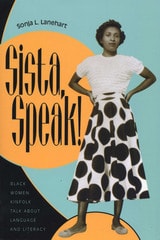
Sista, Speak!
Black Women Kinfolk Talk about Language and LiteracyBy Sonja L. Lanehart
University of Texas Press, 2002
2003 — Honorable Mention, Myers Outstanding Book Award – The Gustavus Myers Center for the Study of Bigotry and Human Rights in North America
The demand of white, affluent society that all Americans should speak, read, and write "proper" English causes many people who are not white and/or middle class to attempt to "talk in a way that feel peculiar to [their] mind," as a character in Alice Walker's The Color Purple puts it. In this book, Sonja Lanehart explores how this valorization of "proper" English has affected the language, literacy, educational achievements, and self-image of five African American women—her grandmother, mother, aunt, sister, and herself.
Through interviews and written statements by each woman, Lanehart draws out the life stories of these women and their attitudes toward and use of language. Making comparisons and contrasts among them, she shows how, even within a single family, differences in age, educational opportunities, and social circumstances can lead to widely different abilities and comfort in using language to navigate daily life. Her research also adds a new dimension to our understanding of African American English, which has been little studied in relation to women.
Sites of Translation
What Multilinguals Can Teach Us about Digital Writing and RhetoricLaura Gonzales
University of Michigan Press, 2018
Winner of the 2016 Sweetland Digital Rhetoric Collaborative Book Prize
Sites of Translation illustrates the intricate rhetorical work that multilingual communicators engage in as they translate information for their communities. Blending ethnographic and empirical methods from multiple disciplines, Laura Gonzales provides methodological examples of how linguistic diversity can be studied in practice, both in and outside the classroom, and provides insights into the rhetorical labor that is often unacknowledged and made invisible in multilingual communication. Sites of Translation is relevant to researchers and teachers of writing as well as technology designers interested in creating systems, pedagogies, and platforms that will be more accessible and useful to multilingual audiences. Gonzales presents multilingual communication as intellectual labor that should be further valued in both academic and professional spaces, and supported by multilingual technologies and pedagogies that center the expertise of linguistically diverse communicators.
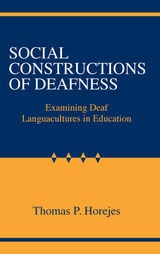
Social Constructions of Deafness
Examining Deaf Languacultures in EducationThomas P. Horejes
Gallaudet University Press, 2012
Thomas P. Horejes’s new book focuses on revealing critical knowledge that addresses certain social justice issues, including deafness, language, culture, and deaf education. He conveys this information through discourses about his own experiences being deaf and through his research in which he “stresses the contingency of the social” in educational institutions.
In Social Constructions of Deafness: Examining Deaf Languacultures in Education, Horejes contends that schools as social institutions play powerful and exacting roles in the creation and maintenance of social constructions such as language and culture for deaf children. He subscribes to Michael Agar’s concept of “languaculture,” defined as the inextricable relationship between language and culture in which a specific language will shape and influence culture. His approach employs other anthropological terminology as he connects his personal experience as a deaf student (emic) to academic research on deafness (etic) to bring understanding to the multidimensional aspects of his own negotiated identities.
Horejes extends his inquiry through his analysis of two kindergarten classes for deaf students, one orally oriented and the other conducted using sing language. His findings are sobering evidence of the myriad challenges educators face in defining appropriate academic, linguistic, and cultural pedagogy for deaf children in schools and other social institutions.

Spanish and Empire
Nelsy Echavez-Solano
Vanderbilt University Press, 2007
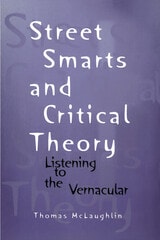
Street Smarts and Critical Theory
Listening to the VernacularThomas McLaughlin
University of Wisconsin Press, 1996
Everybody’s got a theory . . . or do they?
Thomas McLaughlin argues that critical theory—raising serious, sustained questions about cultural practice and ideology—is practiced not only by an academic elite but also by savvy viewers of sitcoms and TV news, by Elvis fans and Trekkies, by labor organizers and school teachers, by the average person in the street.
Like academic theorists, who are trained in a tradition of philosophical and political skepticism that challenges all orthodoxies, the vernacular theorists McLaughlin identifies display a lively and healthy alertness to contradiction and propaganda. They are not passive victims of ideology but active questioners of the belief systems that have power over their lives. Their theoretical work arises from the circumstances they confront on the job, in the family, in popular culture. And their questioning of established institutions, McLaughlin contends, is essential and healthy, for it energizes other theorists who clarify the purpose and strategies of institutions and justify the existence of cultural practices.
Street Smarts and Critical Theory leads us through eye-opening explorations of social activism in the Southern Christian anti-pornography movement, fan critiques in the ‘zine scene, New Age narratives of healing and transformation, the methodical manipulations of the advertising profession, and vernacular theory in the whole-language movement. Emphasizing that theory is itself a pervasive cultural practice, McLaughlin calls on academic institutions to recognize and develop the theoretical strategies that students bring into the classroom.
“This book demystifies the idea of theory, taking it out of the hands of a priestly caste and showing it as the democratic endowment of the people.”—Daniel T. O’Hara, Temple University, author of Radical Parody: American Culture and Critical Agency after Foucault and Lionel Trilling: The Work of Liberation.
“McLaughlin takes seriously the critical and theoretical activity of everyday people and does so in a way that will empower these very populations to take seriously their own activities as theorists. . . . A manifesto that is sure to be heard by the younger generation of thinkers in American cultural studies.”—Henry Jenkins, MIT, author of Textual Poachers: Television Fans and Participatory Culture