Results by title
78 books match the query 'Legends' and 8 start with s
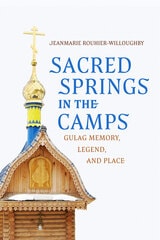
Sacred Springs in the Camps
Gulag Memory, Legend, and PlaceJeanmarie Rouhier-Willoughby
University of Wisconsin Press, 2026
Grounded by detailed ethnography, Sacred Springs in the Camps explores how legend creates, negotiates, and challenges collective memory; how lived religious practices intersect with the current revival of the Russian Orthodox Church; how politics intertwine with belief; and how the social construction of sacred places affects folk narratives, faith, and local identity. These unlikely holy waters thus reflect important facets of contemporary Russian religion, politics, and society, refracting and reframing memories of the socialist past even as they offer important lessons for the present moment.
Saints of the Christianization Age of Central Europe
Tenth to Eleventh CenturiesCristian Gaspar
Central European University Press, 2012
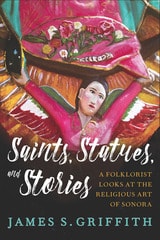
Saints, Statues, and Stories
A Folklorist Looks at the Religious Art of SonoraJames S. Griffith
University of Arizona Press, 2019
So describes well-known and beloved folklorist James S. Griffith as he takes us back through the decades to a town in northern Sonora where a statue is saved—and in so doing, a community is saved as well.
In Saints, Statues, and Stories Griffith shares stories of nearly sixty years of traveling through Sonora. As we have come to expect through these journeys, “Big Jim”—as he is affectionately known by many—offers nothing less than the living traditions of Catholic communities. Themes of saints as agents of protection or community action are common throughout Sonora: a saint coming out of the church to protect the village, a statue having a say in where it resides and paying social calls to other communities, or a beloved image rescued from destruction and then revered on a private altar. A patron saint saves a village from outside attackers in one story—a story that has at least ten parallels in Sonora’s former mission communities. Details may vary, but the general narrative remains the same: when hostile nonbelievers attack the village, the patron saint of the church foils them.
Griffith uncovers the meanings behind the devotional uses of religious art from a variety of perspectives—from artist to audience, preservationist to community member. The religious artworks transcend art objects, Griffith believes, and function as ways of communicating between this world and the next. Setting the stage with a brief geography, Griffith introduces us to roadside shrines, artists, fiestas, saints, and miracles. Full-color images add to the pleasure of this delightful journey through the churches and towns of Sonora.

Scandinavian Folk Belief and Legend
Reimund Kvideland
University of Minnesota Press, 1991
An entertaining collection of over 400 folk tales of legends, stories, and magic. Translated from the original Norwegian, Danish, and Swedish, this highly acclaimed work is perfect for bedside or fireside reading.
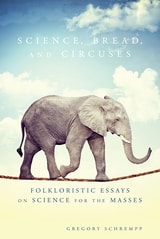
Science, Bread, and Circuses
Folkloristic Essays on Science for the MassesGregory Schrempp
Utah State University Press, 2014
In Science, Bread, and Circuses, Gregory Schrempp brings a folkloristic viewpoint to the topic of popular science, calling attention to the persistence of folkloric form, idiom, and worldview within the increasingly important dimension of popular consciousness defined by the impact of science.
Schrempp considers specific examples of texts in which science interpreters employ folkloric tropes—myths, legends, epics, proverbs, spectacles, and a variety of gestures from religious tradition—to lend credibility and appeal to their messages. In each essay he explores an instance of science popularization rooted in the quotidian round: variations of proverb formulas in monumental measurements, invocations of science heroes like saints or other inspirational figures, the battle of mythos and logos in parenting and academe, how the meme has become embroiled in quasi-religious treatments of the problem of evil, and a range of other tropes of folklore drafted to serve the exposition of science.
Science, Bread, and Circuses places the relationship of science and folklore at the very center of folkloristic inquiry by exploring a range of attempts to rephrase and thus domesticate scientific findings and claims in folklorically imbued popular forms.
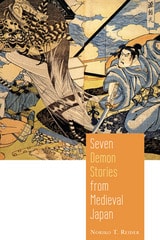
Seven Demon Stories from Medieval Japan
Noriko T. Reider
Utah State University Press, 2016
Reider, concordant with many scholars of Japanese cultural studies, argues that to study oni is to study humanity. These tales are from an era in which many new oni stories appeared for the purpose of both entertainment and moral/religious edification and for which oni were particularly important, as they were perceived to be living entities. They reflect not only the worldview of medieval Japan but also themes that inform twenty-first-century Japanese pop and vernacular culture, including literature, manga, film, and anime. With each translation, Reider includes an introductory essay exploring the historical and cultural importance of the characters and oni manifestations within this period.
Offering new insights into and interpretations of not only the stories therein but also the entire genre of Japanese ghost stories, Seven Demon Stories is a valuable companion to Reider’s 2010 volume Japanese Demon Lore. It will be of significant value to folklore scholars as well as students of Japanese culture.

South Jersey Towns
History and LegendsMcMahon, William
Rutgers University Press, 1973

Spanish Peaks
Land and LegendsConger Beasley, Jr.
University Press of Colorado, 2006