Results by title
172 books match the query 'Legislative Branch' and 7 start with s

Securing Approval
Domestic Politics and Multilateral Authorization for WarTerrence L. Chapman
University of Chicago Press, 2011
Among the most momentous decisions that leaders of a state are called upon to make is whether or not to initiate warfare. How their military will fare against the opponent may be the first consideration, but not far behind are concerns about domestic political response and the reaction of the international community.
Securing Approval makes clear the relationship between these two seemingly distinct concerns, demonstrating how multilateral security organizations like the UN influence foreign policy through public opinion without ever exercising direct enforcement power. While UN approval of a proposed action often bolsters public support, its refusal of endorsement may conversely send a strong signal to domestic audiences that the action will be exceedingly costly or overly aggressive. With a cogent theoretical and empirical argument, Terrence L. Chapman provides new evidence for how multilateral organizations matter in security affairs as well as a new way of thinking about the design and function of these institutions.
Self-Financed Candidates in Congressional Elections
Jennifer A. Steen
University of Michigan Press, 2006
Are our elections for sale? Americans have long asked this question in the face of skyrocketing campaign spending by candidates and parties. Then, in the 1990s, came a wave of wealthy individuals whose deep pockets seemed to be buying political offices across the country. Our worst suspicions were confirmed. Or were they? What effect do self-financers really have on electoral outcomes? Jennifer Steen's authoritative empirical study of self-financed candidates is a landmark in American politics. Steen thoroughly dispels the notion that self-funded candidates can buy legislative seats, proving that the vast majority of self-financers do not win their elections. Her book gives us a truer understanding of self-financers' actual influence on campaign competition and rhetoric.
Jennifer A. Steen is Assistant Professor of Political Science at Boston College and a former political consultant. She is one of the nation's leading authorities on self-financed candidates.
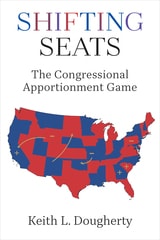
Shifting Seats
The Congressional Apportionment GameKeith L. Dougherty
University of Michigan Press, 2027
Winning presidential elections isn’t just about the ballot box; it is shaped by the rules of the “apportionment game.” Shifting Seats uncovers the gritty history of how politicians fought for greater legislative influence and how those decisions determined control of Congress—and sometimes the presidency. Moving beyond abstract debates, Keith L. Dougherty takes readers inside high-stakes bargaining from the Founding era, the Antebellum period, and post–Civil War struggles over representation. Within these periods, Dougherty models how legislators manipulated the building blocks of apportionment—including metrics, ratios, House sizes, and rounding methods—to maximize their state’s proportion of seats. He explains how a 1920s stalemate fixed the House’s size at 435 members and created the automatic system in use today.
Bridging the gap between political history and formal theory, the book identifies the long-term mechanisms that stabilize or disrupt distributions of power. Further, it shows how different apportionment methods could have flipped some presidential elections. By connecting these clashes to our current polarized climate, Shifting Seats explains why some apportionment rules endure while others fail, revealing the hidden mechanics that continue to dictate the balance of power in Washington today.
Sizing Up the Senate
The Unequal Consequences of Equal RepresentationFrances E. Lee and Bruce I. Oppenheimer
University of Chicago Press, 1999
But does it matter that California's 32 million people have the same number of Senate votes as Wyoming's 480,000? Frances Lee and Bruce Oppenheimer systematically show that the Senate's unique apportionment scheme profoundly shapes legislation and representation. The size of a state's population affects the senator-constituent relationship, fund-raising and elections, strategic behavior within the Senate, and, ultimately, policy decisions. They also show that less populous states consistently receive more federal funding than states with more people. In sum, Lee and Oppenheimer reveal that Senate apportionment leaves no aspect of the institution untouched.
This groundbreaking book raises new questions about one of the key institutions of American government and will interest anyone concerned with issues of representation.

Standing on Principle
Lessons Learned in Public LifeFlorio, James J
Rutgers University Press, 2018
This political memoir tells the remarkable story of how Florio, a high school dropout who left to join the Navy as a teenager, went on to become an attorney, a state assemblyman, a congressman, and a governor. A passionate defender of the environment, Florio played a crucial role in the enactment of 1980s-era Superfund laws, which helped to clean up toxic waste sites in New Jersey and around the country. As governor, he fought for the groundbreaking Clean Water Enforcement Act. But his reforms quite literally came at a cost, as he raised New Jersey sales taxes and income taxes to balance the state budget. Florio reflects upon the challenges of meeting the state’s budgetary needs while keeping his tax-averse constituents happy.
Standing on Principle reveals a politician who has never been afraid to take a progressive stand—including a firm stance against semiautomatic weapons that led gun lobbyists to bankroll his opponent. His story is sure to inspire readers from New Jersey and across the nation.
Published in cooperation with the Center on the American Governor, Eagleton Institute of Politics, Rutgers University
Strategic Party Government
Why Winning Trumps IdeologyGregory Koger and Matthew J. Lebo
University of Chicago Press, 2017
In Strategic Party Government, Koger and Lebo argue that Congress is now primarily a forum for partisan competition. In order to avoid losing, legislators unite behind strong party leaders, even when they do not fully agree with the policies their party is advocating. They do so in the belief that party leaders and voters will reward them for winning—or at least trying to win—these legislative contests. And as the parties present increasingly united fronts, partisan competition intensifies and pressure continues to mount for a strong party-building strategy—despite considerable disagreement within the parties.
By bringing this powerful but underappreciated force in American politics to the forefront, Koger and Lebo provide a new interpretation of the problems facing Congress that is certain to reset the agenda for legislative studies.
Supreme Court Confirmation Hearings in the U.S. Senate
Reconsidering the CharadeDion Farganis and Justin Wedeking
University of Michigan Press, 2014