Results by title
998 books match the query 'Life' and 64 start with s

S. L. Frank
The Life And Work Of A Russian Philosopher, 1877-1950Philip Boobbyer
Ohio University Press, 1995
“There are many reasons for writing a biography of Semyon Frank. Quite apart from his philosophy, he lived a remarkable life. Born in Moscow in 1877, he was exiled from Soviet Russia in 1922 and died in London in 1950. The son of a Jewish doctor, he became a revolutionary Social Democrat in his teens and finished his life as a Neoplatonist Christian. One of the Russian revisionist Marxists, he was then involved in the Kadet Party during the 1905 revolution before breaking with active political activity and turning to philosophy. He lived in Petrograd through the First World War until September 1917, after which he went to Saratov, where he experienced the chaos of the Russian Civil War. Living in Germany after his exile, he witnessed the rise of Hitler in Berlin, left for France in a hurry in 1937, and spent part of the war hiding from the Gestapo in the Grenoble mountains. It was a life that encompassed a lot of history.
”Yet along with this, Frank was arguably Russia’s greatest twentieth-century philosopher. Indeed, V.V. Zen‘kovskii, the historian of Russian philosophy, considered Frank ’in strength of philosophic vision … the most outstanding among Russian philosophers generally — not merely among those who share his ideas.‘ For its lucidity, conciseness, systematic character, and unity, Zen’kovskii considered Frank’s system ‘ the highest achievement … of Russian philosophy.’ Doubtless, Zen‘kovskii’s assessment is disputable, but his remarks emphasize Frank’s stature in the Russian tradition. In the style of German idealism, Frank constructed a comprehensive philosophical system, which he believed offered a coherent alternative to materialism. He was deeply worried by the implications of epistemological relativism and constructed a system of metaphysics designed to link epistemology and ontology, to bridge the gulf between thought and being. In addition, he attempted to express the idea of a personal God in philosophical language. His system also embraced social philosophy, anthropology, and ethics.“
— from the Introduction by the author
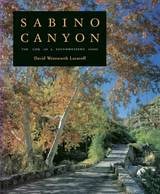
Sabino Canyon
The Life of a Southwestern OasisDavid Wentworth Lazaroff
University of Arizona Press, 1993
David Lazaroff has called on years of studying, photographing, and educating people about Sabino Canyon to produce this clearly written and beautifully illustrated book. Focusing on the importance of Sabino Creek both to plants and animals and to human recreation, he tracks the ebb and flow of canyon life through the year and tells how people have sought to utilize the canyon through history. First-time visitors to Sabino Canyon will find their experience enriched through Lazaroff's insights into plants, animals, and geology, while those who regularly frequent Sabino's trails or pools can become better informed about its fragile desert and riparian habitats.
For anyone curious about life in a genuine Southwestern oasis, this book captures the beauty and uniqueness of a natural treasure-house located in a bustling city's back yard.
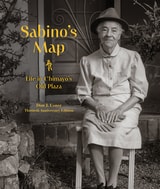
Sabino's Map
Life in Chimayó’s Old Plaza, Thirtieth Anniversary EditionDon J. Usner
Museum of New Mexico Press, 2024
“Brimming with voices, las voces de la gente…. the first-person narrator who returns again and again to the text like a knowing and trusted pariente inviting the reader to sit for a while in the Plaza del Cerro. —Jim Sagel
“Quite simply…the best history yet made of a northern New Mexico community. It is thorough, balanced, gracefully written, and blessed with an insider’s access and affection.”—William De Buys
Chimayó is renowned for its Hispano master weaving families, lowriders, and its storied church, El Santurio de Chimayó. The old Plaza del Cerro had once been the village’s center place, where locals gathered to pick up mail, socialize and celebrate religious and family events. Over the years after WWII, the plaza was neglected, but the memory of the once-vibrant place remained vivid in the stories of village elders.
The first edition of Sabino’s Map, published in 1995, documented oral histories of these elders. It would prove to be a critical turning point for many Chimayosos. At the Chimayó book launch, Usner recalls locals embraced the book, one cousin of his even declaring, “For the first time in my life I feel like I can be proud to be from Chimayó.” In the past thirty years since its publication, the community and its people have been revitalized with the help of the Chimayó Cultural Preservation Association and the establishment of a museum on the old plaza—in the home of Usner’s ancestors.
This landmark publication, read and passed on through generations, is considered a classic of New Mexico literature, alongside other treasured books including John Nichols’s Milagro Beanfield War, Rudolfo Anaya’s Bless Me Ultima, and Ruben Cobos’s Dictionary of New Mexico and Northern New Mexico Spanish.
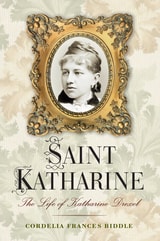
Saint Katharine
The Life of Katharine DrexelCordelia Frances Biddle
Westholme Publishing, 2015
When Katharine Drexel was born in 1858, her grandfather, financier Francis Martin Drexel, had a fortune so vast he was able to provide a loan of sixty million dollars to the Union’s cause during the Civil War. Her uncle and mentor, Anthony, established Drexel University to provide instruction to the working class regardless of race, religion, or gender. Her stepmother was Emma Bouvier whose brother, John, became the great-grandfather of Jacqueline Bouvier Kennedy Onassis. Katharine Drexel’s family were American royalty. As a Philadelphia socialite, “Kitty,” as she was often called, adored formal balls and teas, rowing regattas, and sailing races. She was beautiful, intelligent, and high-spirited. But when her stepmother died in 1883, and her father two years later, a sense of desolation nearly overwhelmed her. She was twenty-seven and in possession of a staggering inheritance. Approached for aid by the Catholic Indian Missions, she surprised her family by giving generously of money and time. It was during this period of acute self-examination that she journeyed to Rome for a private audience with Pope Leo XIII. With characteristic energy and fervor, she detailed the plight of the Native Americans, and begged for additional missionaries to serve them. His reply astonished her. “Why not, my child, yourself become a missionary?”
In Saint Katharine: The Life of Katharine Drexel, Cordelia Frances Biddle recounts the extraordinary story of a Gilded Age luminary who became a selfless worker for the welfare and rights of America’s poorest persons. After years of supporting efforts on behalf of African Americans and American Indians, Katharine finally decided to follow her inner voice and profess vows. The act made headlines. Like her father and grandfather, she was a shrewd businessperson; she retained her financial autonomy and established her own order, the Sisters of the Blessed Sacrament. Until her death in 1955, she devoted herself and her inheritance to building much-needed schools in the South and Southwest, despite threats from the Ku Klux Klan and others. Pragmatic, sometimes willful, ardent, and a charismatic leader, Katharine Drexel was an indefatigable champion of justice and parity. When illness incapacitated her in later years, divine radiance was said to emanate from her, a radiance that led to her canonization on October 1, 2000.
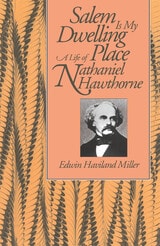
Salem Is My Dwelling Place
Life Of Nathaniel HawthorneEdwin Haviland Miller
University of Iowa Press, 1992
In one of his public disavowals of autobiography, Nathaniel Hawthorne informed his readers that external traits "hide the man, instead of displaying him," directing them instead to "look through the whole range of his fictitious characters, good and evil, in order to detect any of his essential traits." In this multidimensional biography of America's first great storyteller, Edwin Haviland Miller answers Hawthorne's challenge and reveals the inner landscapes of this modest, magnetic man who hid himself in his fiction. Thomas Woodson hails Miller's account as "the best biography of this most elusive of American authors."
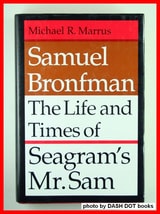
Samuel Bronfman
The Life and Times of Seagram’s Mr. SamMichael R. Marrus
Brandeis University Press, 1991
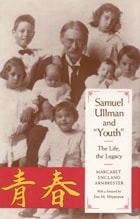
Samuel Ullman and "Youth"
The Life, the LegacyMargaret E. Armbrester
University of Alabama Press, 2009
Thousands of wonderful and sometimes strange fads have captured the public fancy in the almost five decades since the end of World War II. Most have been short-lived and soon faded away. There is, however, a poem that has not only withstood the vicissitudes of time, but has spread around the world like the waves lapping at a beach. This is the poem "Youth," by Samuel Ullman.
In December 1945, the Reader’s Digest published the poem and reported that General Douglas MacArthur, Commander of the Allied Forces, Far East, kept a copy of the poem near his desk.
Around that time, Yoshio Okada, a Japanese businessman, bought a copy of that December 1945 edition of the Reader's Digest, read the poem and was deeply affected by it. He translated it into Japanese and displayed it in his office as a guiding inspiration. Many of Okada's friends read the poem and were fascinated by its beauty. It began to receive national publicity through newspapers and magazines and became popular throughout Japan, especially among the intellectual community. Part of the reason for this widespread popularity is the excellence of the translation. Yoshio Okada, a man of noble character, gifted with a profound philosophy of life and literary talent, translated the poem into a beautiful, soulstirring Japanese version.
Samuel Ullman's “Youth” reflects the truth of life, and his outcry of spirituality touches the intrinsic nature of man.
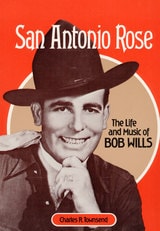
San Antonio Rose
The Life and Music of Bob WillsCharles R. Townsend; Discography and filmusicography by Bob Pinson
University of Illinois Press, 1976
"Until Hank Williams came along, it was just Bob Willis," says Willie Nelson. "He was it." And indeed he was, especially for the thousands in the Southwest who knew and loved the King of Western Swing. The colorful band leader-composer-fiddler from Turkey, Texas, lassoed the emotions of country-and-western fans nationwide. In the early 1940s, his records outsold those of any other recording artist. He was voted not only into the Country Music Hall of Fame but also into the National Cowboy Hall of Fame, the only performer other than Gene Autry to be so honored.
Affectionately written by a Texan who responded to the legendary fiddler's style, San Antonio Rose captures Wills's magnetism and the musical excitement he created. Charles R. Townsend traces Wills's dynamic life from his birth into a family of frontier fiddlers through his career and stardom and on to the poignant last recording session in 1973 and his death two years later. Townsend shows how Wills brought black and white music together and examines the tremendous impact he had on both popular and country music through the more than 550 selections he recorded and the forty years he and his Texas Playboys performed in dance halls and on radio.
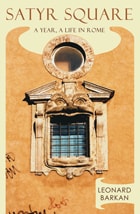
Satyr Square
A Year, a Life in RomeLeonard Barkan
Northwestern University Press, 2008
Part memoir, part literary criticism, part culinary and aesthetic travelogue, this loving reflection is a poignant, funny narrative about an American professor spending a year in Rome. A scarred veteran of academic culture wars retreating to a cradle of culture, Barkan is at first hungry, lonely, and uncertain of his intellectual mission. But soon he is appointed unofficial mascot of an eccentric community of gastronomes, becomes virtually bilingual, and falls in love. As the year progresses, he finds his voice as a writer, loses his lover, and definitively returns to America with heart, mind, and body. His memoir is the celebration of a life lived in the uncanny spaces where art and real people intersect.
Barkan’s reminiscence is not just about the Renaissance and ancient statuary, or Shakespeare and Mozart, Charles Bukowski and Paul de Man, eggplant antipasto and Brunello di Montalcino, foot fetishism and sulfur baths. At the heart of the narrative—beneath that beguiling surface of irony, humor, and misdirection—is a man of genuine ardor, struggling with what it means to be a homosexual and a Jew, trying to rediscover or reinvent his own intellectual passions. Hilarious, erudite, and lusciously rendered, Satyr Square gives us the whole of a life made up from fragments of Italy, art, food, and longing.
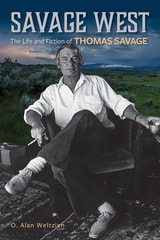
Savage West
The Life and Fiction of Thomas SavageO. Alan Weltzien
University of Nevada Press, 2022
O. Alan Weltzien's insightful and detailed literary biography chronicles the life and work of this neglected but deeply talented novelist. Savage, a closeted gay family man, was both an outsider and an insider, navigating an intense conflict between his sexual identity and the claustrophobic social restraints of the rural West. Unlike many other Western writers, Savage avoided the formula westerns— so popular in his time— and offered instead a realistic, often subversive version of the region. His novels tell a hard, harsh story about dysfunctional families, loneliness, and stifling provincialism in the small towns and ranches of the northern Rockies, and his minority interpretation of the West provides a unique vision and caustic counternarrative contrary to the triumphant settler-colonialism themes that have shaped most Western literature. Savage West seeks to claim Thomas Savage's well-deserved position in American literature and to reintroduce twenty-first-century readers to a major Montana writer.
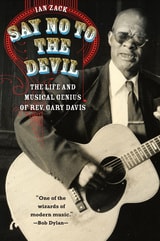
Say No to the Devil
The Life and Musical Genius of Rev. Gary DavisIan Zack
University of Chicago Press, 2015
The first biography of Davis, Say No to the Devil restores “the Rev’s” remarkable story. Drawing on extensive research and interviews with many of Davis’s former students, Ian Zack takes readers through Davis’s difficult beginning as the blind son of sharecroppers in the Jim Crow South to his decision to become an ordained Baptist minister and his move to New York in the early 1940s, where he scraped out a living singing and preaching on street corners and in storefront churches in Harlem. There, he gained entry into a circle of musicians that included, among many others, Lead Belly, Woody Guthrie, and Dave Van Ronk. But in spite of his tremendous musical achievements, Davis never gained broad recognition from an American public that wasn’t sure what to make of his trademark blend of gospel, ragtime, street preaching, and the blues. His personal life was also fraught, troubled by struggles with alcohol, women, and deteriorating health.
Zack chronicles this remarkable figure in American music, helping us to understand how he taught and influenced a generation of musicians.
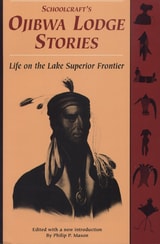
Schoolcraft's Ojibwa Lodge Stories
Life on the Lake Superior FrontierPhilip P. Mason
Michigan State University Press, 1997
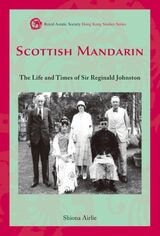
Scottish Mandarin
The Life and Times of Sir Reginald JohnstonShiona Airlie
Hong Kong University Press, 2012
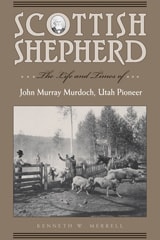
Scottish Shepherd
The Life and Times of John Murray Murdoch, Utah PioneerMerrell, Kenneth W
University of Utah Press, 2007
Murdoch embraced Mormonism and set out for the Utah Territory in 1852 with his wife, Ann, and their family. En route they suffered the deaths of their two young children. Two years later, John’s mother, Wee Granny, and Ann’s brother, James Steele, both perished, along with many others of the ill-fated Martin handcart company, as they attempted to immigrate to Salt Lake City.
Murdoch was a respected member of the community and participated in the military preparations and maneuvers against the U.S. Army in the 1857 Utah War. Eventually the family moved to the Heber valley as early settlers there. Murdoch later became one of Wasatch county’s first elected officials and helped establish the sheep-ranching industry in Utah. The 'everyman' aspect of John Murdoch’s life makes his a compelling story. It will fascinate anyone interested in the individuals who helped create Utah's history.
Winner of the Evans Handcart Award.
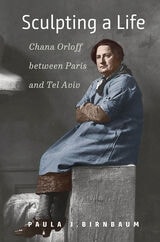
Sculpting a Life
Chana Orloff between Paris and Tel AvivPaula J. Birnbaum
Brandeis University Press, 2022
In Sculpting a Life, the first book-length biography of sculptor Chana Orloff (1888-1968), author Paula Birnbaum tells the story of a fiercely determined and ambitious woman who fled antisemitism in Ukraine, emigrated to Palestine with her family, then travelled to Paris to work in haute couture before becoming an internationally recognized artist. Against the backdrop of revolution, world wars, a global pandemic and forced migrations, her sculptures embody themes of gender, displacement, exile, and belonging. A major figure in the School of Paris, Orloff contributed to the canon of modern art alongside Picasso, Modigliani and Chagall.
Stories from her unpublished memoir enrich this life story of courage, perseverance, and extraordinary artistic accomplishments that take us through the aftermath of the Holocaust when Orloff lived between Paris and Tel Aviv. This biography brings new perspectives and understandings to Orloff’s multiple identities as a cosmopolitan émigré, woman, and Jew, and is a much-needed intervention into the narrative of modern art.
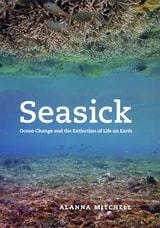
Seasick
Ocean Change and the Extinction of Life on EarthAlanna Mitchell
University of Chicago Press, 2009
We have long lorded over the ocean. But only recently have we become aware of the myriad life-forms beneath its waves. We now know that this delicate ecosystem is our life-support system; it regulates the earth’s temperatures and climate and comprises 99 percent of living space on earth. So when we change the chemistry of the whole ocean system, as we are now, life as we know it is threatened.
In Seasick, veteran science journalist Alanna Mitchell dives beneath the surface of the world’s oceans to give readers a sense of how this watery realm can be managed and preserved, and with it life on earth. Each chapter features a different group of researchers who introduce readers to the importance of ocean currents, the building of coral structures, or the effects of acidification. With Mitchell at the helm, readers submerge 3,000 feet to gather sea sponges that may contribute to cancer care, see firsthand the lava lamp–like dead zone covering 17,000 square kilometers in the Gulf of Mexico, and witness the simultaneous spawning of corals under a full moon in Panama.
The first book to look at the planetary environmental crisis through the lens of the global ocean, Seasick takes the reader on an emotional journey through a hidden realm of the planet and urges conservation and reverence for the fount from which all life on earth sprang.

Secrets of Life with Brachial Plexus Palsy
Written by Denise Justice; Illustrated by Susan Eatmon; Edited by Holly Wagner
Michigan Publishing Services, 2020
Secrets of Life with Brachial Plexus Palsy is the story of a baby girl who grows up with dreams and ambitions like everybody else. Some of her dreams are to play like other children, to show others that there is nothing that she cannot do, and to pursue any career that she chooses when she grows up. Life with this condition can be challenging, and as the years pass, Marie uncovers secrets that allow her to overcome the stigma of her Brachial Plexus Palsy – secrets she would like to share with you…
Let Marie show you that living life with Brachial Plexus Palsy is an exciting journey!
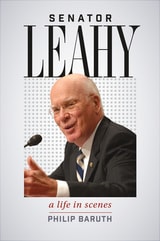
Senator Leahy
A Life in ScenesPhilip Baruth
University Press of New England, 2017
Serious Reflections During the Life and Surprising Adventures of Robinson Crusoe with his Vision of the Angelick World
The Stoke Newington EditionDaniel Defoe
Bucknell University Press, 2022
Shakespeare Dwelling
Designs for the Theater of LifeJulia Reinhard Lupton
University of Chicago Press, 2018
Focusing on five works (Romeo and Juliet, Macbeth, Pericles, Cymbeline, and The Winter’s Tale), Lupton remakes the concept of dwelling by drawing on a variety of sources, including modern design theory, Renaissance treatises on husbandry and housekeeping, and the philosophies of Hannah Arendt and Martin Heidegger. The resulting synthesis not only offers a new entry point into the contemporary study of environments; it also shows how Shakespeare’s works help us continue to make sense of our primal creaturely need for shelter.
Shaking the Tree
Readings from Nature in the History of LifeEdited by Henry Gee
University of Chicago Press, 2000
Shaking the Tree brings together nineteen review articles written for Nature over the past decade by many of the major figures in paleontology and evolution, from Stephen Jay Gould to Simon Conway Morris. Each article is brief, accessible, and opinionated, providing "shoot from the hip" accounts of the latest news and debates. Topics covered include major extinction events, homeotic genes and body plans, the origin and evolution of the primates, and reconstructions of phylogenetic trees for a wide variety of groups. The editor, Henry Gee, gives new commentary and updated references.
Shaking the Tree is a one-stop resource for engaging overviews of the latest research in the history of life on Earth.
Siberian Village
Land and Life in the Sakha RepublicBella Bychkova Jordan
University of Minnesota Press, 2001
A fascinating portrait of the history and landscape of this remote settlement.
The village of Djarkhan is in the heart of Russia’s Sakha Republic, on the Central Yakut Plain. The world around Djarkhan, with its extreme subarctic climate and intractable permafrost, seems an unlikely place to look for a rich, historic, and exotic efflorescence of human life, and yet this is precisely what the authors found. Their book is a remarkable account of how the people of Djarkhan have created their own distinctive place through their unique relationship with a severe and demanding land.
This book traces the way of life of the village’s Turkic inhabitants, the Yakuts, from their arrival in the 1600s through czarist times and the Soviet era to the present day. As a native of the village, geographer Bella Bychkova Jordan enjoyed unparalleled access to its people and their stories, myths, humor, problems, and folklore. Viewed through the prism of cultural geography, this material forms the basis of a remarkable portrait of a people wresting a living from the land in one of the coldest and most isolated spots on Earth. Published in collaboration with the Center for American Places.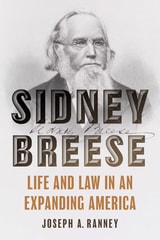
Sidney Breese
Life and Law in an Expanding AmericaJoseph A. Ranney
University of Illinois Press, 2026
Born in New York, Breese moved to Illinois in 1818. An ambitious personality combined with acumen in law, politics, and business boosted Breese into the state’s frontier elite and involved him in the political controversies that roiled the Jacksonian Era. First a circuit court judge, Breese rose to the state Supreme Court before his election to the US Senate in 1842. Breese focused his senatorial energies on westward expansion and transforming the nation into a world power—ambitions symbolized by his pivotal role in the creation of the Illinois Central Railroad. After returning to the state Supreme Court, Breese ruled on essential cases that enshrined expansionist jurisprudence in American law and regulated the growing power of corporations in post–Civil War America.
A first full-length biography, Sidney Breese places the life of an overlooked figure within legal and Illinois history.
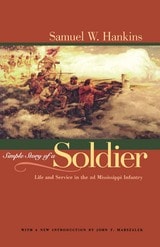
Simple Story Of A Soldier
Life And Service in the 2d Mississippi InfantrySamuel W. Hankins
University of Alabama Press, 2004
This fast-paced memoir was written in 1905 by 61-year-old Samuel W. Hankins while he was living in the Soldiers Home in Gulfport, Mississippi. It vividly details his years as a Confederate rifleman from the spring of 1861, when at a mere sixteen years of age he volunteered for the 2d Mississippi Infantry, through the end of the war in 1865, when he was just twenty years old and maimed for life.
The 2d Mississippi was part of the Army of Northern Virginia and as such saw action at Bull Run/Manassas, Seven Pines and the Peninsular Campaign, and Gettysburg. Besides being hospitalized with measles, suffering severely frostbitten feet, and being wounded by a minié ball at Railroad Cut, Hankins was captured by Federal forces and sent to a prisoner of war camp on David’s Island, New York. Later, he was transferred to a South Carolina hospital, returned home on furlough, joined a cavalry unit that fought at Atlanta. He was stationed in Selma, Alabama, when the war ended.
The strength of Hankins’s text lies in his straightforward narrative style virtually free of Lost Cause sentiment. Both Union and Confederate veterans could relate to his stories because so many of them had faced similar challenges during the war. Full of valuable information on a common soldier’s experience, the memoir still conjures the sights, sounds, and smells of warfare.
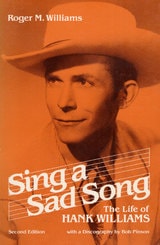
Sing a Sad Song
The Life of Hank WilliamsRoger M. Williams
University of Illinois Press, 1981
Sing a Sad Songs tells the story of Hank Williams's rise from impoverished Alabama roots, his coming of age during and after World War II, his meteoric climb to national acclaim and star status on the Grand Ole Opry, his star-crossed marriages and recurring health problems, the chronic bouts with alcoholism and the alienation it caused in those he loved and sang for, and finally his tragic death at twenty-nine and subsequent emergence as a folk hero.
In addition, the book includes an essential discography compiled by Bob Pinson of the Country Music Foundation.
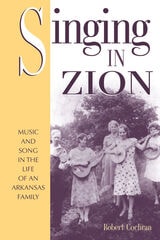
Singing in Zion
Music and Song in the Life of One Arkansas FamilyRobert Cochran
University of Arkansas Press, 1999
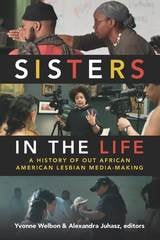
Sisters in the Life
A History of Out African American Lesbian Media-MakingYvonne Welbon and Alexandra Juhasz, editors
Duke University Press, 2018
Contributors. Jennifer DeVere Brody, Jennifer DeClue, Raul Ferrera-Balanquet, Alexis Pauline Gumbs, Thomas Allen Harris, Devorah Heitner, Pamela L. Jennings, Alexandra Juhasz, Kara Keeling, Candace Moore, Marlon Moore, Michelle Parkerson, Roya Rastegar, L. H. Stallings, Yvonne Welbon, Patricia White, Karin D. Wimbley
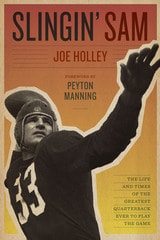
Slingin' Sam
The Life and Times of the Greatest Quarterback Ever to Play the GameBy Joe Holley
University of Texas Press, 2012
Dan Jenkins calls him “the greatest quarterback who ever lived, college or pro.” Slingin’ Sammy Baugh, who played for TCU and the Washington Redskins, single-handedly revolutionized the game of football. While the pros still wore leather helmets and played the game more like rugby, Baugh’s ability to throw the ball with rifle-like accuracy made the forward pass a strategic weapon, not a desperation heave. Like Babe Ruth, who changed the very perception of how baseball is played, Slingin’ Sam transformed the notion of offense in football and how much yardage can be gained through the air. As the first modern quarterback, Baugh led the Redskins to five title games and two NFL championships, while leading the league in passing six times—a record that endures to this day—and in punting four times. In 1943, the triple-threat Baugh also scored a triple crown when he led the league in passing, punting, and interceptions.
Slingin’ Sam is the first major biography of this legendary quarterback, one of the first inductees into the Pro Football Hall of Fame. Joe Holley traces the whole arc of Baugh’s life (1914–2008), from his small-town Texas roots to his college ball success as an All-American at TCU, his brief flirtation with professional baseball, and his stellar career with the Washington Redskins (1937–1952), as well as his later career coaching the New York Titans and Houston Oilers and ranching in West Texas. Through Holley’s vivid descriptions of close-fought games, Baugh comes alive both as the consummate all-around athlete who could play every minute of every game, on both offense and defense, and as an all-around good guy.
Small
Life and Death on the Front Lines of Pediatric SurgeryCatherine Musemeche
Dartmouth College Press, 2014
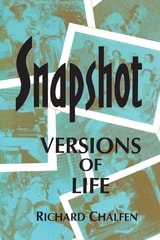
Snapshot Versions of Life
Richard Chalfen
University of Wisconsin Press, 1987
Chalfen’s “Polaroid People” are recognizable—if ironically viewed—relatives, uncles, aunts, and All-American kids. As members of “Kodak Culture” they watch home movies, take pictures of newborn babies, and even, in their darker moments, scratch out the faces of disliked relatives in group photographs. He examines who shoots these photos and why, as well as how they think (or don’t) of planning, editing, and exhibiting their shots. Chalfen’s analysis reveals the culturally structured behavior underlying seemingly spontaneous photographic activities.
So Far Away
A Daughter's Memoir of Life, Loss, and LoveChristine W. Hartmann
Vanderbilt University Press, 2011
Christine's father, as it turned out, prepared too slowly for old age. Before he had made any decision, fate disabled him through a series of strokes. Confined to a nursing home, severely impaired by dementia and frustrated by his circumstances, his life epitomized the predicament her mother wanted to avoid.
So Far Away gives us an intimate view of a person interacting with and reacting to her parents at the ends of their lives. In a richly detailed, poignant story of family members' separate yet interwoven journeys, it underscores the complexities and opportunities that life presents each one of us.
So We Died
A Memoir of Life and Death in the Ghetto of Šiauliai, LithuaniaLevi Shalit, translated and edited by Veronica Belling, Ellen Cassedy, and Andrew Cassel, introduction by Veronica Belling, afterword by Justin Cammy
University of Alabama Press, 2025
In the shadow of death, Levi Shalit wrote to remember—so we would never forget.
So We Died: A Memoir of Life and Death in the Ghetto of Šiauliai, Lithuania (Azoy zaynen mir geshtorbn) is a powerful eyewitness account of the Shavl ghetto during the Nazi occupation of Lithuania. Written in Yiddish by Levi Shalit and available now for the first time in English, the work fills a stark void in historical records.
Shalit divided his work into four sections. In the first, he describes the German invasion of Šiauliai, the murder of thousands of Jews in the city and surrounding countryside, and the forced relocation of the surviving Jews into the Shavl ghetto. In the second, he describes daily life in the ghetto in engrossing detail. In the third, titled “The Masada Book,” Shalit describes ghetto residents’ attempt to organize a resistance group of which he himself was a member. In the fourth, he narrates the transformation of the ghetto into a concentration camp and the seizure and deportation of the community’s children.
Few accounts of the Shavl ghetto survived the war. Shalit’s work offers English-language readers a rare insight into a vital chapter of history. The translators artfully reveal Shalit’s literary prowess and the ways he illuminated the Shavl ghetto’s daily struggles, false hopes, and atrocities.
More than an account of a previously overlooked episode in Holocaust history, So We Died is a testament to the enduring power of the human spirit in the face of unspeakable tragedy. It offers keen insight into a time of war, fascism, and resistance. A must-read for anyone seeking understanding and remembrance.
Some Seed Fell on Good Ground
The Life of Edwin V. O'HaraTimothy Michael Dolan
Catholic University of America Press, 2012
Someone to Watch Over Me
The Life and Music of Ben WebsterFrank Büchmann-Møller
University of Michigan Press, 2010
Early in his career, Webster worked with many of the greatest orchestras of the time, including those led by Willie Bryant, Cab Calloway, Benny Carter, Fletcher Henderson, Andy Kirk, Bennie Moten, and Teddy Wilson. In 1940 Webster became Duke Ellington's first major tenor soloist, and during the next three years he played on many famous recordings, including "Cotton Tail."
Someone to Watch Over Me tells, for the first time, the complete story of Ben Webster's brilliant and troubled career. For this comprehensive study of Webster, author Frank Büchmann-Møller interviewed more than fifty people in the United States and Europe, and he includes numerous translated excerpts from European periodicals and newspapers, none previously available in English. In addition, the author studies every known Webster recording and film, including many private recordings from Webster's home collection not available to the public.
Exhaustively researched, this is a much needed and long overdue study of the life and music of one of jazz's most important artists.
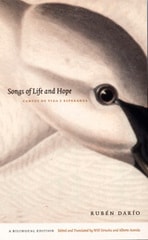
Songs of Life and Hope/Cantos de vida y esperanza
Rubén Darío
Duke University Press, 2004
Written over the course of seven years and in many locales in Latin America and Europe, the poems in Cantos de vida y esperanza reflect both Darío’s anguished sense of modern life and his ecstatic visions of transcendence, freedom, and the transformative power of art. They reveal Darío’s familiarity with Spanish, French, and English literature and the wide range of his concerns—existential, religious, erotic, and socio-political. Derusha and Acereda’s translation renders Darío’s themes with meticulous clarity and captures the structural and acoustic dimensions of the poet’s language in all its rhythmic sonority. Their introduction places this singular poet—arguably the greatest to emerge from Latin America in modern literature—and his best and most widely known work in historical and literary context. An extensive glossary offers additional information, explaining terms related to modernismo, Hispanic history, mythological allusions, and artists and writers prominent at the turn of the last century.
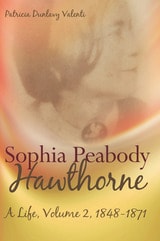
Sophia Peabody Hawthorne
A Life, Volume 2, 1848-1871Patricia Dunlavy Valenti
University of Missouri Press, 2015
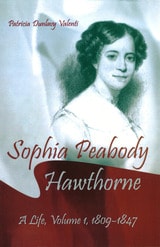
Sophia Peabody Hawthorne
A Life, Volume I, 1809-1847Patricia Dunlavy Valenti
University of Missouri Press, 2004
Sophia was born into an expansive, somewhat chaotic home in which women provided financial as well as emotional sustenance. She was a precocious, eager student whose rigorous education, in her mother’s and her sisters’ schools, began her association with the children of New England’s elite. Sophia aspired to become a professional, self-supporting painter, exhibiting her art and seeking criticism from established mentors. She relished an eighteen-month sojourn in Cuba. Nathaniel’s reclusive family, his reluctant early education, his anonymous pursuit of a career, and his relatively circumscribed life contrast markedly with the experience of the woman who became his wife and the mother of his children. Those differences resulted in a creative abrasion that ignited his fiction during the first years of their marriage.
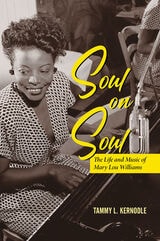
Soul on Soul
The Life and Music of Mary Lou WilliamsTammy L. Kernodle
University of Illinois Press, 2020
The jazz musician-composer-arranger Mary Lou Williams spent her sixty-year career working in—and stretching beyond—a dizzying range of musical styles. Her integration of classical music into her works helped expand jazz's compositional language. Her generosity made her a valued friend and mentor to the likes of Thelonious Monk, Charlie Parker, and Dizzy Gillespie. Her late-in-life flowering of faith saw her embrace a spiritual jazz oriented toward advancing the civil rights struggle and helping wounded souls.
Tammy L. Kernodle details Williams's life in music against the backdrop of controversies over women's place in jazz and bitter arguments over the music's evolution. Williams repeatedly asserted her artistic and personal independence to carve out a place despite widespread bafflement that a woman exhibited such genius. Embracing Williams's contradictions and complexities, Kernodle also explores a personal life troubled by lukewarm professional acceptance, loneliness, relentless poverty, bad business deals, and difficult marriages.
In-depth and epic in scope, Soul on Soul restores a pioneering African American woman to her rightful place in jazz history.
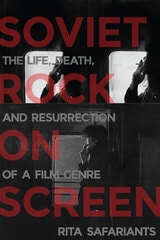
Soviet Rock on Screen
The Life, Death, and Resurrection of a Film GenreRita Safariants
University of Wisconsin Press, 2026
In Soviet Rock on Screen, Rita Safariants chronicles the birth, life, death, and resurrection of a genre that rapidly became one of the most readily recognized cultural signifiers of the perestroika era and which continues to reflect and codify Russian culture. During their initial heyday in the 1980s, rock films were influenced by and encouraged the cultural shifts of perestroika and the incipient political storm. Today, Safariants argues, the reemergence and reconfiguration of the genre indicates the extent to which Soviet-era cultural emblems inform Russian national identity and obliquely support the current political repression under Putin.

Special Care
Medical Decisions at the Beginning of LifeFred M. Frohock
University of Chicago Press, 1986
But there is a dark underside to the exercise of these skills. A growing number of babies live only to be tethered to life-support systems, unconscious or suffering incessant pain for years and sometimes for the duration of their lives. The ethical issues raised by these children are among the most difficult in our society. Should life be maintained no matter what its quality? Or is there a point at which treatment should be stopped on humane grounds? Who is to make decisions on continuing or ending therapy for damaged children? Is the law a suitable instrument for regulating medical decisions in intensive care nurseries? Should the growing cost of intensive care influence therapy decisions?
Special Care explores the moral and legal issues in neonatal intensive care. Fred M. Frohock spent four months in a special care nursery, observing the daily actions of doctors and nurses and interviewing staff and parents of patients. This engaging, human drama is told through the author's own journal entries interspersed with generous excerpts from taped interviews that display the practical reasoning of staff and parents as they address the moral problems raised by intensive care medicine. Several case studies of infants highlight the often contradictory directions in which medical staffs are pulled and the painful decisions that doctors and parents together are often called upon to make. The result is a book that reconstructs the ordinary life of a neonatal nursery and presents the moral views of those who are most intimately involved in therapy decisions.
This book is an urgently needed entry in the current discussions of treatment for badly damaged babies. Frohock argues that our tradition of rights language, which rests on the premise that we know what a human being is, is inappropriate when dealing with the paradoxes of decision making in neonatal nurseries. Calling for a new moral vocabulary better adapted to the world of medicine, he introduces the notion of harm in place of rights, a concept drawn from medicine's Hippocratic oath that pledges to "do no harm," as a way to begin framing questions and making decisions. Special Care will interest anyone who wants to understand medical decisions at the margins of human life.
Stages of Life
Transcultural Performance and Identity in U.S. Latina TheaterAlberto Sandoval-Sánchez
University of Arizona Press, 2001
This is the first in-depth study of the entire corpus of Latina theater, based on close readings of works both published and in manuscript. It considers a large body of productions and performances, including works by such internationally known authors as Dolores Prida, Cherríe Moraga, and Janis Astor del Valle.
Applying feminist and postcolonial theory as well as theories of transculturation, Sandoval-Sánchez and Sternbach show how, despite cultural differences among Latinas, their works share a common poetics by building upon the politics of representation, identity, and location. In addition to covering theater, this study also shows that solo performance has its own history, properties, structure, and poetics. It examines performances of Carmelita Tropicana, Monica Palacios, and Marga Gomez—artists whose hybrid identities as Latina lesbians constitute living examples of transculturation in the making—to show how solo performance has roots in and digresses from more traditional modes of theater. With their Latina heritage as a unifying link, these women reflect common traits, patterns, dramatic structures, and properties that overcome regional differences. Stages of Life reads these eclectic cultural productions as a unified body of work that contributes to the formation of Latina identity in America today.
Staking Her Claim
Life Of Belinda MulrooneyMelanie J. Mayer
Ohio University Press, 1999
In Staking Her Claim, Melanie Mayer and Robert N. DeArmond provide a faithful and comprehensive portrait of this unique character in North American frontier history. Their exhaustive research has resulted in a sweeping saga of determination and will, tempered by disaster and opportunity.
Like any good Horatio Alger hero, Belinda overcame the challenges that confronted her, including poverty, prejudice, a lack of schooling, and the early loss of parents. Her travels took her from her native Ireland as a young girl to a coal town in Pennsylvania to Chicago, San Francisco, and finally, in 1897, to the Yukon.
Staking Her Claim is a testament to the human spirit and to the idea of the frontier. It is a biography of a woman who made her own way in the world and in doing so left an indelible mark.
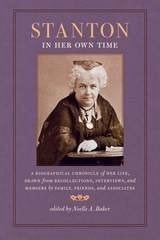
Stanton in Her Own Time
A Biographical Chronicle of Her Life, Drawn from Recollections, Interviews, and Memoirs by Family, Friends, and AssociatesNoelle A. Baker
University of Iowa Press, 2016
Among nineteenth-century women’s rights reformers, Elizabeth Cady Stanton (1815–1902) stands out for the maternal and secular advocacy that shaped her activism and public reception. A wife and mother of seven, she was also a prolific writer, transatlantic women’s rights leader, popular lecturer, congressional candidate, canny historian, and freethought champion. Her lifelong interest in women’s sexual and reproductive rights and late efforts to reform institutional religion are as relevant to our time as they were to her own.
Stanton’s professional life lasted a half-century, ranging from antebellum women’s rights organization and oratory, to a post–Civil War career as a lyceum lecturer, to a late-century role as an incisive religious and cultural critic. Acutely aware of the medical, religious, legal, and educational barriers to women’s independence, she advocated for married women’s right to vote, obtain a divorce, gain custody of their children, and own property. As she grew more radical over the years, she also demanded judicial reform, the separation of church and state, free love, progressive coeducational opportunities, and women’s right to limit their fertility.
In this richly contextualized collection of primary sources, Noelle A. Baker brings together accounts of Stanton’s life and ideas from both well-known and recently recovered figures. From the teacher chiding an assertive young woman to erstwhile allies worrying about her growing radicalism, their voices paint a vivid portrait of a woman of vaunting ambition, powerhouse intellect, and her share of human failings.

Stars at Noon
Poems from the Life of Jacqueline CochranEnid Shomer
University of Arkansas Press, 2001
These poems give voice to the life of the first woman to fly faster than the speed of sound. While Jacqueline Cochran was alive, no man or woman in the world could match her records for speed, distance, and altitude flying. Founder and director of the Women’s Airforce Service Pilots (WASP) during World War II, Cochran continued to fly competitively until she was sixty, owned and operated her own line of designer cosmetics for three decades, ran for Congress, and generally placed herself on the path of history. Having begun life as a foundling in the crushing poverty of a lumber company town of the Florida panhandle, she described her life as “a passage from sawdust to stardust.” Yet after her death she has barely been remembered.
Poet Enid Shomer brings back this mercurial, dazzling, powerful woman. These poems speak in her voice and in the voices of her mother, teachers, husband, confidants, and political opponents, shaped by Shomer’s consummate formal control and stunning lyricism.
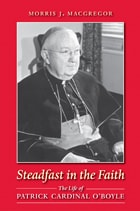
Steadfast in the Faith
The Life of Patrick Cardinal O'BoyleMorris J. MacGregor
Catholic University of America Press, 2006
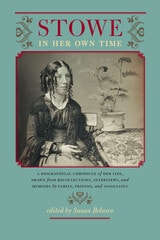
Stowe in Her Own Time
A Biographical Chronicle of Her Life, Drawn from Recollections, Interviews, and Memoirs by Family, FSusan Belasco
University of Iowa Press, 2009
One of the first celebrity authors, Harriet Beecher Stowe (1811–1896) became famous almost overnight when Uncle Tom’s Cabin—which sold more than 300,000 copies in its first year of publication—appeared in 1852. Known by virtually all famous writers in the United States and many in England and regarded by many women writers as a role model because of her influence in the literary marketplace, Stowe herself was the subject of many books, articles, essays, and poems during her lifetime.
This volume brings together for the first time a range of primary materials about Stowe’s private and public life written by family members, friends, and fellow writers who knew or were influenced by her before and after Uncle Tom’s Cabin catapulted her to fame. Included are periodical articles by Fanny Fern and Charles Dudley Warner; biographical essays by Sarah Josepha Hale and Rose Terry Cooke; letters by Oliver Wendell Holmes, Elizabeth Barrett Browning, and Harriet Jacobs; recollections by Frederick Douglass, Annie Adams Fields, Isabella Beecher Hooker, and Charles Beecher; and poems by Paul Laurence Dunbar and John Greenleaf Whittier. An introduction at the beginning of each essay connects it to its historical and cultural context, explanatory notes provide information about people and places, and the book includes a detailed introduction and a chronology of Stowe’s life.
The thirty-eight recollections gathered in Stowe in Her Own Time form a biographical narrative designed to provide several perspectives on the famous author, sometimes in conflict and sometimes in agreement but always perceptive. The figure who emerges from this insightful, analytical collection is far more complex than the image she helped construct in her lifetime.
Stream Of Life
Clarice Lispector
University of Minnesota Press, 1989

Stringbean
The Life and Murder of a Country LegendTaylor Hagood
University of Illinois Press, 2023
A beloved member of the country music community, David “Stringbean” Akeman found nationwide fame as a cast member of Hee Haw. The 1973 murder of Stringbean and his wife forever changed Nashville’s sense of itself. Millions of others mourned not only the slain couple but the passing of the way of life that country music had long represented.
Taylor Hagood merges the story of Stringbean’s life with an account of murder and courtroom drama. Mentored by Uncle Dave Macon and Bill Monroe, Stringbean was a bridge to country’s early days. His instrumental savvy and old-time singing style drew upon a deep love for traditional country music that, along with his humor and humanity, won him the reverence of younger artists and made his violent death all the more shocking. Hagood delves into the unexpected questions and uneasy resolutions raised by the atmosphere of retribution surrounding the murder trial and recounts the redemption story that followed decades later.

Strong Advocate
The Life of a Trial LawyerThomas Strong
University of Missouri Press, 2012
In Strong Advocate, Thomas Strong, one of the most successful trial lawyers in Missouri’s history, chronicles his adventures as a contemporary personal injury attorney. Though the profession is held in low esteem by the general public, Strong entered the field with the right motives: to help victims who have been injured by defective products or the negligence of others.