Results by title
58 books match the query 'Loss' and 5 start with s
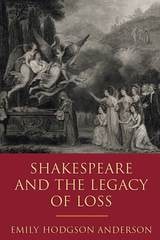
Shakespeare and the Legacy of Loss
Emily Hodgson Anderson
University of Michigan Press, 2018
How do we recapture, or hold on to, the live performances we most love, and the talented artists and performers we most revere? Shakespeare and the Legacy of Loss tells the story of how 18th-century actors, novelists, and artists, key among them David Garrick, struggled with these questions through their reenactments of Shakespearean plays. For these artists, the resurgence of Shakespeare, a playwright whose works just decades earlier had nearly been erased, represented their own chance for eternal life. Despite the ephemeral nature of performance, Garrick and company would find a way to make Shakespeare, and through him the actor, rise again.
In chapters featuring Othello, Richard III, Hamlet, The Winter’s Tale, and The Merchant of Venice, Emily Hodgson Anderson illuminates how Garrick’s performances of Shakespeare came to offer his contemporaries an alternative and even an antidote to the commemoration associated with the monument, the portrait, and the printed text. The first account to read 18th-century visual and textual references to Shakespeare alongside the performance history of his plays, this innovative study sheds new light on how we experience performance, and why we gravitate toward an art, and artists, we know will disappear.
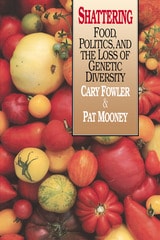
Shattering
Food, Politics, and the Loss of Genetic DiversityCary Fowler and Pat Mooney
University of Arizona Press, 1990
Large-scale agriculture has come to favor uniformity in food crops. More than 7,000 U.S. apple varieties once grew in American orchards; 6,000 of them are no longer available. Every broccoli variety offered through seed catalogs in 1900 has now disappeared. As the international genetics supply industry absorbs seed companies—with nearly one thousand takeovers since 1970—this trend toward uniformity seems likely to continue; and as third world agriculture is brought in line with international business interests, the gene pools of humanity's most basic foods are threatened.
The consequences are more than culinary. Without the genetic diversity from which farmers traditionally breed for resistance to diseases, crops are more susceptible to the spread of pestilence. Tragedies like the Irish Potato Famine may be thought of today as ancient history; yet the U.S. corn blight of 1970 shows that technologically based agribusiness is a breeding ground for disaster.
Shattering reviews the development of genetic diversity over 10,000 years of human agriculture, then exposes its loss in our lifetime at the hands of political and economic forces. The possibility of crisis is real; this book shows that it may not be too late to avert it.
So Far Away
A Daughter's Memoir of Life, Loss, and LoveChristine W. Hartmann
Vanderbilt University Press, 2011
Christine's father, as it turned out, prepared too slowly for old age. Before he had made any decision, fate disabled him through a series of strokes. Confined to a nursing home, severely impaired by dementia and frustrated by his circumstances, his life epitomized the predicament her mother wanted to avoid.
So Far Away gives us an intimate view of a person interacting with and reacting to her parents at the ends of their lives. In a richly detailed, poignant story of family members' separate yet interwoven journeys, it underscores the complexities and opportunities that life presents each one of us.
Subject to Death
Life and Loss in a Buddhist WorldRobert Desjarlais
University of Chicago Press, 2016
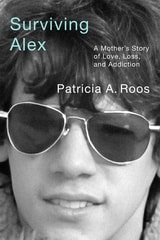
Surviving Alex
A Mother’s Story of Love, Loss, and AddictionPatricia A. Roos
Rutgers University Press, 2024
Weaving together a personal narrative and a sociological perspective, Surviving Alex movingly describes how even children from “good families” fall prey to addiction, and recounts the hellish toll it takes on families. Drawing from interviews with Alex’s friends, family members, therapists, teachers, and police officers—as well as files from his stays in hospitals, rehab facilities, and jails—Roos paints a compelling portrait of a young man whose life veered between happiness, anxiety, success, and despair. And as she explores how a punitive system failed her son, she calls for a community of action that would improve care for substance users and reduce addiction, realigning public health policy to address the overdose crisis.