Results by title
25 books match the query 'Sky'
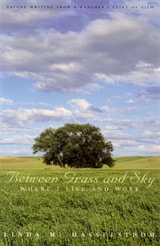
Between Grass And Sky
Where I Live And WorkLinda M. Hasselstrom
University of Nevada Press, 2005
An important collection of personal essays from one of the most widely published American environmental writers addresses the effects of ranching on the environment. Acclaimed nature writer Linda M. Hasselstrom sees herself as a rancher who writes—a definition that shapes the tone and content of her writing. Now owner of the South Dakota cattle ranch where she grew up, Hasselstrom lives in intimate contact with the natural world. "Nature is to me both home and office. Nature is my boss, manager of the branch office—or ranch office—where I toil to convert native grass into meat. . . . If I want to keep my job as well as my home, I pay attention not only to Nature's orders, but to her moods and whims." She writes knowingly of the rancher's toil and of the intelligence and dignity of the wild and domesticated creatures that share the prairie grassland she calls home. As one who knows and loves the land, Hasselstrom appreciates the concerns of environmental activists and understands that responsible ranchers can play a role in nurturing a healthy rural ecosystem. Rich in detail, humor, and pathos, these essays offer wry commentary on the scope of human folly and the even greater human potential for community and empathy. "Only people who live in the country," she writes, "could form a relationship with nature so intimate that they feel concern for one lonely duck. People who live in cities . . . only glimpse nature from high windows or speeding vehicles. Even wilderness lovers who probe deeply are only passing through. We who live on the land truly live within the land, each of our lives only one among the other inhabitants of the place." These are essays to read with wonder and delight, to relish and ponder. Available in hardcover and paperback.
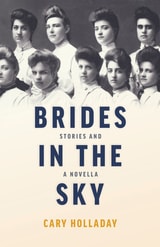
Brides in the Sky
Stories and a NovellaCary Holladay
Ohio University Press, 2019
Each of the crystalline worlds Cary Holladay brings us in the short stories and novella that make up Brides in the Sky has sisterhood, in all its urgency and peril, at its heart. In the title story, two women in 1850s Virginia marry brothers who promptly uproot them to follow the Oregon Trail west, until an unexpected shift of allegiance separates the sisters forever. Elsewhere in the book, a young boy’s kidnapping ignites tensions in a sorority house; frontier figure Cynthia Ann Parker struggles upon her return to her birth community from the Comanche people with whom she’s lived a full life; and in a metafictional twist, a gothic tale resonates in the present. In the novella, “A Thousand Stings,” three sisters come of age in the 1960s over a long summer of small-town scandal and universal stakes. These are just some of the lives, shaped by migrations, yearning, and the long shadows of myth, that Holladay creates. She crafts them with subtle humor, a stunning sense of place, and an unerring eye for character.
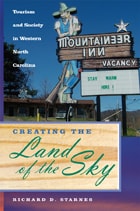
Creating the Land of the Sky
Tourism and Society in Western North CarolinaRichard D. Starnes
University of Alabama Press, 2005
A sophisticated inquiry into tourism's social and economic power across the South.
In the early 19th century, planter families from South Carolina, Georgia, and eastern North Carolina left their low-country estates during the summer to relocate their households to vacation homes in the mountains of western North Carolina. Those unable to afford the expense of a second home relaxed at the hotels that emerged to meet their needs. This early tourist activity set the stage for tourism to become the region's New South industry. After 1865, the development of railroads and the bugeoning consumer culture led to the expansion of tourism across the whole region.
Richard Starnes argues that western North Carolina benefited from the romanticized image of Appalachia in the post-Civil War American consciousness. This image transformed the southern highlands into an exotic travel destination, a place where both climate and culture offered visitors a myriad of diversions. This depiction was futher bolstered by partnerships between state and federal agencies, local boosters, and outside developers to create the atrtactions necessary to lure tourists to the region.
As tourism grew, so did the tension between leaders in the industry and local residents. The commodification of regional culture, low-wage tourism jobs, inflated land prices, and negative personal experiences bred no small degree of animosity among mountain residents toward visitors. Starnes's study provides a better understanding of the significant role that tourism played in shaping communities across the South.
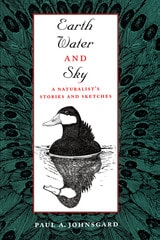
Earth, Water, and Sky
A Naturalist's Stories and SketchesBy Paul A. Johnsgard
University of Texas Press, 1999
"As I write this, I am sitting in a cabin at Cedar Point Biological Station in southwestern Nebraska.... The glorious elemental mixture of earth, water, and sky around me is the home of nearly three hundred species of birds, and comprises one of my favorite places in the world. Here no radio stations blare out the most recent results of meaningless sports events ... no traffic noises confound the senses. Instead the wind is the unquestioned dominating summer influence. The prairie grasses bend willingly and gracefully before it, and the leaves of the cottonwood trees convert its breezes into soft music."
Paul Johnsgard is one of America's most prominent ornithologists and a world authority on waterfowl behavior. In these popularly written, often lyrical essays, he describes some of his most fascinating encounters with birds, from watching the annual mating displays of prairie-chickens on a hilltop in Pawnee County, Nebraska, to attempting to solve some of the mysteries surrounding Australia's nearly flightless musk duck.
Reflecting his worldwide interests and travels, the birds Johnsgard describes inhabit many parts of the globe. Grouping the birds by the element they frequent most—earth, water, or sky—he weaves a wealth of accurate natural history into personal stories drawn from a lifetime of avian observation. And, as a bonus, Johnsgard's lovely pen-and-ink drawings illustrate each species he describes.
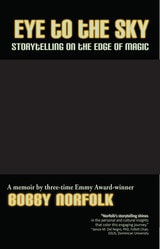
Eye to the Sky
Storytelling on the Edge of MagicBobby Norfolk
Parkhurst Brothers, Inc., 2016
Nobody knows how to tell a story like Bobby Norfolk, and here he tells his own life story. Norfolk grew up in hardscrabble neighborhoods of Saint Louis, Missouri, during the 1950s and 60s, sometimes walking to elementary school from an apartment his parents could not afford to heat. Lifting himself up by force of will and God-given talent, Norfolk defeated a childhood stutter to become a high school dramatist and later an exceptional college student. The path was never easy—and often frightening. With men of color being killed all-too-frequently in America, Norfolk sought a personal identity based upon talent and hard work, but also upon where safety and justice might be found. He tells these stories—some heartwarming or humorous, some frightful and treacherous—honestly, with a graceful mindfulness that all would do well to emulate.
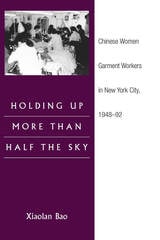
Holding Up More Than Half the Sky
Chinese Women Garment Workers in New York City, 1948-92Xiaolan Bao
University of Illinois Press, 2001
In 1982, 20,000 Chinese-American garment workers—most of them women—went on strike in New York City. Every Chinese garment industry employer in the city soon signed a union contract. The successful action reflected the ways women's changing positions within their families and within the workplace galvanized them to stand up for themselves.
Xiaolan Bao's now-classic study penetrates to the heart of Chinese American society to explain how this militancy and organized protest, seemingly so at odds with traditional Chinese female behavior, came about. Drawing on more than one hundred interviews, Bao blends the poignant personal stories of Chinese immigrant workers with the interwoven history of the garment industry and the city's Chinese community. Bao shows how the high rate of married women employed outside the home profoundly transformed family culture and with it the image and empowerment of Chinese American women. At the same time, she offers a complex and subtle discussion of the interplay of ethnic and class factors within New York's garment industry.
Passionately told and prodigiously documented, Holding Up More Than Half the Sky examines the journey of a community's women through an era of change in the home, on the shop floor, and walking the picket line.
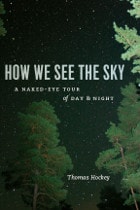
How We See the Sky
A Naked-Eye Tour of Day and NightThomas Hockey
University of Chicago Press, 2002
Gazing up at the heavens from our backyards or a nearby field, most of us see an undifferentiated mess of stars—if, that is, we can see anything at all through the glow of light pollution. Today’s casual observer knows far less about the sky than did our ancestors, who depended on the sun and the moon to tell them the time and on the stars to guide them through the seas. Nowadays, we don’t need the sky, which is good, because we’ve made it far less accessible, hiding it behind the skyscrapers and the excessive artificial light of our cities.
How We See the Sky gives us back our knowledge of the sky, offering a fascinating overview of what can be seen there without the aid of a telescope. Thomas Hockey begins by scanning the horizon, explaining how the visible universe rotates through this horizon as night turns to day and season to season. Subsequent chapters explore the sun’s and moon’s respective motions through the celestial globe, as well as the appearance of solstices, eclipses, and planets, and how these are accounted for in different kinds of calendars. In every chapter, Hockey introduces the common vocabulary of today’s astronomers, uses examples past and present to explain them, and provides conceptual tools to help newcomers understand the topics he discusses.
Packed with illustrations and enlivened by historical anecdotes and literary references, How We See the Sky reacquaints us with the wonders to be found in our own backyards.

On the Way to the Sky
Remembering Bob BrookmeyerMichael Stephans
University of North Texas Press, 2025
Phantom in the Sky
A Marine's Back Seat View of the Vietnam WarTerry L. Thorsen
University of North Texas Press, 2019
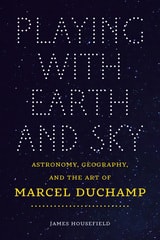
Playing with Earth and Sky
Astronomy, Geography, and the Art of Marcel DuchampJames Housefield
Dartmouth College Press, 2016
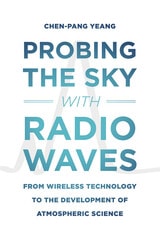
Probing the Sky with Radio Waves
From Wireless Technology to the Development of Atmospheric ScienceChen-Pang Yeang
University of Chicago Press, 2013
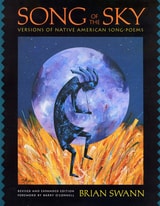
Song of the Sky
Versions of Native American Song-PoemsBrian Swann
University of Massachusetts Press, 1993
“Swann's ‘concrete’ renderings of the poems are visually striking and are meant to embody the notions of silence and cycle that are so important in Native American culture. . . . [He] does a fine job of encouraging readers to return to return to these original songs and poems from a culture that most latter-day Americans know far too little about.”—Anne Bromley, Georgia Review
Based on the work of anthropologist collectors, this compendium of more than 100 Native American chants and songs revises and updates a prior edition out of print since 1989. ‘These poems are not translations,’ argues Swann. They're versions that have gone through ‘a series of mediations and filters and exist somewhere between the individual lyric voice’ and a diverse, multileveled Native American imaginative-mystical identity. Whether versions, translations, or poems, whether sung at a Crazy Dance, potlatch, corn-grinding, or curative or marriage ceremony, whether celebrating buffalo, maize, red fox, or tobacco, these works capture the ‘otherness’ of the primeval spirit of the Native American fusion of natural and supernatural, animal and deity. Originally performed aloud, these ‘verbal artifacts’—which are sometimes breathtakingly pure, sometimes obscure—reveal that there can be no conventional or single notion of ‘the Indian.’”—Library Journal
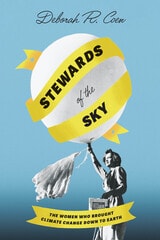
Stewards of the Sky
The Women Who Brought Climate Change Down to EarthDeborah R. Coen
University of Chicago Press, 0
The forgotten history of grassroots climate science, built by women.
For over two centuries, scientists have struggled to predict how people will respond to the vagaries of weather and climate. Today, governments, insurance companies, and investment firms continue to forecast what climate change will mean for local communities, setting adaptation goals from the top down. But hidden in the archives is another approach to this problem that is democratic, collaborative, and grows from the bottom up.
In Stewards of the Sky, historian Deborah R. Coen uncovers the stories of women who documented the humble drivers of change that unfold at the scale of everyday life, modeling the stewardship of the atmosphere as an equitably shared resource—a commons. These naturalists revealed how insects and plants work together to survive unusual weather, how air powers the cycle of life and death, and how people with disabilities cope with pollution. Coen spotlights Geneviève Thiroux d’Arconville, Anna Kingsford, Rosa Luxemburg, and Margaret Collins, as well as the contemporary figures Susan Cutter, Diana Liverman, and Maria Lemos, scientists and activists who resisted their colleagues’ efforts to replace traditional forms of collective security with predictive sciences that would make risk profitable. In contrast, Coen’s antiheroines demonstrated the value of humility and respect for the interpersonal and cross-species relationships that make research possible. Their work shows that surviving climate change is not a zero-sum game, that mutual aid is critical, and that antiheroic science can help build alliances that respect different ways of knowing the world.
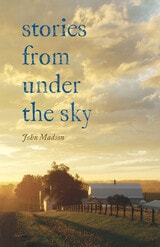
Stories From Under The Sky
John Madson
University of Iowa Press, 2006
Whatever the topic, Madson’s love of nature shines through, be it coon hunting or an explanation of the incredible bird machine. His obvious affection is tempered with the recognition that not everything “natural” is a pretty sight. All of which leaves readers with a better understanding of life under the sky.
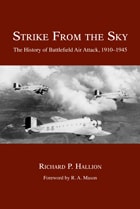
Strike From the Sky
The History of Battlefield Air Attack, 1910-1945Richard P. Hallion, foreword by R. A. Mason
University of Alabama Press, 2010
The definitive history of how air power transformed the battlefield between two world wars.
Strike from the Sky: The History of Battlefield Air Attack, 1910–1945 is a comprehensive examination of the emergence and evolution of battlefield aviation during the first half of the twentieth century. Written by renowned aviation historian Richard P. Hallion, the book traces the development of air-ground warfare from the earliest military use of aircraft in combat through the decisive campaigns of World War II. Combining operational history with analysis of doctrine, technology, and leadership, Hallion reveals how battlefield air attack became a critical element of modern military strategy.
The study explores major conflicts including the First World War, the Spanish Civil War, colonial campaigns, and the global battles of World War II. Hallion examines the evolution of close air support, air interdiction, reconnaissance, command and control systems, and the aircraft that carried out these missions. He also analyzes how military organizations adapted to the challenges of integrating air and ground forces, creating doctrines that continue to influence military operations today.
Strike from the Sky demonstrates how advances in aviation transformed the battlefield and altered the conduct of war. It remains an essential resource for understanding the origins of modern air power and the technological and strategic innovations that reshaped twentieth-century combat.
The Dialogue of Earth and Sky
Dreams, Souls, Curing, and the Modern Aztec UnderworldTimothy J. Knab
University of Arizona Press, 2004
The Horse Who Drank the Sky
Film Experience Beyond Narrative and TheoryPomerance, Murray
Rutgers University Press, 2008
By looking at point of view, the gaze, the voice from nowhere, diegesis and its discontents, ideology, the system of the apparatus, invisible editing, and the technique of overlapping sound, he argues that it is often the minuscule or transitional moments in motion pictures that penetrate most deeply into viewers' experiences. In films that include Rebel Without a Cause, Dead Man, Chinatown, The Graduate, North by Northwest, Dinner at Eight, Jaws, M, Stage Fright, Saturday Night Fever, The Band Wagon, The Bourne Identity, and dozens more, Pomerance invokes complexities that many of the best of critics have rarely tackled and opens a revealing view of some of the most astonishing moments in cinema.
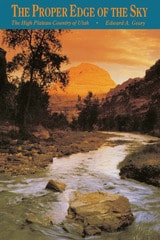
The Proper Edge of the Sky
High Plateau Country of UtahEdward A Geary
University of Utah Press, 1992
Edward Geary’s collection of writings on the High Plateau country of central and southern Utah, a combination guidebook, travel narrative, personal essays, and natural, social, and literary history, encompasses each of those forms with a sweep as broad as the landscape it describes.
It traces the progress of travelers to the region, including the historic Dominguez-Escalante party in 1776, and trappers and explorers such as Jedediah Smith, John C. Freemont, and Kit Carson. Scandinavian and English descendants of the early Mormon pioneers, sent to settle Manti and surrounding areas by Brigham Young in 1849, populate many of the pages and dominate the agrarian villages described by the author. The book also describes the multiethnic society of French Basque, Greeks, Slavs, Italians, Chinese, Welsh, and Finnish laborers and coal miners that developed in the region.
Geary writes of all these people with affection and a deep sense of place, of belonging to a distinctive landscape and its history. It is a book that will bring a rush of understanding to those who have lived in the High Plateaus and greater depth of appreciation to visitors.
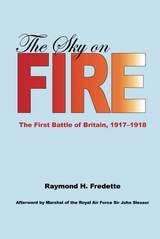
The Sky on Fire
The First Battle of Britain, 1917-1918Raymond H. Fredette
University of Alabama Press, 2005
The forgotten air campaign that gave birth to modern air power.
A fascinating examination of the strategies and uses of air power in the First World War, Sky on Fire covers not only developments in military hardware and tactics but also how public policy and political considerations shaped the ways air power was deployed. Providing an excellent balance of data and statistics as well as human insights, Fredette’s book is essential reading for readers interested in the air power, both historically and in contemporary conflicts.
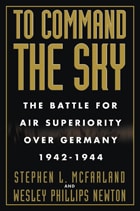
To Command the Sky
The Battle for Air Superiority Over Germany, 1942-1944Stephen L. McFarland and Wesley Phillips Newton
University of Alabama Press, 2006
To Command the Sky is a scholarly record of the fight for domination of the skies over western Europe during World War II. It also explains the technical details of the tactics used to defeat the Luftwaffe. This book is important for serious students of World War II or military aviation.
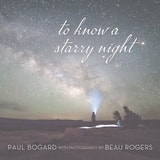
To Know a Starry Night
Paul Bogard
University of Nevada Press, 2021
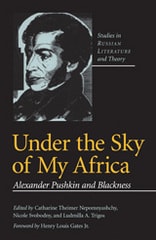
Under the Sky of My Africa
Alexander Pushkin and BlacknessCatherine Nepomnyashchy
Northwestern University Press, 2006
Roughly in the year 1705, a young African boy, acquired from the seraglio of the Turkish sultan, was transported to Russia as a gift to Peter the Great. This child, later known as Abram Petrovich Gannibal, was to become Peter's godson and to live to a ripe old age, having attained the rank of general and the status of Russian nobility. More important, he was to become the great-grandfather of Russia's greatest national poet, Alexander Pushkin. It is the contention of the editors of this book, borne out by the essays in the collection, that Pushkin's African ancestry has played the role of a "wild card" of sorts as a formative element in Russian cultural mythology; and that the ways in which Gannibal's legacy has been included in or excluded from Pushkin's biography over the last two hundred years can serve as a shifting marker of Russia's self-definition.
The first single volume in English on this rich topic, Under the Sky of My Africa addresses the wide variety of interests implicated in the question of Pushkin's blackness-race studies, politics, American studies, music, mythopoetic criticism, mainstream Pushkin studies. In essays that are by turns biographical, iconographical, cultural, and sociological in focus, the authors-representing a broad range of disciplines and perspectives-take us from the complex attitudes toward race in Russia during Pushkin's era to the surge of racism in late Soviet and post-Soviet contemporary Russia. In sum, Under the Sky of My Africa provides a wealth of basic material on the subject as well as a series of provocative readings and interpretations that will influence future considerations of Pushkin and race in Russian culture.
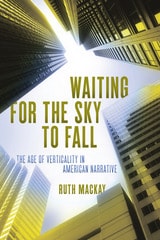
Waiting for the Sky to Fall
The Age of Verticality in American NarrativeRuth Mackay
The Ohio State University Press, 2016
With this study, Mackay asks: In what oblique ways has verticality leaked into American narrative? Why do metaphors of up and down recur across the twentieth century? With close readings of Jonathan Safran Foer’s Extremely Loud and Incredibly Close, Winsor McCay’s comic strip Little Nemo in Slumberland, Upton Sinclair’s Oil! and its film rendering There Will Be Blood, Allen Ginsberg’s poetic dissections of the nuclear bomb, and Leslie Marmon Silko’s imagining of flight in Almanac of the Dead, this interdisciplinary study culminates with a discussion of Philippe Petit’s tightrope walk between the Twin Towers. Waiting for the Sky to Fall examines how vertical representation cleaves to, and often transforms the associations of, specific events that are physically and visually disorienting, disquieting, or even traumatic.
Worlds in the Sky
Planetary Discovery from Earliest Times Through Voyager and MagellanWilliam Sheehan
University of Arizona Press, 1992
In Worlds in the Sky, William Sheehan gives us a history of this long fascination, weaving together scientific history, anecdotes surrounding planetary discoveries, and the personal reflections of an incurable amateur astronomer. He describes how we arrived at our current understanding of the Moon and the planets and shows how certain individuals in history shaped the world’s knowledge about the Solar System.
Written in the Sky
Lessons of a Southern DaughterPatricia Foster
University of Alabama Press, 2023
In Written in the Sky: Lessons of a Southern Daughter, Patricia Foster presents a double portrait of place and family, a book of deeply personal essays that interrogate the legacy of racial tensions in the South, the constriction of caste and gender, and the ways race, class, and white privilege are entwined in her family story. After interviewing girls at Booker T. Washington High School in Tuskegee, Alabama, visiting the National Memorial for Peace and Justice in Montgomery, Alabama, and exploring Africatown in Plateau, Alabama, Patricia Foster was moved to reflect on the racial scars and crossroads in her southern past as well as to reckon with the intimate places of her own wounding and grief.
The story of place, she discovers, emerges not only from family histories and cultural traditions but also from wrestling with a culture’s irreconcilable ideas: the hard push to determine what matters. What matters to her are the shadow stories beneath our mythologies, the complicated and radiant narratives that must be excavated and reckoned with, stories that have no neat or binary resolution, stories full of luminous moments and riveting facts, and stories where the secrets hide. Written in the Sky presents the best of nonfiction storytelling: searingly honest portraits, dramatic encounters, and lyrical narratives that will interest teachers and students as well as social justice advocates, policymakers, and readers compelled by stories of awakening and the white-hot beauty of language.