Results by title
262 books match the query 'Love' and 19 start with s
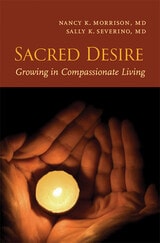
Sacred Desire
Growing in Compassionate LivingNancy K. Morrison
Templeton Press, 2009
Is the call to spirituality embedded in human biology? Authors Nancy K. Morrison and Sally K. Severino draw on cutting-edge research, including the recent discovery of brain "mirror neurons" and the elucidation of the physiology of social affiliation and attachment, to make a bold case that we are, in fact, biologically wired to seek oneness with the divine. They have termed this innate urge "sacred Desire."
In their new book on the subject, ,em>Sacred Desire: Growing in Compassionate Living, Morrison and Severino, both highly esteemed academic psychiatrists, draw on neurophysiology, relationship studies, research on spiritual development, and psychotherapy to show how spirituality is intimately connected with our physical being. The authors offer several clinical examples of how recognizing sacred Desire can advance a person's healing and they provide an action plan for using Desire to move from fear to love of self, others, and all creation.
In addition to psychiatrists and neurophysiologists, who will undoubtedly welcome this significant contribution to their fields of study, Sacred Desire is sure to appeal as well to the much wider audience of spiritual seekers looking for intellectually and scientifically credible ways to understand spirituality in today's world.
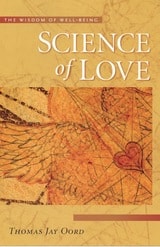
Science Of Love
Wisdom Of Well BeingThomas Oord
Templeton Press, 2004
We all know the saying, "Love can change the world." When science looks at love, it considers cosmology, sociobiology, evolutionary psychology, neurology, sex and romance, and the role of emotions as each relates to love. It also explores religious, ethical, and philosophical issues, such as virtue, creation ex nihilo, progress, divine action, agape, values, religious practices, pacifism, sexuality, friendship, freedom, and marriage. All affect the ways in which people understand each other and interact with one another. In this book, Oord explores these varied dimensions of love, illuminating the love-science symbiosis for both scholars and general readers.
His definition of love is "to act intentionally, in sympathetic response to others (including God), to promote overall well-being. Love acts are influenced by previous actions and executed in the hope of attaining a high degree of good for all." He begins his study with an exploration of the role love plays in all major world religions: Hinduism, Buddhism, Confucianism, Judaism, Islam, and Christianity. He explains how divine love in action can be viewed as consonant with the big bang theory and the continual creation of the universe.
He looks at pacifism and concludes that nonviolence is not always the most loving thing (sometimes violence must be used to rescue victims or prevent holocausts). He explores the animal kingdom to see how creatures work together with the Creator to make the world a better place. And he analyzes the fundamentals of love, the basic characteristics of existence that must be present for love to be expressed. He concludes with the important argument that progress can best be made when religion and science work together to both understand and promote love.

Sex, Love, and Health in America
Private Choices and Public PoliciesEdited by Edward O. Laumann and Robert T. Michael
University of Chicago Press, 2000
Sixteen researchers have contributed essays to this collection that explore controversial topics, including teenage sexuality, sexual contact between children and adults, abortion, the role of cohabitation in the sexual satisfaction of couples, and how sexual behavior has changed in response to AIDS, as well as a widely heralded examination of circumcision, reported in the New York Times, which discusses the effects of the procedure on disease transmission and the preference for certain sexual practices. In its analysis, policy recommendations, and revelations about private practices, Sex, Love, and Health in America will, like the earlier volume, have a major role in shaping the discussion about American sexual behavior.

Shakespeare and the Nature of Love
Literature, Culture, EvolutionMarcus Nordlund
Northwestern University Press, 2007
After addressing critical issues about love, biology, and culture raised by his method, Nordlund considers four specific forms of love in seven of Shakespeare’s plays. Examining the vicissitudes of parental love in Titus Andronicus and Coriolanus, he argues that Shakespeare makes a sustained inquiry into the impact of culture and society upon the natural human affections. King Lear offers insight into the conflicted relationship between love and duty. In two problem plays about romantic love, Troilus and Cressida and All’s Well that Ends Well, the tension between individual idiosyncrasies and social consensus becomes especially salient. And finally, in Othello and The Winter’s Tale, Nordlund asks what Shakespeare can tell us about the dark avatar of jealousy.

Shakespeare on Love and Friendship
Allan Bloom
University of Chicago Press, 2000
This volume includes essays on five plays, Romeo and Juliet, Anthony and Cleopatra, Measure for Measure, Troilus and Cressida, and The Winter's Tale, and within these Bloom meditates on Shakespeare's work as a whole. He also draws on his formidable knowledge of Plato, Rousseau, and others to bring both ancients and moderns into the conversation. The result is a truly synoptic treatment of eros—not only a philosophical reflection on Shakespeare, but a survey of the human spirit and its tendency to seek what Bloom calls the "connectedness" of love and friendship.
These highly original interpretations of the plays convey a deep respect for their author and a deep conviction that we still have much to learn from him. In Bloom's view, we live in a love-impoverished age; he asks us to turn once more to Shakespeare because the playwright gives us a rich version of what is permanent in human nature without sharing our contemporary assumptions about erotic love.
"Provocative and illuminating." —Michiko Kakutani, New York Times
"A brilliant analysis of the erotic ugliness and the balancing erotic grace of The Winter's Tale . . . and Bloom makes more sense of [Measure for Measure] than anyone else I have read." —A. S. Byatt, Washington Post Book World
At his death in 1992, Allan Bloom was the John U. Nef Distinguished Service Professor in the Committee on Social Thought at the University of Chicago. He is the author of several books, including Shakespeare's Politics (with Harry V. Jaffa) and The Closing of the American Mind.

Shards of Love
Exile and the Origins of the LyricMaría Rosa Menocal
Duke University Press, 1994
It is in exile that Menocal locates the founding conditions for philology--as a discipline that loves origins--and for the genre of love songs that philology reveres. She crosses the boundaries, both temporal and geographical, of 1492 to recover the "original" medieval culture, with its Mediterranean mix of European, Arabic, and Hebrew poetics. The result is a form of literary history more lyrical than narrative and, Menocal persuasively demonstrates, more appropriate to the Middle Ages than to the revisionary legacy of the Renaissance. In discussions ranging from Eric Clapton's adaption of Nizami's Layla and Majnun, to the uncanny ties between Jim Morrison and Petrarch, Shards of Love deepens our sense of how the Middle Ages is tied to our own age as it expands the history and meaning of what we call Romance philology.

Sharing the Love of Gardening
The History of The Westport Garden ClubKristie C. Wolferman
University of Missouri Press, 2025
With the post-World War II housing boom, the nascent WGC became involved in landscaping projects aimed at beautifying Kansas City. These efforts continued when the WGC led re-landscaping efforts after the Great Flood of 1951. Early in their club’s history, the women of the WGC learned that collaboration with other organizations allowed them to have a greater impact on the causes about which they cared. They soon began working with city governments and park departments on both sides of the Missouri-Kansas state line, including with the Linda Hall Library and Arboretum, the Nelson-Atkins Museum of Art, and the Loose Park Garden Center.
In addition to being a thorough history of The Westport Garden Club—and the considerable influence that a small number of dedicated, educated women have had on it—Sharing the Love of Gardening is a book of stunning photography, showcasing previously unpublished images from the clubs’ archives and the original work of club member and professional photographer Marianne Kilroy.
Shuva
The Future of the Jewish PastYehuda Kurtzer
Brandeis University Press, 2012

So Far Away
A Daughter's Memoir of Life, Loss, and LoveChristine W. Hartmann
Vanderbilt University Press, 2011
Christine's father, as it turned out, prepared too slowly for old age. Before he had made any decision, fate disabled him through a series of strokes. Confined to a nursing home, severely impaired by dementia and frustrated by his circumstances, his life epitomized the predicament her mother wanted to avoid.
So Far Away gives us an intimate view of a person interacting with and reacting to her parents at the ends of their lives. In a richly detailed, poignant story of family members' separate yet interwoven journeys, it underscores the complexities and opportunities that life presents each one of us.
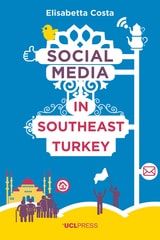
Social Media in Southeast Turkey
Love, Kinship and PoliticsElisabetta Costa
University College London, 2016

Solitaire of Love
Cristina Peri Rossi
Duke University Press, 2000
Tracing the course of a relationship as it evolves into uncompromising self-destruction, the narrator of Solitaire of Love becomes addicted to his own passion and to the body of his beloved. Erotic, romantic love becomes bewitchment, producing a heightened state where time is measured in the rhythms of a chosen body and pride becomes subservient to obsession. The specifics of this other body trump any claim to ordinary existence for the narrator, as sex becomes a kind of idolatrous slavery and love becomes a mechanism for self-immolation. As in Peri Rossi’s other works, an ambiguous sense of gender and sexuality arise from her uniquely experimental prose and mystically erotic logic. Language is subsumed into this process as a way to bear witness, to transfix and capture the love object. The limbo of obsession, as described by Peri Rossi, creates an infantilizing brand of loneliness, broken by flashes of joy, insight, fury, and fear.
This novel was originally published in Spanish in 1988.
Some Kinds of Love
StoriesSteve Yates
University of Massachusetts Press, 2013
Songs of Love and Grief
A Bilingual Anthology in the Verse Forms of the OriginalsHeinrich Heine
Northwestern University Press, 1995

Sonnets of Love and Death
Jean De Sponde
Northwestern University Press, 2001
South Africa and the Dream of Love to Come
Queer Sexuality and the Struggle for FreedomBrenna M. Munro
University of Minnesota Press, 2012
After apartheid, South Africa established a celebrated new political order that imagined the postcolonial nation as belonging equally to the descendants of indigenous people, colonizing settlers, transported slaves, indentured laborers, and immigrants. Its constitution, adopted in 1996, was the first in the world to include gays and lesbians as full citizens. Brenna M. Munro examines the stories that were told about sexuality, race, and nation throughout the struggle against apartheid in order to uncover how these narratives ultimately enabled gay people to become imaginable as fellow citizens. She also traces how the gay, lesbian, or bisexual person appeared as a stock character in the pageant of nationhood during the transition to democracy. In the process, she offers an alternative cultural history of South Africa.
Munro asserts that the inclusion of gay people made South Africans feel “modern”—at least for a while. Being gay or being lesbian was reimagined in the 1990s as distinctly South African, but the “newness” that made these sexualities apt symbols for a transformed nation can also be understood as foreign and un-African. Indeed, a Western-style gay identity is often interpreted through the formula “gay equals modernity equals capitalism.” As South Africa’s reentrance into the global economy has failed to bring prosperity to the majority of its citizens, homophobic violence has been on the rise.
Employing a wide array of texts—including prison memoirs, poetry, plays, television shows, photography, political speeches, and the postapartheid writings of Nobel Laureates Nadine Gordimer and J. M. Coetzee—Munro reports on how contemporary queer activists and artists are declining to remain ambassadors for the “rainbow nation” and refusing to become scapegoats for the perceived failures of liberation and liberalism.
St. Austin Review, Laughter & the Love of Friends, November/December 2016, Vol. 16, No. 6
Joseph Pearce
St. Augustine's Press, 2016

Stephanie Dinkins
On Love & DataSrimoyee Mitra
University of Michigan Press, 2024
Stephanie Dinkins: On Love & Data brings together nationally renowned curators and theorists who draw from methodologies of art criticism, social practice, new media theory, and critical studies to offer an in-depth analysis of key installations in Dinkins’s survey exhibition. The book also includes an important essay by Stephanie Dinkins on her concept of Afro-now-ism in which she expands on her theoretical framework and positionality as a Black new media artist in the 21st century. Dinkins’s artistic research transcends the boundaries of visual art to challenge and expose the bias and inequities of caste, race, and gender, which are encoded within digital systems on which governance, healthcare, and security infrastructures in the United States are based.
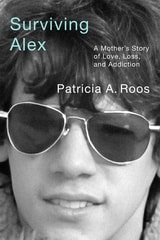
Surviving Alex
A Mother’s Story of Love, Loss, and AddictionPatricia A. Roos
Rutgers University Press, 2024
Weaving together a personal narrative and a sociological perspective, Surviving Alex movingly describes how even children from “good families” fall prey to addiction, and recounts the hellish toll it takes on families. Drawing from interviews with Alex’s friends, family members, therapists, teachers, and police officers—as well as files from his stays in hospitals, rehab facilities, and jails—Roos paints a compelling portrait of a young man whose life veered between happiness, anxiety, success, and despair. And as she explores how a punitive system failed her son, she calls for a community of action that would improve care for substance users and reduce addiction, realigning public health policy to address the overdose crisis.
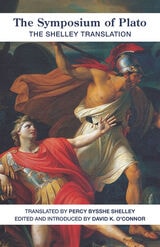
Symposium Of Plato
Shelley TranslationPercy Bysshe Shelley
St. Augustine's Press, 2002