Results by title
55 books match the query 'Maritime History & Piracy' and 6 start with s

SS Australis
Bert Lamers
Amsterdam University Press, 2024
The ss 'Australis' was a well known ocean liner which entered service in 1940 as the
ss 'America' for the United States Lines. The ship was sold to the Greek Chandris Lines in 1964 and served until 1977 very succesfully on the route Western-Europe-Australia-New Zealand. Later the route became a full round-the-world-service. After her Australian period the liner sailed under the names of 'America' (for the third time), 'Italis', 'Noga', 'Alferdoss' and finally 'American Star'. In this volume of Liners the history of the great liner from when she was purchased by the Greek interest in 1964 until her sad wracking in January 1994.
ss 'America' for the United States Lines. The ship was sold to the Greek Chandris Lines in 1964 and served until 1977 very succesfully on the route Western-Europe-Australia-New Zealand. Later the route became a full round-the-world-service. After her Australian period the liner sailed under the names of 'America' (for the third time), 'Italis', 'Noga', 'Alferdoss' and finally 'American Star'. In this volume of Liners the history of the great liner from when she was purchased by the Greek interest in 1964 until her sad wracking in January 1994.
[more]

Sea Nomads of Southeast Asia
From the Past to the PresentEdited by Bérénice Bellina, Roger Blench, and Jean-Christophe Galipaud
National University of Singapore Press, 2020
Sea nomads have been part of the economic and political landscape of Southeast Asia for millennia. They have played many roles over the longue-durée: in certain periods proving central to the ability of land-based polities to generate wealth, by sourcing valuable maritime commodities, facilitating trade, forming a naval force to secure and protect vital sea lanes and providing crucial connectivity. They have existed in complex, codified relations with different sedentary populations, as pirates, guardians of the sea-lanes, merchants and explorers. Paradoxically, as modern states emerged, the sea-nomads became progressively marginalized and impoverished.
For many years, the sea nomads were assumed to be without history, and even without archaeology. This has proven far from the case, and recent archaeological findings allow us to more closely describe sea nomadism from the Pleistocene through the early Holocene up to the present. Integrating these findings with the latest in historical research, linguistics, ethnography and historical genetics allows us to better understand sea-nomad ways of life over a scale of millennia and to appreciate the diversity and flexibility of this sea-nomad world. This in turn enriches our understanding of nomadism and mobility as ways of life more generally, and of the sea not only as a landscape of resources, but as a home and spiritual landscape.
For many years, the sea nomads were assumed to be without history, and even without archaeology. This has proven far from the case, and recent archaeological findings allow us to more closely describe sea nomadism from the Pleistocene through the early Holocene up to the present. Integrating these findings with the latest in historical research, linguistics, ethnography and historical genetics allows us to better understand sea-nomad ways of life over a scale of millennia and to appreciate the diversity and flexibility of this sea-nomad world. This in turn enriches our understanding of nomadism and mobility as ways of life more generally, and of the sea not only as a landscape of resources, but as a home and spiritual landscape.
[more]
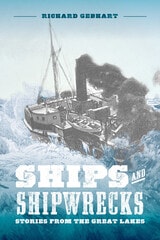
Ships and Shipwrecks
Stories from the Great LakesRichard Gebhart
Michigan State University Press, 2022
From the day that French explorer Robert Cavelier de La Salle launched the Griffin in 1679 to the 1975 sinking of the celebrated Edmund Fitzgerald, thousands of commercial ships have sailed on the vast and perilous waters of the Great Lakes. In a harbinger of things to come, on the return leg of its first trip in late summer 1679, the Griffin disappeared and has never been seen again. In the centuries since then, the records show that an alarming number of shipwrecks have occurred on the Great Lakes. If vessels that wrecked but were later repaired and returned to service are included, the number certainly swells into the thousands. Most did not mysteriously vanish like the Griffin. Instead, they suffered the occupational hazards of every lake boat: collisions, groundings, strands, fires, boiler explosions, and capsizes. Many of these disasters took the lives of crews and passengers. The fearsome wrath of the storms that brew over the Great Lakes has challenged and defeated some of the staunchest vessels constructed in the shipyards of port cities along the U.S. and Canadian lakeshores. Here Richard Gebhart tells the tales of some of these ships and their captains and crews, from their launches to their sad demises—or sometimes, their celebrated retirements. This volume is a must-read for anyone intrigued by the maritime history of the Great Lakes.
[more]
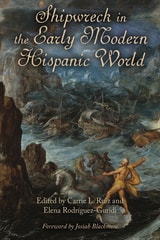
Shipwreck in the Early Modern Hispanic World
Carrie L. Ruiz
Bucknell University Press, 2022
Seafaring activity for trade and travel was dominant throughout the Spanish Empire, and in the worldview and imagination of its inhabitants, the specter of shipwreck loomed large. Shipwreck in the Early Modern Hispanic World probes this preoccupation by examining portrayals of nautical disasters in sixteenth- and seventeenth-century Spanish literature and culture. The essays collected here showcase shipwreck’s symbolic deployment to question colonial expansion and transoceanic trade; to critique the Christian enterprise overseas; to signal the collapse of dominant social order; and to relay moral messages and represent socio-political debates. The contributors find examples in poetry, theater, narrative fiction, and other print artifacts, and approach the topic variously through the lens of historical, literary, and cultural studies. Ultimately demonstrating how shipwrecks both shaped and destabilized perceptions of the Spanish Empire worldwide, this analytically rich volume is the first in Hispanic studies to investigate the darker side of mercantile and imperial expansion through maritime disaster.
[more]
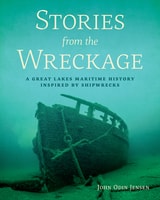
Stories from the Wreckage
A Great Lakes Maritime History Inspired by ShipwrecksJohn Odin Jensen
Wisconsin Historical Society Press, 2019
Every shipwreck has a story that extends far beyond its tragic end. The dramatic tales of disaster, heroism, and folly become even more compelling when viewed as junction points in history—connecting to stories about the frontier, the environment, immigration, politics, technology, and industry. In Stories from the Wreckage, John Odin Jensen examines a selection of Great Lakes shipwrecks of the wooden age for a deeper dive into this transformative chapter of maritime history. He mines the archeological evidence and historic record to show how their tragic ends fit in with the larger narrative of Midwestern history. Featuring the underwater photography of maritime archeologist Tamara Thomsen, this vibrant volume is a must-have for shipping enthusiasts as well as anyone interested in the power of water to shape history.
[more]

Surviving the Essex
The Afterlife of America's Most Storied ShipwreckDavid O. Dowling
University Press of New England, 2016
Surviving the “Essex” tells the captivating story of a ship’s crew battered by whale attack, broken by four months at sea, and forced—out of necessity—to make meals of their fellow survivors. Exploring the Rashomon-like Essex accounts that complicate and even contradict first mate Owen Chase’s narrative, David O. Dowling examines the vital role of viewpoint in shaping how an event is remembered and delves into the ordeal’s submerged history—the survivors’ lives, ambitions, and motives, their pivotal actions during the desperate moments of the wreck itself, and their will to reconcile those actions in the short- and long-term aftermath of this storied event. Mother of all whale tales, Surviving the “Essex” acts as a sequel to Nathaniel Philbrick’s In the Heart of the Sea, while probing deeper into the nature of trauma and survival accounts, an extreme form of notoriety, and the impact that the story had on Herman Melville and the writing of Moby-Dick.
[more]