Results by title
79 books match the query 'Media & Communications' and 5 start with s

Shaded Lives
African American Women and TelevisionBeretta E Smith-Shomade
Rutgers University Press, 2002
In Shaded Lives, Beretta Smith-Shomade sets out to dissect images of the African American woman in television from the 1980s. She calls their depiction "binaristic," or split. African American women, although an essential part of television programming today, are still presented as distorted and deviant. By closely examining the television texts of African-American women in comedy, music video, television news and talk shows (Oprah Winfrey is highlighted), Smith-Shomade shows how these voices are represented, what forces may be at work in influencing these images, and what alternate ways of viewing might be available.
Smith-Shomade offers critical examples of where the sexist and racist legacy of this country collide with the cultural strength of Black women in visual and real-lived culture. As the nation's climate of heightened racial divisiveness continues to relegate the representation of Black women to depravity and display, her study is not only useful, it is critical.
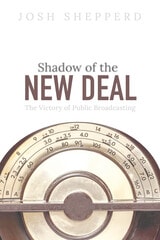
Shadow of the New Deal
The Victory of Public BroadcastingJosh Shepperd
University of Illinois Press, 2023
- Winner of the 2024 BEA Book Award
- Runner-up in the History Division of the Association for Education in Journalism and Mass Communication (AEJMC)
- Runner-up for the AJHA Book of the Year (American Journalism Historians Association).
Despite uncertain beginnings, public broadcasting emerged as a noncommercial media industry that transformed American culture. Josh Shepperd looks at the people, institutions, and influences behind the media reform movement and clearinghouse the National Association of Educational Broadcasters (NAEB) in the drive to create what became the Public Broadcasting Service and National Public Radio.
Founded in 1934, the NAEB began as a disorganized collection of undersupported university broadcasters. Shepperd traces the setbacks, small victories, and trial and error experiments that took place as thousands of advocates built a media coalition premised on the belief that technology could ease social inequality through equal access to education and information. The bottom-up, decentralized network they created implemented a different economy of scale and a vision of a mass media divorced from commercial concerns. At the same time, they transformed advice, criticism, and methods adopted from other sectors into an infrastructure that supported public broadcasting in the 1960s and beyond.

Smartland Korea
Mobile Communication, Culture, and SocietyDal Yong Jin
University of Michigan Press, 2017
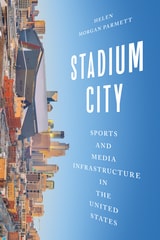
Stadium City
Sports and Media Infrastructure in the United StatesHelen Morgan Parmett
University of Illinois Press, 2025

Studying Unmade, Unseen, and Unreleased Film and Television
Histories, Theories, MethodsJames Fenwick and Kieran Foster
Intellect Books, 2026
Unmade, unseen, and unreleased film and television are a strikingly underexplored aspect of media history, even though significant financial investment and creative labor in these industries are devoted to projects that never reach production or distribution. This groundbreaking collection offers a comprehensive examination of this phenomenon, bringing together interdisciplinary perspectives from film history, gender and sexuality studies, industry studies, archival research, and creative practice.
Each chapter presents a state-of-the-art overview of a key theme, debate, method, or theory, drawing on illuminating case studies from different historical periods and global contexts. Together, the contributions define what it means for a work to remain unmade, unseen, or unreleased, while showcasing innovative research approaches and mapping the scale of unfinished projects in film and television. Serving as both a foundational text for students and a valuable reference for established researchers, the volume’s scope will offer an essential resource for anyone seeking to understand the hidden histories of the screen industries.