Results by title
105 books match the query 'Mind' and 7 start with s
Sex between Body and Mind
Psychoanalysis and Sexology in the German-speaking World, 1890s-1930sKatie Sutton
University of Michigan Press, 2019
This is the first book to closely examine vital encounters among this era’s German-speaking researchers across their emerging professional and disciplinary boundaries. Although psychoanalysis was often considered part of a broader “sexual science,” sexologists increasingly distanced themselves from its mysterious concepts and clinical methods. Instead, they turned to more pragmatic, interventionist therapies—in particular, to the burgeoning field of hormone research, which they saw as crucial to establishing their own professional relevance. As sexology and psychoanalysis diverged, heated debates arose around concerns such as the sexual life of the child, the origins and treatment of homosexuality and transgender phenomena, and female frigidity. This new story of the emergence of two separate approaches to the study of sex demonstrates that the distinctions between them were always part of a dialogic and competitive process. It fundamentally revises our understanding of the production of modern sexual subjects.
Slips of the Mind
Poetry as ForgettingJennifer Soong
University of Chicago Press, 2025
In Slips of the Mind, poet and critic Jennifer Soong turns away from forgetting’s long-standing associations with suppression, privation, and error to argue that the absence or failure of memory has often functioned as a generative creative principle. Exploring forgetting not as the mere rejection of a literary past or a form of negative poetics, Soong puts to the test its very aesthetic meaning. What new structures, forms of desires, styles, and long and short feelings do lapses in time allow? What is oblivion’s relationship to composition? And how does the twentieth-century poet come to figure as the quintessential embodiment of such questions?
Soong uncovers forgetting’s influence on Gertrude Stein, Lyn Hejinian, Tan Lin, Harryette Mullen, Lissa Wolsak, and New York School poets John Ashbery, James Schuyler, Bernadette Mayer, and Ted Berrigan, among others. She reveals that forgetting’s shapeshifting produces differences in poetic genre, interest, and degrees of intentionality—and that such malleability is part of forgetting’s nature. Most provocatively, Soong shows how losing track of things, leaving them behind, or finding them already gone resists overdetermination and causality in the name of surprise, as poets leverage forgetting in order to replace identity with style. Slips of the Mind is the kind of literary criticism that will reward all readers of modern and contemporary poetry.

Soccer in Mind
A Thinking Fan's Guide to the Global GameAndrew M. Guest
Rutgers University Press, 2022
This book provides a thinking fan’s guide to the world’s most popular game, proposing a way of engaging soccer that sparks intellectual curiosity and employs critical consciousness. Using stories and data, along with ideas from sociology, psychology, and across the social sciences, it provides readers with new ways of understanding fanaticism, peak performance, talent development, and more. Drawing on concepts ranging from cognitive bias to globalization, it illuminates meanings of the game for players and fans while investigating impacts on our lives and communities. While it considers soccer cultures across the globe, the book also analyzes what makes U.S. soccer culture special, including its embrace of the women’s game.
As a scholar, former minor league player and coach, and fan, Andrew Guest offers a distinctive perspective on soccer in society. Whatever name you call it, and whatever your interest in it, Soccer in Mind will enrich your own view of the one truly global game.
Social Origins Of Islam
Mind, Economy, DiscourseMohammed Bamyeh
University of Minnesota Press, 1999
Explores the genesis of Islam for insight into the nature of ideological transformation.
The story of the origins of Islam provides a rich and suggestive example of sweeping cultural transformation. Incorporating both innovation and continuity, Islam built upon the existing cultural patterns among the peoples of the Arabian peninsula even as it threatened to eradicate these same patterns. In this provocative interdisciplinary study, Mohammed A. Bamyeh combines perspectives from sociology, literary studies, anthropology, and economic history to examine the cultural ecology that fostered Islam.
Highlighting the pivotal connections in pre-Islamic society between the emergence of certain economic practices (such as trade and money-based exchange), worldview (as rendered in pre-Islamic literature and theology), and the reconfiguration of transtribal patterns of solidarity and settlement, Bamyeh finds in the genesis of Islam a sophisticated model for examining ideological transformation in general.At the heart of Bamyeh’s enterprise are close readings of both the Qur’an and the pre-Islamic poetry that preceded it. Bamyeh uncovers in these texts narrative and pedagogical content, poetic structure, use of metaphor, and historical references that are suggestive of societies in transition. He also explores the expressive limits of the pre-Islamic literature and its transmutation into Qur’anic speech in the wake of social transformation. Emphasizing the organic connections between belief structures, economic formations, and modes of discourse in pre-Islamic Arabia, The Social Origins of Islam explains how various material and discursive changes made the idea of Islam possible at a particular point in history. More broadly, it persuasively demonstrates how grand cultural shifts give rise to new systems of faith.
Staging Consciousness
Theater and the Materialization of MindWilliam W. Demastes
University of Michigan Press, 2002
William W. Demastes makes use of the writings of such varied theater practitioners as Antonin Artaud, Jerzy Grotowski, Samuel Beckett, Tony Kushner, Sam Shepard, Spalding Gray, Peter Shaffer, and others, illuminating theater as proof that mind is an extension of body. The living stage incubates and materializes thought in a way that highlights the processes of daily existence outside the theater. This book offers a new way for theater practitioners to look at the unique value of the theater and an invitation for philosophers and scientists to search for new paradigms in theater, the oldest of art forms.
William W. Demastes is Professor of English, Louisiana State University. His previous books include Theatre of Chaos: Beyond Absurdism, into Disorderly Order.
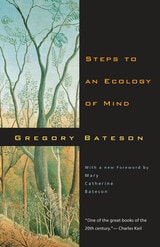
Steps to an Ecology of Mind
Collected Essays in Anthropology, Psychiatry, Evolution, and EpistemologyGregory Bateson
University of Chicago Press, 2000

Survived by One
The Life and Mind of a Family Mass MurdererRobert E. Hanlon, PhD with Thomas V. Odle
Southern Illinois University Press, 2013
On November 8, 1985, 18-year-old Tom Odle brutally murdered his parents and three siblings in the small southern Illinois town of Mount Vernon, sending shockwaves throughout the nation. The murder of the Odle family remains one of the most horrific family mass murders in U.S. history. Odle was sentenced to death and, after seventeen years on death row, expected a lethal injection to end his life. However, Illinois governor George Ryan’s moratorium on the death penalty in 2000, and later commutation of all death sentences in 2003, changed Odle’s sentence to natural life.
The commutation of his death sentence was an epiphany for Odle. Prior to the commutation of his death sentence, Odle lived in denial, repressing any feelings about his family and his horrible crime. Following the commutation and the removal of the weight of eventual execution associated with his death sentence, he was confronted with an unfamiliar reality. A future. As a result, he realized that he needed to understand why he murdered his family. He reached out to Dr. Robert Hanlon, a neuropsychologist who had examined him in the past. Dr. Hanlon engaged Odle in a therapeutic process of introspection and self-reflection, which became the basis of their collaboration on this book.
Hanlon tells a gripping story of Odle’s life as an abused child, the life experiences that formed his personality, and his tragic homicidal escalation to mass murder, seamlessly weaving into the narrative Odle’s unadorned reflections of his childhood, finding a new family on death row, and his belief in the powers of redemption.
As our nation attempts to understand the continual mass murders occurring in the U.S., Survived by One sheds some light on the psychological aspects of why and how such acts of extreme carnage may occur. However, Survived by One offers a never-been-told perspective from the mass murderer himself, as he searches for the answers concurrently being asked by the nation and the world.