Results by title
138 books match the query 'Minority Studies' and 7 start with s

Separate Destinations
Migration, Immigration, and the Politics of PlacesJames G. Gimpel
University of Michigan Press, 1999
Sexual Politics, Sexual Communities
Second EditionJohn D'Emilio
University of Chicago Press, 1998
"How many students of American political culture know that during the McCarthy era more people lost their jobs for being alleged homosexuals than for being Communists? . . . These facts are part of the heretofore obscure history of homosexuality in America—a history that John D'Emilio thoroughly documents in this important book."—George DeStefano, Nation
"John D'Emilio provides homosexual political struggles with something that every movement requires—a sympathetic history rendered in a dispassionate voice."—New York Times Book Review
"A milestone in the history of the American gay movement."—Rudy Kikel, Boston Globe

Showdown in Desire
The Black Panthers Take a Stand in New OrleansOrissa Arend
University of Arkansas Press, 2009
Social Studies in the Storytelling Classroom
Exploring Our Cultural Voices and PerspectivesJane Stenson
Parkhurst Brothers, Inc., 2012
“Accessible, inspirational and practical plans that make storytelling a portal to multifaceted insights about culture, history, geography and identity.”
– Janice M. Del Negro, Ph.D., GSLIS Dominican University
Soil and Soul
How Russia’s Minority Communities Create Meaning and IdentityEdited by Yana Hashamova and Gulnaz Sharafutdinova
University of Wisconsin Press, 2027
By landmass, Russia is the world’s largest country, due largely to centuries of military expansion, imperial rule, and colonization. As a result, it contains people of many ethnicities, nationalities, religions, and languages. Yet Russia’s non-Russian, Indigenous, and minority communities have often been marginalized by state policy and underrepresented in scholarship. Soil and Soul explores how these communities sustain distinct forms of identity and belonging not only through discourse or state institutions but also through embodied relations with land, nature, and animals. These local practices complicate and unsettle state-centered narratives of Russian cultural superiority by showing how meaning and identity are created through relationships with the nonhuman world. Drawing on decolonial, anthropological, environmental, sociological, linguistic, and geographic approaches, this volume reframes minority agency as ecosocial practice embedded in local ecologies, everyday life, and postimperial power asymmetries.
Contributors: Megan Dixon, Yana Hashamova, Kristina Kovalskaya, Jesko Schmoller, Gulnaz Sharafutdinova, Laura Siragusa, Zoia Tarasova, Baasanjav Terbish
Stagnant Dreamers
How the Inner City Shapes the Integration of the Second GenerationMaria G. Rendon
Russell Sage Foundation, 2019
Winner of the 2020 Robert E. Park Award for Best Book from the Community and Urban Sociology Section of the American Sociological Association
Winner of the 2020 Distinguished Contribution to Research Award from the Latino/a Section of the American Sociological Association
Honorable Mention for the 2020 Thomas and Znaniecki Award from the International Migration Section of the American Sociological Association
A quarter of young adults in the U.S. today are the children of immigrants, and Latinos are the largest minority group. In Stagnant Dreamers, sociologist and social policy expert María Rendón follows 42 young men from two high-poverty Los Angeles neighborhoods as they transition into adulthood. Based on in-depth interviews and ethnographic observations with them and their immigrant parents, Stagnant Dreamers describes the challenges they face coming of age in the inner city and accessing higher education and good jobs, and demonstrates how family-based social ties and community institutions can serve as buffers against neighborhood violence, chronic poverty, incarceration, and other negative outcomes.
Neighborhoods in East and South Central Los Angeles were sites of acute gang violence that peaked in the 1990s, shattering any romantic notions of American life held by the immigrant parents. Yet, Rendón finds that their children are generally optimistic about their life chances and determined to make good on their parents’ sacrifices. Most are strongly oriented towards work. But despite high rates of employment, most earn modest wages and rely on kinship networks for labor market connections. Those who made social connections outside of their family and neighborhood contexts, more often found higher quality jobs. However, a middle-class lifestyle remains elusive for most, even for college graduates.
Rendón debunks fears of downward assimilation among second-generation Latinos, noting that most of her subjects were employed and many had gone on to college. She questions the ability of institutions of higher education to fully integrate low-income students of color. She shares the story of one Ivy League college graduate who finds himself working in the same low-wage jobs as his parents and peers who did not attend college. Ironically, students who leave their neighborhoods to pursue higher education are often the most exposed to racism, discrimination, and classism.
Rendón demonstrates the importance of social supports in helping second-generation immigrant youth succeed. To further the integration of second-generation Latinos, she suggests investing in community organizations, combating criminalization of Latino youth, and fully integrating them into higher education institutions. Stagnant Dreamers presents a realistic yet hopeful account of how the Latino second generation is attempting to realize its vision of the American dream.
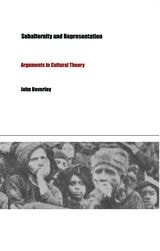
Subalternity and Representation
Arguments in Cultural TheoryJohn Beverley
Duke University Press, 1999
Dismissed by some as simply another new fashion in the critique of culture and by others as a postmarxist heresy, subaltern studies began with the work of Ranajit Guha and the South Asian Subaltern Studies collective in the 1980s. Beverley’s focus on Latin America, however, is evidence of the growing province of this field. In assessing subaltern studies’ purposes and methods, the potential dangers it presents, and its interactions with deconstruction, poststructuralism, cultural studies, Marxism, and political theory, Beverley builds his discussion around a single, provocative question: How can academic knowledge seek to represent the subaltern when that knowledge is itself implicated in the practices that construct the subaltern as such? In his search for answers, he grapples with a number of issues, notably the 1998 debate between David Stoll and Rigoberta Menchú over her award-winning testimonial narrative, I, Rigoberta Menchú. Other topics explored include the concept of civil society, Florencia Mallon’s influential Peasant and Nation, the relationship between the Latin American “lettered city” and the Túpac Amaru rebellion of 1780–1783, the ideas of transculturation and hybridity in postcolonial studies and Latin American cultural studies, multiculturalism, and the relationship between populism, popular culture, and the “national-popular” in conditions of globalization.
This critique and defense of subaltern studies offers a compendium of insights into a new form of knowledge and knowledge production. It will interest those studying postcolonialism, political science, cultural studies, and Latin American culture, history, and literature.