Results by title
618 books match the query 'Motion pictures' and 33 start with s

Savage Theory
Cinema as Modern MagicRachel O. Moore
Duke University Press, 2000
Moore mines the theories of language, spectatorship, and cinematic expression in the writings of Vachel Lindsay, Sergei Eisenstein, Siegfried Kracauer, and Walter Benjamin, among others. Illuminating the links between these theorists’ preoccupations with cinema as a form of primal communication and the numbing effects of modernity, she demonstrates how movies are uniquely able to negotiate the fragmentary and isolating nature of a modern world. In constructing an alternative to cognitive, psychoanalytic, and ideological approaches to film analysis, Moore provides eye-opening discussions of films such as Kenneth Anger’s Scorpio Rising, Hollis Frampton’s Nostalgia, and Robert Bresson’s l’Argent. Drawing from Marx’s theory of the commodity and Lukács’s work on second nature, she outlines the fetish character of the film image and reveals the emergence of the camera as a magical tool replete with animistic powers otherwise lost in the storm of progress.
Bound to influence the way future scholars think about the connection between modernism and primitivism, as well as the role of cinema therein during the early twentieth century, Savage Theory will be welcomed by scholars of film theory and anthropology and will also appeal to a wider cultural studies audience.
Screen Traffic
Movies, Multiplexes, and Global CultureCharles R. Acland
Duke University Press, 2003
Integrating film and cultural theory with close analysis of promotional materials, entertainment news, trade publications, and economic reports, Acland presents an array of evidence for the new understanding of movies and moviegoing that has developed within popular culture and the entertainment industry. In particular, he dissects a key development: the rise of the megaplex, characterized by large auditoriums, plentiful screens, and consumer activities other than film viewing. He traces its genesis from the re-entry of studios into the movie exhibition business in 1986 through 1998, when reports of the economic destabilization of exhibition began to surface, just as the rise of so-called e-cinema signaled another wave of change. Documenting the current tendency toward an accelerated cinema culture, one that appears to arrive simultaneously for everyone, everywhere, Screen Traffic unearths and critiques the corporate and cultural forces contributing to the “felt internationalism” of our global era.
Screening China
Critical Interventions, Cinematic Reconfigurations, and the Transnational Imaginary in Contemporary Chinese CinemaZhang Yingjin
University of Michigan Press, 2001
Screening Cuba
Film Criticism as Political Performance during the Cold WarHector Amaya
University of Illinois Press, 2010
Screening Modernism
European Art Cinema, 1950-1980András Bálint Kovács
University of Chicago Press, 2007
Spanning from the 1950s to the 1970s, András Bálint Kovács’s encyclopedic work argues that cinematic modernism was not a unified movement with a handful of styles and themes but rather a stunning range of variations on the core principles of modern art. Illustrating how the concepts of modernism and the avant-garde variously manifest themselves in film, Kovács begins by tracing the emergence of art cinema as a historical category. He then explains the main formal characteristics of modern styles and forms as well as their intellectual foundation. Finally, drawing on modernist theory and philosophy along the way, he provides an innovative history of the evolution of modern European art cinema.
Exploring not only modernism’s origins but also its stylistic, thematic, and cultural avatars, Screening Modernism ultimately lays out creative new ways to think about the historical periods that comprise this golden age of film.
Screening Morocco
Contemporary Film in a Changing SocietyValérie K. Orlando
Ohio University Press, 2011
Screening Neoliberalism
Transforming Mexican Cinema, 1988-2012Ignacio M. Sánchez Prado
Vanderbilt University Press, 2014
Screening Out the Past
The Birth of Mass Culture and the Motion Picture IndustryLary May
University of Chicago Press, 1983
"It is impossible to follow a narrow trail through the movies. The vistas keep opening, and May, linking movies to mass society, finds and makes new perceptions on emerging women, the rise of the studios, the special growth and appeal of Los Angeles, the nature of studio leadership and the early and persistent imputed corrupting power of film."—Charles Champlin, Los Angeles Times
"Lary May . . . has provided a set of new and rich insights into the changing patterns of American culture, 1890-1929. . . . His concentration on social and cultural history indirectly provides answers to questions which have baffled political historians for several decades."—David W. Noble, Minneapolis Tribune
"[Screening Out the Past is] a scrupulously argued, clearly written account of Hollywood's role in bringing America skipping and giggling from the Victorian world into the twentieth century. May is splendid on the psychology of the immigrant movie moguls, on Douglas Fairbanks and Mary Pickford as post Great War role models, and many other things."—Philip French, London Sunday Observor
"Altogether, the book represents the most successful blending of movie and cultural history to date."—Benjamin McArthur, Journal of Social History
Screening Stephen King
Adaptation and the Horror Genre in Film and TelevisionBy Simon Brown
University of Texas Press, 2018
Since the 1970s, the name Stephen King has been synonymous with horror. His vast number of books has spawned a similar number of feature films and TV shows, and together they offer a rich opportunity to consider how one writer’s work has been adapted over a long period within a single genre and across a variety of media—and what that can tell us about King, about adaptation, and about film and TV horror. Starting from the premise that King has transcended ideas of authorship to become his own literary, cinematic, and televisual brand, Screening Stephen King explores the impact and legacy of over forty years of King film and television adaptations.
Simon Brown first examines the reasons for King’s literary success and then, starting with Brian De Palma’s Carrie, explores how King’s themes and style have been adapted for the big and small screens. He looks at mainstream multiplex horror adaptations from Cujo to Cell, low-budget DVD horror films such as The Mangler and Children of the Corn franchises, non-horror films, including Stand by Me and The Shawshank Redemption, and TV works from Salem’s Lot to Under the Dome. Through this discussion, Brown identifies what a Stephen King film or series is or has been, how these works have influenced film and TV horror, and what these influences reveal about the shifting preoccupations and industrial contexts of the post-1960s horror genre in film and TV.
Seeing by Electricity
The Emergence of Television, 1878-1939Doron Galili
Duke University Press, 2020
Seeing the Big Picture, Revised Edition
A Cinematic Approach to Understanding Cultures in AmericaEllen Summerfield and Sandra Lee
University of Michigan Press, 2006
In addition to increasing students' knowledge and understanding of cultural differences, Seeingthe Big Picture will help students develop strong critical-thinking and analytic abilities as they learn to recognize and question messages inherent in the films' portrayals of different populations. A unique feature of the text are the Points of View segments from directors, insiders, and students that appear throughout the text, provoking perspectives students might not otherwise encounter.
This text is the ideal coursebook for undergraduate diversity electives and other multicultural awareness courses.
Shadows on the Past
Studies in the Historical Fiction FilmLeger Grindon
Temple University Press, 1994
Studying popular Hollywood films from Gone With the Wind to Reds and such distinguished European films as La Marseillaise and The Rise to Power of Louis XIV, Leger Grindon examines how historical fiction films interpret the present through a representation of the past.
The historical fiction film is characterized by a set of motives and, Grindon argues, deserves to be considered a genre unto itself. Appropriation of historical events can insinuate a film's authority of its subject, veil an intention, provide an escape into nostalgia, or direct a search for knowledge and origins. Utilizing the past as a way of responding to social conflicts in the present, Grindon shows how the genre promotes a political agenda, superseding the influence of scholarship on the public's perception and interpretation of history.
In the series Culture and the Moving Image, edited by Robert Sklar.
Shaping the Future of African American Film
Color-Coded Economics and the Story Behind the NumbersMonica White Ndounou
Rutgers University Press, 2014
In Hollywood, we hear, it’s all about the money. It’s a ready explanation for why so few black films get made—no crossover appeal, no promise of a big payoff. But what if the money itself is color-coded? What if the economics that governs film production is so skewed that no film by, about, or for people of color will ever look like a worthy investment unless it follows specific racial or gender patterns? This, Monica Ndounou shows us, is precisely the case. In a work as revealing about the culture of filmmaking as it is about the distorted economics of African American film, Ndounou clearly traces the insidious connections between history, content, and cash in black films.
How does history come into it? Hollywood’s reliance on past performance as a measure of potential success virtually guarantees that historically underrepresented, underfunded, and undersold African American films devalue the future prospects of black films. So the cycle continues as it has for nearly a century. Behind the scenes, the numbers are far from neutral. Analyzing the onscreen narratives and off-screen circumstances behind nearly two thousand films featuring African Americans in leading and supporting roles, including such recent productions as Bamboozled, Beloved, and Tyler Perry’s Diary of a Mad Black Woman, Ndounou exposes the cultural and racial constraints that limit not just the production but also the expression and creative freedom of black films. Her wide-ranging analysis reaches into questions of literature, language, speech and dialect, film images and narrative, acting, theater and film business practices, production history and financing, and organizational history.
By uncovering the ideology behind profit-driven industry practices that reshape narratives by, about, and for people of color, this provocative work brings to light existing limitations—and possibilities for reworking stories and business practices in theater, literature, and film.
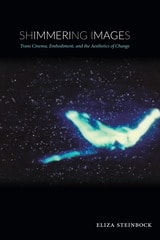
Shimmering Images
Trans Cinema, Embodiment, and the Aesthetics of ChangeEliza Steinbock
Duke University Press, 2019
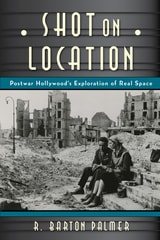
Shot on Location
Postwar American Cinema and the Exploration of Real PlacePalmer, R. Barton
Rutgers University Press, 2016
Renowned film scholar R. Barton Palmer answers this question in Shot on Location by exploring the historical, ideological, economic, and technological developments that led Hollywood to head back outside in order to capture footage of real places. His groundbreaking research reveals that wartime newsreels had a massive influence on postwar Hollywood film, although there are key distinctions to be made between these movies and their closest contemporaries, Italian neorealist films. Considering how these practices were used in everything from war movies like Twelve O’Clock High to westerns like The Searchers, Palmer explores how the blurring of the formal boundaries between cinematic journalism and fiction lent a “reality effect” to otherwise implausible stories.
Shot on Location describes how the period’s greatest directors, from Alfred Hitchcock to Billy Wilder, increasingly moved beyond the confines of the studio. At the same time, the book acknowledges the collaborative nature of moviemaking, identifying key roles that screenwriters, art designers, location scouts, and editors played in incorporating actual geographical locales and social milieus within a fictional framework. Palmer thus offers a fascinating behind-the-scenes look at how Hollywood transformed the way we view real spaces.
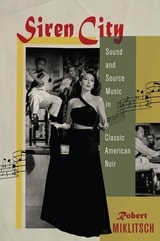
Siren City
Sound and Source Music in Classic American NoirMiklitsch, Robert
Rutgers University Press, 2011
Focusing on a wide range of celebrated and less well known films and offering an introductory discussion of film sound, Robert Miklitsch mobilizes the notion of audiovisuality to investigate period sound technologies such as the radio and jukebox, phonograph and Dictaphone, popular American music such as "hot" black jazz, and "big numbers" featuring iconic performers such as Lauren Bacall, Veronica Lake, and Rita Hayworth. Siren City resonates with the sounds and source music of classic American noir-gunshots and sirens, swing riffs and canaries. Along with the proverbial private eye and femme fatale, these audiovisuals are central to the noir aesthetic and one important reason the genre reverberates with audiences around the world.
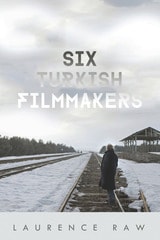
Six Turkish Filmmakers
Laurence Raw
University of Wisconsin Press, 2017
In analysis of and personal interviews with Dervis Zaim, Zeki Demirkubuz, Semih Kaplanoglu, Çagan Irmak, Tolga Örnek, and Palme d'Or winner Nuri Bilge Ceylan, Raw draws connections with Turkish theater, art, sculpture, literature, poetry, philosophy, and international cinema. A native of England and a twenty-five-year resident of Turkey, Raw interleaves his film discussion with thoughtful commentary on nationalism, gender, personal identity, and cultural pluralism.
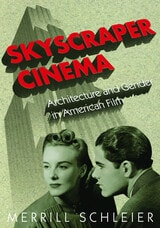
Skyscraper Cinema
Architecture and Gender in American FilmMerrill Schleier
University of Minnesota Press, 2008
Schleier analyzes cinematic works in which skyscrapers are an integral component, interpreting the iconography and spatial practices in these often fictional modern buildings, especially on concepts of gender. Organized chronologically and thematically, she offers close readings of films including Safety Last, Skyscraper Souls, Wife vs. Secretary, Baby Face, The Fountainhead, and Desk Set. Opening with the humorous antics of Harold Lloyd, the premier skyscraper actor of the silent era, the book moves through the disillusionment of the Depression era, in which skyscrapers are employed as players in moralistic, class-conscious stories, to post–World War II and its reimagining of American political and economic values and ends with the complicated prosperity of the 1950s and the lives of white-collar workers and their spouses.
Taking inspiration from Walter Benjamin’s Arcades Project, among works of other critical theorists, Schleier creates in this book a model for understanding architecture as a purveyor of desire and class values and, ultimately, contributes broadly to thinking on the rich intersection of the built environment, cinema, and gender.
Small Nation, Global Cinema
The New Danish CinemaMette Hjort
University of Minnesota Press, 2005
Hjort offers two key strategies underwriting the transformation and globalization of contemporary Danish cinema—the processes of cultural circulation and the psychological efficacy of heritage. Exploring the Dogma 95 movement initiated by Lars von Trier and Thomas Vinterberg as well as films by Erik Clausen, Gabriel Axel, Henning Carlsen, and Ole Bornedal, among others, Hjort examines means for cinematic globalization specific to Denmark, but then evolves her investigation into a truly comparative framework encompassing references to Hong Kong, Latin America, and Hollywood filmmaking. Providing a fresh way of looking at cultural influence in the era of globalization, Hjort’s concept of “small” nation points as much to the dynamics of recognition, indifference, and participation as it does to more common measures of population size, economic strength, or linguistic reach.
Mette Hjort is professor of intercultural studies at Aalborg University.
So What, or How to Make Films with Words
Alexander García Düttmann
Northwestern University Press, 2023
Images, whether filmic or not, cannot be replaced by words. Yet words can make images. This is the general thesis underlying So What, a collection of essays on canonical filmmakers like Luchino Visconti and Orson Welles; more experimental directors, such as Marguerite Duras and Albert Serra; and visual artists, including Hollis Frampton and Agnes Martin. Alexander García Düttmann aims to make their films as if they did not precede his text, capturing their idea and experience.
If the relationship between filmic image and text is a heterogeneous one, then this heterogeneity must leave a trace. This is why the book’s chapters are organized not according to historical periods or on the basis of film theories but rather by single concepts that function like dictionary entries. The chapters adopt different forms, blurring the lines between art and philosophy. So What is a practical exercise in “making films with words,” inviting readers to draw out insights from its conceptual play.
So What compiles previously untranslated and hard-to-find essays into a single volume, one that represents the absorbing and singular thought process of a major contemporary philosopher.
Sociology on Film
Postwar Hollywood's Prestige CommodityCagle, Chris
Rutgers University Press, 2016
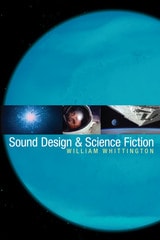
Sound Design and Science Fiction
By William Whittington
University of Texas Press, 2007
Sound is half the picture, and since the 1960s, film sound not only has rivaled the innovative imagery of contemporary Hollywood cinema, but in some ways has surpassed it in status and privilege because of the emergence of sound design.
This in-depth study by William Whittington considers the evolution of sound design not only through cultural and technological developments during the last four decades, but also through the attitudes and expectations of filmgoers. Fans of recent blockbuster films, in particular science fiction films, have come to expect a more advanced and refined degree of film sound use, which has changed the way they experience and understand spectacle and storytelling in contemporary cinema.
The book covers recent science fiction cinema in rich and compelling detail, providing a new sounding of familiar films, while offering insights into the constructed nature of cinematic sound design. This is accomplished by examining the formal elements and historical context of sound production in movies to better appreciate how a film sound track is conceived and presented.Whittington focuses on seminal science fiction films that have made specific advances in film sound, including 2001: A Space Odyssey, THX 1138, Star Wars, Alien, Blade Runner (original version and director's cut), Terminator 2: Judgment Day and The Matrix trilogy and games—milestones of the entertainment industry's technological and aesthetic advancements with sound.
Setting itself apart from other works, the book illustrates through accessible detail and compelling examples how swiftly such advancements in film sound aesthetics and technology have influenced recent science fiction cinema, and examines how these changes correlate to the history, theory, and practice of contemporary Hollywood filmmaking.
Sound
Dialogue, Music, and EffectsKalinak, Kathryn
Rutgers University Press, 2015
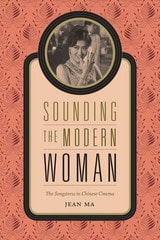
Sounding the Modern Woman
The Songstress in Chinese CinemaJean Ma
Duke University Press, 2015
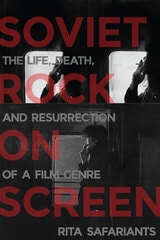
Soviet Rock on Screen
The Life, Death, and Resurrection of a Film GenreRita Safariants
University of Wisconsin Press, 2026
In Soviet Rock on Screen, Rita Safariants chronicles the birth, life, death, and resurrection of a genre that rapidly became one of the most readily recognized cultural signifiers of the perestroika era and which continues to reflect and codify Russian culture. During their initial heyday in the 1980s, rock films were influenced by and encouraged the cultural shifts of perestroika and the incipient political storm. Today, Safariants argues, the reemergence and reconfiguration of the genre indicates the extent to which Soviet-era cultural emblems inform Russian national identity and obliquely support the current political repression under Putin.
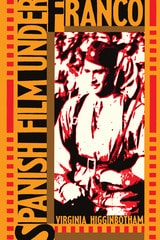
Spanish Film Under Franco
By Virginia Higginbotham
University of Texas Press, 1988
How does a totalitarian government influence the arts, and how do the arts respond? Spanish Film Under Franco raises these important questions, giving English speakers a starting point in their study of Spanish cinema.
After a brief overview of Spanish film before Franco, the author proceeds to a discussion of censorship as practiced by the Franco regime. The response of directors to censorship—the “franquista aesthetic,” or “aesthetic of repression,” with its highly metaphorical, oblique style—is explored in the works of Luis Buñuel, Carlos Saura, Juan Antonio Bardem, Luis García Berlanga, and other important directors.
Virginia Higginbotham combines historical perspective with detailed critical analysis and interpretation of many famous Franco-era films. She shows how directors managed to evade the censors and raise public awareness of issues relating to the Spanish Civil War and the repressions of the Franco regime.
Film has always performed an educational function in Spain, reaching masses of poor and uneducated citizens. And sometimes, as this study also reveals, Spanish film has been ignored when the questions it raised became too painful or demanding.
The author concludes with a look at post-Franco cinema and the directions it has taken. For anyone interested in modern Spanish film, this book will be essential reading.
Spectral Aesthetics
Visualizing the Crisis of Migrant DisappearanceChina Medel
University of Texas Press, 2026
Analyzing how artists reimagine migrant disappearance and visibility at the US–Mexico border.
In the mid-1990s, the US government implemented Prevention through Deterrence, a major buildup of troops, walls, and surveillance around El Paso and San Diego. Cut off from these crucial urban crossings, migrants flowed into the dangerous surrounding deserts, where some ten thousand have since died. This is all according to plan: Pentagon documents describe the strategy of funneling migrants toward “mortal danger.”
In this bracing critique, China Medel explores the aesthetics enabling and resisting the crisis of migrant death. The nation-state’s performance of sovereignty along the border, predicated on mass casualties, is tolerated and even celebrated, thanks to the images in our heads of racialized and therefore criminal bodies, made invisible as they disintegrate in the baking sand. Spectral Aesthetics shows how state officials and mainstream media, relying on postracial ideologies and white-supremacist agendas, collectively foster this picture of a brown body so abject that it is disposable. In close readings of artworks contesting this murderous visual regime, Medel discovers an alternative kind of sight, one emphasizing the ghostly traces of the dead. These are images not of the individual “alien” but of life itself, indisposable.
Sports Movies
Lester D. Friedman
Rutgers University Press, 2020
In Sports Movies, Lester D. Friedman describes the traditional formulas that have made these movies such crowd-pleasers, including stock figures like the disgraced athlete on a quest for redemption, or the wise old coaches who help mentor the heroes to victory. He also explores how the genre’s attitudes have changed over time, especially in key issues like class, race, masculinity, and women in sports.
Along the way, he takes stock of sports films from the dawn of cinema’s silent era to the present day, including classic baseball movies like Pride of the Yankees and Bull Durham, basketball movies like Hoosiers and He’s Got Game, football movies like Friday Night Lights and Rudy, and boxing movies like Raging Bull and Million Dollar Baby. As Friedman’s analyses reveal, not only do sports movies influence our perceptions about the drama of real-life sports, but they also help to shape our attitudes toward the competitive ethos in American life.
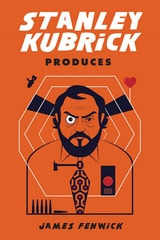
Stanley Kubrick Produces
James Fenwick
Rutgers University Press, 2021
Making use of overlooked archival sources and uncovering newly discovered ‘lost’ Kubrick projects (The Cop Killer, Shark Safari, and The Perfect Marriage among them), as well as providing the first detailed overview of the World Assembly of Youth film, James Fenwick provides a comprehensive account of Kubrick’s life and career and of how he managed to obtain the level of control that he possessed by the 1970s. Along the way, the book traces the rapid changes taking place in the American film industry in the post-studio era, uncovering new perspectives about the rise of young independent producers, the operations of influential companies such as Seven Arts and United Artists, and the whole field of film marketing.
Stardust
Cinematic Archives at the End of the WorldHannah Goodwin
University of Minnesota Press, 2024
An exploration of the fundamental bond between cinema and the cosmos
The advent of cinema occurred alongside pivotal developments in astronomy and astrophysics, including Albert Einstein’s theories of relativity, all of which dramatically altered our conception of time and provided new means of envisioning the limits of our world. Tracing the many aesthetic, philosophical, and technological parallels between these fields, Stardust explores how cinema has routinely looked toward the cosmos to reflect our collective anxiety about a universe without us.
Employing a “cosmocinematic gaze,” Hannah Goodwin uses the metaphorical frameworks from astronomy to posit new understandings of cinematic time and underscore the role of light in generating archives for an uncertain future. Surveying a broad range of works, including silent-era educational films, avant-garde experimental works, and contemporary blockbusters, she carves out a distinctive area of film analysis that extends its reach far beyond mainstream science fiction to explore films that reckon with a future in which humans are absent.
This expansive study details the shared affinities between cinema and the stars in order to demonstrate how filmmakers have used cosmic imagery and themes to respond to the twentieth century’s moments of existential dread, from World War I to the atomic age to our current moment of environmental collapse. As our outlook on the future continues to change, Stardust illuminates the promise of cinema to bear witness to humanity’s fragile existence within the vast expanse of the universe.
Still Moving
Between Cinema and PhotographyKaren Beckman and Jean Ma, eds.
Duke University Press, 2008
Foregrounding the productive tension between stasis and motion, two terms inherent to cinema and to photography, the contributors trace the shifting contours of the encounter between still and moving images across the realms of narrative and avant-garde film, photography, and installation art. Still Moving suggests that art historians and film scholars must rethink their disciplinary objects and boundaries, and that the question of medium specificity is a necessarily interdisciplinary question. From a variety of perspectives, the contributors take up that challenge, offering new ways to think about what contemporary visual practice is and what it will become.
Contributors: George Baker, Rebecca Baron, Karen Beckman, Raymond Bellour, Zoe Beloff,Timothy Corrigan, Nancy Davenport, Atom Egoyan, Rita Gonzalez, Tom Gunning, Louis Kaplan,
Jean Ma, Janet Sarbanes, Juan A. Suárez
Suture and Narrative
Deep Intersubjectivity in Fiction and FilmGeorge Butte
The Ohio State University Press, 2017
Suture and Narrative: Deep Intersubjectivity in Fiction and Film by George Butte offers a new phenomenological understanding of how fiction and film narratives use particular techniques to create and represent the experience of community. Butte turns to the concept of suture from Lacanian film theory and to the work of Merleau-Ponty to contribute a deeper and broader approach to intersubjectivity for the field of narrative theory.
Butte’s approach allows for narratives that represent insight as well as blindness, love, and loss, locating these connections and disconnections in narratological techniques that capture the crisscrossing of perspectives, such as those in fiction’s free indirect discourse and in the oblique angle of film’s shot/reverse shot convention. Butte studies the implications of this chiasmus in the novels and film adaptations of later Henry James works, Barrie’s Peter Pan tales and film adaptations, and the films Silence of the Lambsand Nothing But a Man. Suture’s story in the twentieth century, according to Butte, is a story of the loss of immediacy and community. Yet in concluding this, Butte finds optimism in the Coen brothers’ Raising Arizona as well as in Why Be Happy When You Could Be Normal? by Jeanette Winterson and Marc Webb’s film (500) Days of Summer.

Sync
Stylistics of Hieroglyphic TimeAuthored by James Tobias
Temple University Press, 2010
In Sync, James Tobias examines the development of musical sound and image in cinema and media art, indicating how these elements define the nature and experience of reception. Placing musicality at the center of understanding streaming media, Tobias presents six interwoven stories about synchronized audiovisual media—from filmmaker Sergei Eisenstein’s Alexander Nevsky to today’s contemporary digital art and computer games—to show how these effects are never merely "musical" in the literal sense of organized sound.