Results by title
99 books match the query 'National' and 6 start with s

Second in Command
Reevaluating the Role of Vice Presidents and Running Mates in Modern American PoliticsEdited by Karine Prémont and Christopher J. Devine
University of Michigan Press, 2026
In recent years, the office of the vice president has become a focal point of presidential politics and governance. From the emergence of the modern vice presidency under Walter Mondale to Mike Pence’s and Kamala Harris’s dramatic influence on the outcome of the 2020 election, Second in Command explores how vice presidents and vice-presidential candidates have shaped the direction of the country and changed American politics. The frenzy of speculation surrounding the “veepstakes” every four years and extensive media coverage of the vice-presidential debate may seem odd, given the vice presidency’s limited constitutional powers and dismal public reputation.
Dispelling the myth that the vice presidency is a powerless or merely ceremonial role, Second in Command draws on the multidisciplinary expertise of more than a dozen leading vice-presidential scholars to reveal the complex, consequential, and often misunderstood nature of the office. With accessible language and vivid examples, it traces the transformation of vice-presidential power over the past half-century, reveals the evolving electoral significance of vice-presidential running mates, and highlights the need for a deeper public understanding of these pivotal figures. Chapters employ a range of qualitative and quantitative methodologies, including elite interviews, archival research, case studies, and advanced statistical modeling to cover topics such as gender and media effects in running mate selection and the representation of vice presidents in popular culture. This book offers a fresh, engaging, and essential perspective on a vital institution at the heart of American democracy.

Self-Rule
A Cultural History of American DemocracyRobert H. Wiebe
University of Chicago Press, 1995
American democracy arrived abruptly in the 19th century; it changed just as dramatically early in the 20th. Hence, Self-Rule divides the history of American democracy into two halves: a 19th century half covering the 1820s to the present, and a 20th century half, with a major transition from the 1890s to the 1920s between them. As Wiebe explains why the original democracy of the early 19th century represented a sharp break from the past, he recreates in vivid detail the way European visitors contrasted the radical character of American democracy with their own societies. He then discusses the operation of various 19th century democratic publics, including a nationwide public, the People. Finally, he places democracy's white fraternal world of equals in a larger environment where other Americans who differed by class, race, and gender, developed their own relations to democracy.
Wiebe then picks up the history of democracy in the 1920s and carries it to the present. Individualism, once integrated with collective self-governance in the 19th century, becomes the driving force behind 20th century democracy. During those same years, other ways of defining good government and sound public policy shunt majoritarian practices to one side. Late in the 20th century, these two great themes in the history of American democracy—individualism and majoritarianism—turn on one another in modern democracy's war on itself.
Finally, Self-Rule assesses the polarized state of contemporary American democracy. Putting the judgments of sixty-odd commentators from Kevin Phillips and E.J. Dionne to Robert Bellah and Benjamin Barber to the test of history, Wiebe offers his own suggestions on the meaning and direction of today's democracy. This sweeping work explains how the history of American democracy has brought us here and how that same history invites us to create a different future.

Some White Folks
The Interracial Politics of Sympathy, Suffering, and SolidarityJennifer Chudy
University of Chicago Press, 2024
A pioneering exploration of the unexamined roots and effect of racial sympathy within American politics.
There is racial inequality in America, and some people are distressed over it while others are not. This is a book about white people who feel that distress. For decades, political scientists have studied the effects of white racial prejudice, but Jennifer Chudy shows that white racial sympathy for Black Americans’ suffering is also a potent force in modern American politics. Grounded in the history of Black-white relations in America, racial sympathy is unique. It is not equivalent to a low level of racial prejudice or sympathy for other marginalized groups. Some White Folks reveals how racial sympathy shapes a significant number of white Americans’ opinions on policy areas ranging from the social welfare state to the criminal justice system. Under certain circumstances, it can also spur action—although effects on political behavior are weaker and less consistent, for reasons Chudy examines.
Drawing on diverse quantitative and qualitative evidence and integrating insights from multiple disciplines, Chudy explores the origins, importance, and complexity of racial sympathy, as well as the practical implications for political and movement leaders. A companion to the rich literature on prejudice, Some White Folks demonstrates the multifaceted role of race in American politics and public opinion.
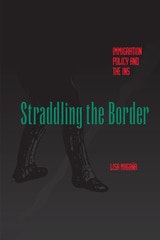
Straddling the Border
Immigration Policy and the INSBy Lisa Magaña
University of Texas Press, 2003
With the dual and often conflicting responsibilities of deterring illegal immigration and providing services to legal immigrants, the U. S. Immigration and Naturalization Service (INS) is a bureaucracy beset with contradictions. Critics fault the agency for failing to stop the entry of undocumented workers from Mexico. Agency staff complain that harsh enforcement policies discourage legal immigrants from seeking INS aid, while ever-changing policy mandates from Congress and a lack of funding hinder both enforcement and service activities.
In this book, Lisa Magaña convincingly argues that a profound disconnection between national-level policymaking and local-level policy implementation prevents the INS from effectively fulfilling either its enforcement or its service mission. She begins with a history and analysis of the making of immigration policy which reveals that federal and state lawmakers respond more to the concerns, fears, and prejudices of the public than to the realities of immigration or the needs of the INS. She then illustrates the effects of shifting and conflicting mandates through case studies of INS implementation of the Immigration Reform and Control Act of 1986, Proposition 187, and the 1996 Welfare Reform and Responsibility Act and their impact on Mexican immigrants. Magaña concludes with fact-based recommendations to improve the agency's performance.
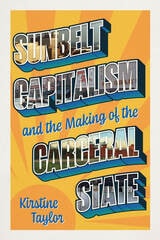
Sunbelt Capitalism and the Making of the Carceral State
Kirstine Taylor
University of Chicago Press, 2025
The story of how the American South became the most incarcerated region in the world’s most incarcerated nation.
Sunbelt Capitalism and the Making of the Carceral State examines the evolution of southern criminal punishment from Jim Crow to the dawn of mass incarceration, charting this definitive era of carceral transformation and expansion in the southern United States. The demise of the county chain gang, the professionalization of police, and the construction of large-scale prisons were among the sweeping changes that forever altered the southern landscape and bolstered the region’s capacity to punish. What prompted this southern revolution in criminal punishment?
Kirstine Taylor argues that the crisis in the cotton fields and the arrival of Sunbelt capitalism in the south’s rising metropolises prompted lawmakers to build expansive, modern criminal punishment systems in response to Brown v. Board of Education and the Black freedom movements of the 1960s and ‘70s. Taking us inside industry-hunting expeditions, school desegregation battles, the sit-in movement, prisoners’ labor unions, and policy commissions, Taylor tells the story of how a modernizing south became the most incarcerated region in the globe’s most incarcerated nation.
Sunbelt Capitalism and the Making of the Carceral State
Kirstine Taylor
University of Chicago Press, 2025
This is an auto-narrated audiobook version of this book.
The story of how the American South became the most incarcerated region in the world’s most incarcerated nation.
Sunbelt Capitalism and the Making of the Carceral State examines the evolution of southern criminal punishment from Jim Crow to the dawn of mass incarceration, charting this definitive era of carceral transformation and expansion in the southern United States. The demise of the county chain gang, the professionalization of police, and the construction of large-scale prisons were among the sweeping changes that forever altered the southern landscape and bolstered the region’s capacity to punish. What prompted this southern revolution in criminal punishment?
Kirstine Taylor argues that the crisis in the cotton fields and the arrival of Sunbelt capitalism in the south’s rising metropolises prompted lawmakers to build expansive, modern criminal punishment systems in response to Brown v. Board of Education and the Black freedom movements of the 1960s and ‘70s. Taking us inside industry-hunting expeditions, school desegregation battles, the sit-in movement, prisoners’ labor unions, and policy commissions, Taylor tells the story of how a modernizing south became the most incarcerated region in the globe’s most incarcerated nation.