75 books match the query 'Nigeria' and 7 start with s
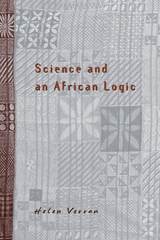
cover of Science and an African Logic

Science and an African Logic

Helen Verran

University of Chicago Press, 2001

Does 2 + 2 = 4? Ask almost anyone and they will unequivocally answer yes. A basic equation such as this seems the very definition of certainty, but is it?

In this captivating book, Helen Verran addresses precisely that question by looking at how science, mathematics, and logic come to life in Yoruba primary schools. Drawing on her experience as a teacher in Nigeria, Verran describes how she went from the radical conclusion that logic and math are culturally relative, to determining what Westerners find so disconcerting about Yoruba logic, to a new understanding of all generalizing logic. She reveals that in contrast to the one-to-many model found in Western number systems, Yoruba thinking operates by figuring things as wholes and their parts. Quantity is not absolute but always relational. Certainty is derived not from abstract logic, but from cultural practices and associations.

A powerful story of how one woman's investigation in this everday situation led to extraordinary conclusions about the nature of numbers, generalization, and certainty, this book will be a signal contribution to philosophy, anthropology of science, and education.
[more]
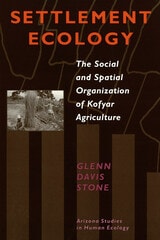
cover of Settlement Ecology: The Social and Spatial Organization of Kofyar Agriculture

Settlement Ecology

The Social and Spatial Organization of Kofyar Agriculture

Glenn Davis Stone

University of Arizona Press, 1996
What determines agrarian settlement patterns? Glenn Davis Stone addresses this question by analyzing the spatial aspects of agrarian ecology--the relationship between how farmers farm and where they settle--and how farming and settlement change as population density rises. Crosscutting the fields of cultural anthropology, archaeology, geography, and agricultural economics, Settlement Ecology presents a new perspective on the process of agricultural intensification and explores the relationships between intensification and settlement decision making. Stone insists that paleotechnic ("traditional") agriculture must be seen as a social process, with the social organization of agricultural work playing a key role in shaping settlement characteristics. These relationships are demonstrated in a richly documented case study of the Kofyar, who have been settling a frontier in the Nigerian savanna. The history of agricultural change and the development of the settlement pattern are reconstructed through ethnography, archival research, and aerial photos and are analyzed using innovative graphical methods. Stone also reflects on the limits of ecological determination of settlement, comparing the farming and settlement trajectories of the Kofyar and Tiv on the same frontier.
[more]
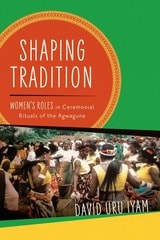
cover of Shaping Tradition: Women's Roles in Ceremonial Rituals of the Agwagune

Shaping Tradition

Women's Roles in Ceremonial Rituals of the Agwagune

David Uru Iyam

University of Wisconsin Press, 2021

Agwagune women in southeastern Nigeria contribute to the cultural construction of their societies in deep and systematic ways. This reality is often concealed, misrepresented, or unexamined in studies that do not consciously set out to address female agency and authority. Most recently women have reshaped traditional male-centered village practices behind the scenes, such as when they updated the premarital ritual of fattening prospective brides, and when they ended female circumcision. Women use their status to direct and influence male leadership on matters of war, finance, education, and political stability.

Using this community as a case study, David Uru Iyam asserts that these women are not stereotypically submissive, oppressed, or passive. Agwagune women participate in male ceremonies by pretending to be unaware of them, concealing their authority under a veneer of secrecy. Instead of focusing on obvious male political power, Iyam highlights the overlooked domestic and public contributions of women that uphold—and change—entire social systems.
[more]
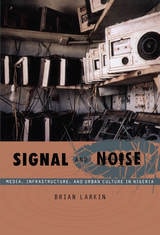
cover of Signal and Noise: Media, Infrastructure, and Urban Culture in Nigeria

Signal and Noise

Media, Infrastructure, and Urban Culture in Nigeria

Brian Larkin

Duke University Press, 2008

Mainstream media and film theory are based on the ways that media technologies operate in Europe and the United States. In this groundbreaking work, Brian Larkin provides a history and ethnography of media in Nigeria, asking what media theory looks like when Nigeria rather than a European nation or the United States is taken as the starting point. Concentrating on the Muslim city of Kano in the north of Nigeria, Larkin charts how the material qualities of technologies and the cultural ambitions they represent feed into the everyday experiences of urban Nigeria.

Media technologies were introduced to Nigeria by colonial regimes as part of an attempt to shape political subjects and create modern, urban Africans. Larkin considers the introduction of media along with electric plants and railroads as part of the wider infrastructural project of colonial and postcolonial urbanism. Focusing on radio networks, mobile cinema units, and the building of cinema theaters, he argues that what media come to be in Kano is the outcome of technology’s encounter with the social formations of northern Nigeria and with norms shaped by colonialism, postcolonial nationalism, and Islam. Larkin examines how media technologies produce the modes of leisure and cultural forms of urban Africa by analyzing the circulation of Hindi films to Muslim Nigeria, the leisure practices of Hausa cinemagoers in Kano, and the dynamic emergence of Nigerian video films. His analysis highlights the diverse, unexpected media forms and practices that thrive in urban Africa. Signal and Noise brings anthropology and media together in an original analysis of media’s place in urban life.
[more]
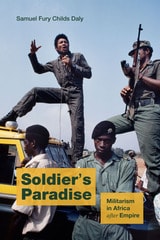
cover of Soldier's Paradise: Militarism in Africa after Empire

Soldier's Paradise

Militarism in Africa after Empire

Samuel Fury Childs Daly

Duke University Press, 2024
In Soldier’s Paradise, Samuel Fury Childs Daly tells the story of how Africa’s military dictators tried and failed to transform their societies into martial utopias. Across the continent, independence was followed by a wave of military coups and revolutions. The soldiers who led them had a vision. In Nigeria and other former British colonies, officers governed like they fought battles—to them, politics was war by other means. Civilians were subjected to military-style discipline, which was indistinguishable from tyranny. Soldiers promised law and order, and they saw judges as allies in their mission to make society more like an army. But law was not the disciplinary tool soldiers thought it was. Using legal records, archival documents, and memoirs, Daly shows how law both enabled militarism and worked against it. For Daly, the law is a place to see decolonization’s tensions and ironies—independence did not always mean liberty, and freedom had a militaristic streak. In a moment when militarism is again on the rise in Africa, Daly describes not just where it came from but why it lasted so long.
[more]
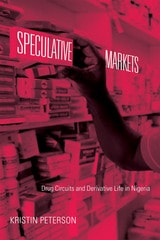
cover of Speculative Markets: Drug Circuits and Derivative Life in Nigeria

Speculative Markets

Drug Circuits and Derivative Life in Nigeria

Kristin Peterson

Duke University Press, 2014
In this unprecedented account of the dynamics of Nigeria's pharmaceutical markets, Kristin Peterson connects multinational drug company policies, oil concerns, Nigerian political and economic transitions, the circulation of pharmaceuticals in the Global South, Wall Street machinations, and the needs and aspirations of individual Nigerians. Studying the pharmaceutical market in Lagos, Nigeria, she places local market social norms and credit and pricing practices in the broader context of regional, transnational, and global financial capital. Peterson explains how a significant and formerly profitable African pharmaceutical market collapsed in the face of U.S. monetary policies and neoliberal economic reforms, and she illuminates the relation between that collapse and the American turn to speculative capital during the 1980s. In the process, she reveals the mutual constitution of financial speculation in the drug industry and the structural adjustment plans that the IMF imposed on African nations. Her book is a sobering ethnographic analysis of the effects of speculation and "development" as they reverberate across markets and continents, and play out in everyday interpersonal transactions of the Lagos pharmaceutical market.
 
[more]
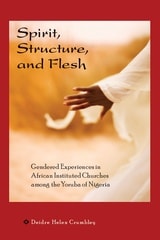
cover of Spirit, Structure, and Flesh: Gender and Power in Yoruba African Instituted Churches

Spirit, Structure, and Flesh

Gender and Power in Yoruba African Instituted Churches

Deidre Helen Crumbley

University of Wisconsin Press, 2008

Although popularized in Africa by Western missionaries, the Christian faith as practiced by Africans has acquired unique traits over time. Some of the most radical reinterpretations of Christianity are offered by those churches known as “AICs” (variously, African Initiated, African Instituted, or African Independent Churches)—new denominations founded by Africans skeptical of dogma offered by mainstream churches with roots in European empires. As these churches spread throughout the African diaspora, they have brought with them distinct practices relating to gender. Such practices range from the expectation that women avoid holy objects and sites during menstruation to the maintenance of church structures in which both men and women may be ordained and assigned the same duties and responsibilities.
            How does having a female body affect one’s experience of indigenized Christianity in Africa? Spirit, Structure, and Flesh addresses this question by exploring the ways ritual, symbol, and dogma circumscribe, constrain, and liberate women in AICs. Through detailed description of worship and doctrine, as well as careful analyses of church history and organizational processes, Deidre Helen Crumbley explores gendered experiences of faith and power in three Nigerian indigenous AICs, demonstrating the roles of women in the day-to-day life of these churches.
[more]